Have you heard about Hiring for Hope? It’s a grassroots, nationally recognized 501(c)3 public charity, conceptualized as a Life Management Community (LMC) designed to help people manage and overcome all the obstacles associated with family building and/or career management challenges.
I heard about this group a while back from Johann Lohrmann, who wrote a guest post on mind-mapping your job search. He put me in touch with Tegan Acree, Hiring for Hope’s Founder and President.
Hiring for Hope offers assistance with:
Career and Family Building Management
Financial Assistance
Online Networking/Support
Workforce Solutions
Hiring for Hope is made up almost entirely of volunteers committed to their mission. I’m excited to be volunteering for a Career Connection Forum event on July 26th in Marietta, GA. This is my first time volunteering for the group, and I am really excited.
Unemployment is such a huge problem in Georgia these days, and I see the impacts of this almost every day. I live in a neighborhood with a mix of rental properties and single-family homes, and many of my neighbors are unemployed. I’ve offered to help a few of my neighbors with coaching and résumés but some of them have been out of work so long they have given up.
Groups like Hiring for Hope combat the very real problems of unemployment and that lost sense of hope that sometimes goes along with it. I’m glad to be doing what I can to contribute. And I’d like to challenge you to do the same.
I’ve signed up to be an online fundraiser for Hiring for Hope and have set a $1000 goal. Please donate what you can, and help give hope and practical assistance to those in need. Click on the badge below to go to my fundraising page. Thanks for helping in whatever way you can.
Understanding how skills you have gained in Student Affairs will benefit you in any position is critical if you plan to advance in your career. I serve on the steering committee for AthFest, a non-profit organization that plans the local music and arts festival each summer, the Athens GA Half-Marathon in the Fall, and year-round art and music education events for local children. The festival was last week and I put many of the skills I gained working in Student Affairs to good use.
Candidates will often be asked to give examples of times when they planned a program, dealt with a difficult person or situation, or responded to a crisis. This week, I will give some examples from my recent experiences during AthFest. I will do my best to explain them in a loose P-A-R (Problem-Action-Resolution) style, to emulate the way that candidates should use in their interviews.
Part 3: Crisis Management
One of my favorite questions to ask Residence Life candidates is related to crisis management. Sure, Residence Life is a “generalist” role in many ways, but if we specialize in anything, it’s crisis management. The ability to respond quickly and calmly to potentially dangerous situations and ensure the safety of students and staff supersedes everything else. This was a running theme throughout my career. I dealt with suicidal students, guns in the residence halls, a riot, drug dealers, sexual assaults, suicide attempts and completed suicides, power outages, bats in the residence halls, and multiple facility issues. I was trained by the Red Cross in Emergency Shelter Operations and for a while, I was responsible for oversight of Residence Life’s Emergency Plan and related training for all the professional staff and RAs. As a result, handling crises comes as a second nature to me.
Good thing, too, because emergencies come on their own schedule, and they don’t usually announce themselves ahead of time. This was the case last Friday, when lightning struck a column on the corner of the Trappeze Pub on Washington Street, and rained bricks onto the street and three people below: the manager of the pub, a man on the patio of the neighboring pub, and one of our business vendors.
People were screaming and running away through the rain, and I heard one lady yell to me “You’ve gotta call the festival! You’ve gotta call it!’ She kept running away, but like most people who handle emergencies, I ran toward the commotion. First, I went to the volunteer area to see if other staff knew what had happened, because it wasn’t clear where the lightning had struck. Someone said they heard it had struck Trappeze, so I rushed back, to find gawkers looking up at loose bricks that might fall at any minute, and scavengers (some adult, some children, some drunk, and some just curious) collecting the bricks. I went in and asked Aaron, the Trappeze manager, if he was aware of the situation (he looked confused, which I later learned from him was the result of him being one of the people bricks rained on. We laughed about that, and he asked why I hadn’t noticed the cement dust in his hair.) I then told him I would like to barricade the area off, and would try to keep scavengers from stealing bricks. He agreed it was a good idea and thanked me. I went out, got one volunteer to stand in the area and shoo people away, and two others to help me get barricades.
We returned, and I ordered onlookers away, telling them the area was unsafe, and worked with staff and police to secure the area and later, to get signs posted. I made two newspapers, talked to a nice reporter from the Red and Black, and as is common when talking to student reporters, got slightly misquoted, but not badly enough to ask for a retraction. Then I spent the next three hours talking to the bar owner, the people hit by bricks, Athfest central staff and the Police.
Student Affairs Skills Used:
The ability to remain calm and move quickly into assessing the situation and taking action to ensure safety of people and security of the area first.
Thinking on my feet about who should know about a situation, and reporting the details to proper authorities.
Following up about the safety of those involved.
Answering questions when approached by the media and referring them to the proper persons.
Having a sense of humor after the fact, and appreciating that the situation could have been worse, but that the response was the best one available at the time.
Looking forward, I plan to ask the steering committee to debrief the incident and to consider writing up an emergency plan (which I will offer to coordinate.)
Questions for Your Consideration
Do you have a good example of a time when you handled a crisis?
What did you do to respond?
How was the problem resolved?
What questions are important to ask yourself, when deciding how to respond to a crisis?
Understanding how skills you have gained in one position will benefit you in another is critical to anyone seeking career advancement. I serve on the steering committee for a local non-profit organization, AthFest, which plans the local music and arts festival each summer, the Athens GA Half-Marathon in the Fall, and year-round art and music education events for local children. The festival was last week and I put many of the skills I gained working in Student Affairs to good use.
Candidates will often be asked to give examples of times when they planned a program, dealt with a difficult person or situation, or responded to a crisis. This week, I will give some examples from my recent experiences during AthFest. I will do my best to explain them in a loose P-A-R (Problem-Action-Resolution) style, to emulate the way that candidates should use in their interviews.
Part 1: Event Planning and Coordination
The AthFest Music and Arts Festival is a multi-day event, featuring an Artist Market with over 50 vendors, a business and food area with about the same number of vendors, two main stages, two beer tents, a kid’s festival with inflatables, arts and crafts, a comedy night, a film festival and music video awards, and a “club crawl” with over 150 bands during the week of the festival. Planning for the festival occurs year-round.
Problem: Select Approximately 50 artists, Assign Booths Spaces and Keep Them Happy
I serve as the Artist Market Chair. In this capacity, I recruited 2 jury members to review artist applications, and facilitated the jury process using online resources (mostly Google Apps) due to the difficulty of coordinating schedules.
Actions:
I fielded a few hundred inquiries, some of which were clearly not fine art, but commercial products, hobby crafts, or materials made by persons other than the applicant. These I notified of their status, and forwarded to the business vendor contact.
From the rest, we reviewed submissions, debated each on their merits, and accepted over 50 artists to exhibit their work in 47 tent spaces. I coordinated the notification of the artists, their payments to the festival, and their assignment to particular booth spaces, taking into account special requests, and trying to vary the assignments so that artists were not directly beside or across from their direct competition.
I also worked with the business vendor chair and her team to keep business vendors separate from the artist market, and to ensure that we maintained legally mandated fire lanes and points of entry and exit. I coordinated the timing and flow of artist and vendor loading and unloading, traffic control and barricade passes.
During the festival, I worked with two judges to select award recipients and managed all aspects of the market, and other festival “duties as assigned or became necessary.”
Experiences from Student Affairs Used:
Jury: My experience serving on award and scholarship committees in Residence Life and at the Smeal College of Business served me well. It’s always interesting to see how groups come together to work out a process for reviewing applications. I worked with my fellow Judges Pat McCaffrey and Susan Staley to review artist applications and the art samples submitted. I scanned samples of the art and saved pdf files to a Google Docs space and set up a Google spreadsheet for the judges to enter their thoughts. Working from there, I coordinated an e-mail conversation and we accepted some artists, and referred the rest to our business vendor contact, in case they still wanted to show their wares, outside of the juried market.
Booth Assignments: I met with our talented intern, Regan Mulcrone, who did a CAD drawing of the festival using Google Sketchup. We created 3 zones for the booths and designated them according to their placement on upper Washington Street, the area of the festival where all of the Artist Market and KidsFest would be located. During the assignment process, we varied assignments by categories and tried to assure that artists were not right by their direct competition. These are skills I developed in helping with Involvement Fairs, Career Days and of course, roommate assignments.
Traffic Control: At Penn State, I was responsible for a while for Residence Life’s Welcome Week events and for a time, I was directly responsible for managing the logistics involved with getting about 6,500 first-year students, their 240 RAs, nearly 500 Welcome Week Leaders, and the appropriate professional staff to their hall meetings and hall dinners, and then over to the President’s Convocation, and after that, to Late Night Penn State, our alcohol-alternative programming. I was the first person in the history of the event to get all these people to the Bryce Jordan Center on time, so that President Spanier could start his dog-and-pony show, and so that Residence Life could be praised for managing the process, instead of roundly criticized for not doing so. I am extremely proud of that accomplishment, and of the fact that the model I designed is still being used. It has been modified a bit, but the larger framework I built still stands. And Residence Life doesn’t get slammed anymore for being late to the President’s party.
Some Take-Aways
Everything you do teaches you something worthwhile, if you remember it and can integrate it into your skill set.
Your ability to appreciate the skills you have gained and to apply them in new ways is critical toward success in any position.
Even things that seem to be minor accomplishments, 0r footnotes in your career history, can hint at areas of expertise you might develop and apply later in your career.
Questions
What transferable skills have you gained from your work in Higher Education?
How can you explain your experience in ways that show that you appreciate the skills you have gained, and are ready to apply them?
How do you explain your ability to get results?
Do you have appropriate examples of your experiences to discuss in your interviews?
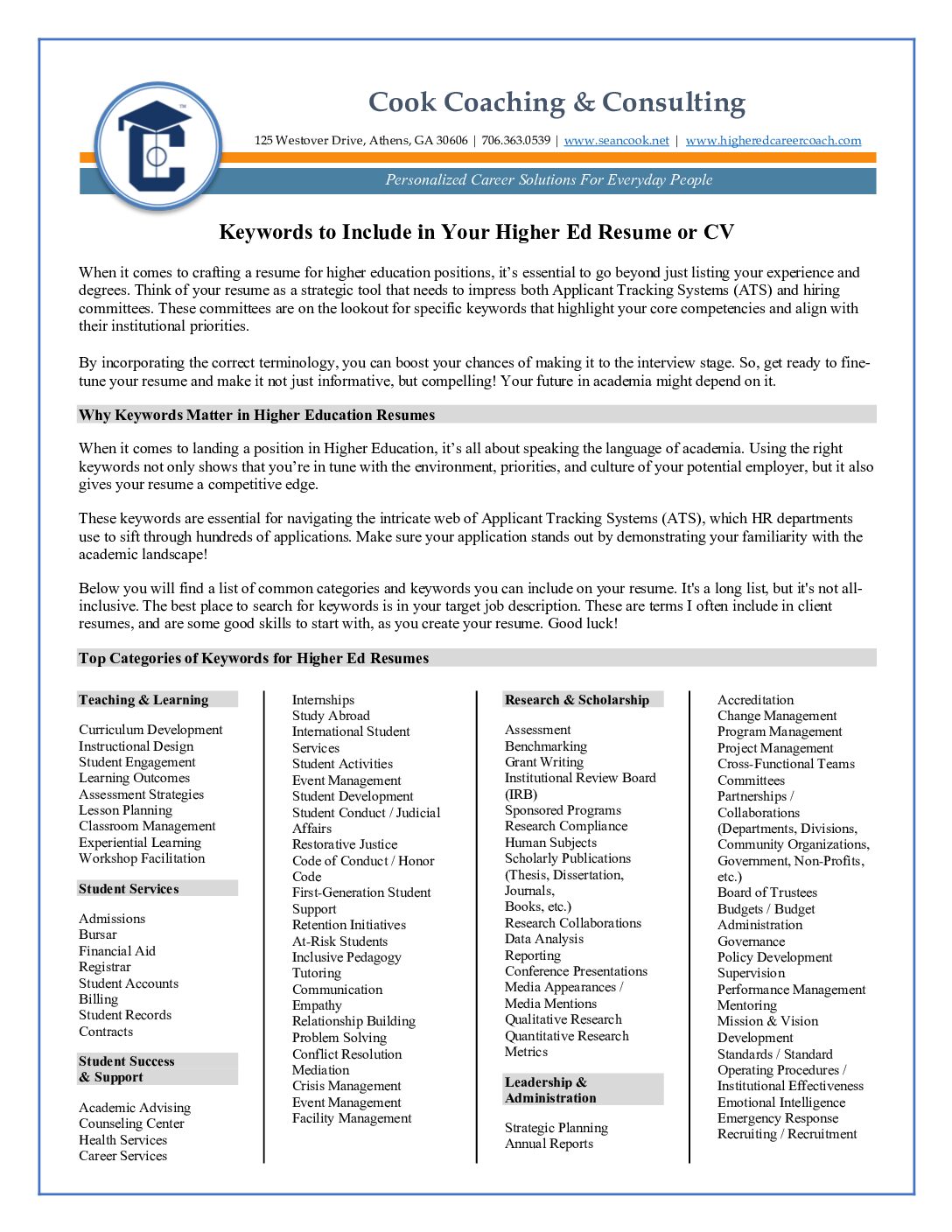
Work with Sean. I help higher ed professionals take control of their careers with tailored services including resume and CV development, LinkedIn profile optimization and networking strategy, interview coaching, and one-on-one career guidance.