When you work in Higher Education, it’s tempting to dismiss some of the conventional wisdom about social networking. If you’ve heard (or said) any of the following, then listen to today’s show.
In higher ed, it’s always about what you know, not who you know.
I’ve already got tenure (or a great job). I don’t need to worry about networking.
LinkedIn doesn’t really do anything.
I don’t need another place to post my CV. IT’s on my website and I can e-mail it to anyone who wants it.
“I don’t know anyone who uses LinkedIn besides my students, and I don’t see what good connecting with Johnny from my [insert class name here] is going to do me any good.”
In today’s Higher Ed Career Coach podcast, I’m going to tell you why all of the above are nonsense, and clue you in to what LinkedIn is really good for.We’ll also cover some higher ed and employment news, upcoming programs, new coaching packages, and site news.
The show airs at 11 a.m. ET today (Friday May 11). If you have questions or comments on today’s topic, or could use advice on a job search issue, call in to the show! The phone number is (347) 989-0055, or you can click on the Skype “S” click-to-talk button from the episode page.
LinkedIn rolled out a new feature the other day, and somehow I missed it until yesterday, when I was using it on my iPhone. It asked me if I wanted to activate the new calendar feature so I could find out more about the people I’m meeting with this week. This is a great enhancement to the app, and something I hope they integrate into the web version soon.
The move is also the latest proof that we have moved beyond the era of simple social networking and solidly into the era of social network intelligence, where the average user can take advantage of the vast data mines we so happily participate in. I’ve covered “social network intelligence” tools before, with my favorite being Gist, a free social CRM tool that was acquired by Blackberry as part of its efforts to integrate cloud-based features into the lagging Blackberry ecosystem and their related notebooks. I’ve also recently been testing Nimble, which does many of the same things, and have tested Rapportive, as well as Xobni’s Smartr Contacts app on iPhone. GMail also gives users the ability to see more about your contacts by turning on the “people widget” in their mail settings.
CRM (Customer Relationship Management) applications have been widely used by sales professionals for years, but the advent of Social CRM apps (especially free ones) brings the possibility of better relationship management to the everyday user.
Some typical features of social CRM apps:
Calendar and e-mail integration. Inside one app, you can see who you are meeting with, when you’ve met with the person before, and the e-mails you’ve traded. It’s great to be able to pull up e-mails and attachments you’ve traded as you meet with a contact. How many times have you been on a phone or web meeting and had to say, “I don’t know if I received that, let me search my inbox.” No more. It’s all right there.
Notes. You can make notes about your meeting.
Tasks. You can create new tasks and set deadlines. In some CRM apps, you can share tasks with colleagues, or assign them to specific team members for follow-up.
Social network integration. Add a social network profile to follow, and you can read tweets, Facebook posts, and LinkedIn updates from within the contact dashboard.
Web searches. Many social CRM apps integrate with Google API and will return possible results for the person, company, and industry related to your contact.
RSS feed integration. Follow a contact’s personal or corporate blogs, podcasts, and anything else with an RSS feed.
Maps. If you have a physical address for a contact, you can get a map and driving directions from within the CRM application.
LinkedIn’s foray into social CRM is interesting, but at this point, it’s also pretty basic. First, you click on the calendar tab (really a frame of sorts) in the upper right, and it shows your calendar. You’ll see the contact’s LinkedIn photo and name. Within the meeting, you see links to the LinkedIn profile for each person in the meeting (including you) and a pane with notes. If you want more information, you click through to view the person’s profile.
I’ll be interested to see how many more of the typical social CRM features LinkedIn integrates in the future. With access to so much user data, and its position as “the” professional social network, LinkedIn could bring Social CRM not only into your schedule, but into the mainstream.
LinkedIn is the largest professional network on the internet, with more than 150 million members in over 200 countries and territories, and it adds 2 new users every second. Using the network effectively is a hot topic in business circles, but in my work with clients in higher ed, I get some interesting responses when I encourage them to look into ways to use LinkedIn effectively.
Five things I’ve heard from clients and colleagues recently:
“In Higher Ed, it’s always about what you know, not who you know.”
“I’ve already got tenure. I don’t need to worry about networking.”
“LinkedIn doesn’t really do anything.”
“I don’t need another place to post my CV. It’s on my website, and I can e-mail it to anyone who might need it.”
“I don’t know anyone who uses LinkedIn besides my students, and I don’t see what good connecting with Johnny from my [insert class name here] is going to do me any good.”
If you’ve said any of the above, or have trouble convincing your colleagues to dive into LinkedIn, this infographic might help. I’ve written it to sum up some of my thoughts, in response to the questions above.
Look for more articles and resources on how to use LinkedIn soon! If you really want to really dive in and learn how to use LinkedIn like a pro, check out Lewis Howes’ LinkedInfluence course. (affiliate link). I bought it and found it well worth the money. It gives a great overview of the LinkedIn profile and how to optimize it, and best ways to use groups, applications and other features.
I also offer LinkedIn coaching and profile writing packages, if you are looking for a little one-on-one help. Contact me at sean@higheredcareercoach.com for more information.
Do you have any great LinkedIn tips? Share them in the comment section.
We here at HigherEdCareerCoach really like infographics. They’re colorful, fun, and they present a lot of information visually, meaning you can pack that much more awesome stuff into a neater package. Here’s a great one that we found on Business2Community, How to Harness the Power of LinkedIn:
Transparency is one of the essential elements of career success. Pick up any modern book on career planning, small business development, marketing, or social media, and you’ll probably find a section devoted to the idea of transparency, and how essential it is to establishing the three foundational elements of successful relationships: people know you, like you and trust you.
It Should Be Easy, Right?
But it’s not easy to be “transparent.” Each of us struggles with something, but no one wants to be defined by their problems. Especially if you are looking for a job, looking for customers, or trying to establish yourself as an “authority” within some niche. If you’re truly transparent, people identify with your humanity, because your successes and your struggles are both familiar, and they root for you.
So What’s the Problem?
Herein lies the rub: the more risks you take in your career or with your business, the greater the potential reward…or potential loss. So you stay within your comfort zone, and try to figure your way through, on your own. And sometimes, it’s neither practical (nor healthy) to do so. But, “issues” put aside are eventually recognized for what they are…problems. And when you have a problem, it’s supposed to be okay to ask for help. As educators and supervisors, we know this. We preach this to our students. We evangelize for this to our young professionals. And yet we resist holding ourselves to the same standard, even though we know–genuinely know–that those who ask for help are usually met with kindness, understanding, and support.
So What’s My Problem?
I’ve arrived at a point with this site and with my business where it would be folly to continue without more help. As I expanded the local aspect of my business, I’ve been getting more clients for résumé writing and LinkedIn profiles, and many of these are from outside of academia, and have varied experiences that are hard to tie together into a coherent package.
I’ve always been good at writing résumés, and I enjoy challenges, but it requires a very different type of energy and focus than writing blog posts and sharing perspectives. And I find it hard sometimes to shift gears and keep moving. For the past couple of months, the result has been writer’s block, and I’ve had to devote more time to the writing I am paid for (the résumés) than to my sites.
What Kind of Help Do I Need?
I have some ideas that need to be implemented, and resources that need to be developed, and not enough time and energy to do them all. And I would like to revive my second site, Higher Ed Life Coach, and continue development on a local career resource site, AthensGACareerCoach.Com. So I am looking for an intern to help in content development, and social media, and also for high-quality, relevant guest posts. I will post something later this week about guest posting opportunities. In the meantime, here’s a description of what I am looking for in an intern.
The Internship
The Career Content Development Intern will compile career resources and develop new content for websites (primarily HigherEdCareerCoach.Com and AthensGACareerCoach.Com, but possibly including other sites currently published or under development by Cook Coaching and Consulting); may appear as a guest or co-host on podcasts; schedule guests for podcast, interview educators, job-seekers, coaches and others for site and podcast features; co-host webinars and twitter chats, assist with social media publishing (Twitter, Facebook) and assist with site management, search engine optimization and site design. Other duties will be negotiated, based on current site development needs and the intern’s interests.
Compensation
Anticipated compensation is $8/hour, for a maximum of 5 hours a week, and the duration of the internship will be 20 weeks or 100 hours. This is a part-time contract position, beginning in late November or early December, and ending in May 2012. The finalist will be required to submit appropriate documentation confirming eligibility to work in the United States of America, keep and submit accurate and timely records of hours worked, and your contract income will be reported to the IRS. Additionally, the intern will receive a profile page on HigherEdCareerCoach.Com, a HigherEdCareerCoach.Com e-mail account, and may be featured on podcasts and videos.
Qualifications
Minimum qualifications: Bachelor’s degree and at least one year of relevant experience in student affairs/higher education (undergraduate and graduate experience counts!). Excellent verbal and written communication skills, ability to research and compile information and resources quickly and accurately, experience using social media, blogging, podcasting, and producing internet video. Access to a working computer, internet connection and some form of telephone (landline, cellular or VOIP.)
Preferred qualifications: Current graduate student or recent graduate of a student affairs, higher education, college student personnel administration or related program. Ideally, the candidate will also be someone not employed full-time, who can use the internship to expand his or her career development portfolio. Experience using Mac computers, WordPress, iMovie, and Garageband to produce engaging content is a plus; Efficient and deadline-oriented, but flexible and good-humored, with an ability to deliver consistently accurate information; creative but organized, who will focus on helping our web sites reach their potential.
Application Process
Applications should consist of the following:
A current résumé
A cover letter, no longer than 2 pages, outlining your relevant experience and your most compelling arguments.
Some explanation or evidence of your positive engagement in social media. This can be addressed in your cover letter, or through creative use of social media platforms (Twitter, YouTube, Facebook, LinkedIn, etc.) to demonstrate your experience, comfort level and engagement with these platforms.
3 professional references who can speak not only to your character and work ethic, but toward your ability and/or potential as a writer and content developer.
Deadline
Applications should be sent via e-mail to sean@higheredcareercoach.com with the subject “Career Content Development Intern” no later than 5 p.m. ET Friday November 18. For documents, .pdf format is preferred for all attachments. Interviews will be scheduled during the last two weeks of November, and will be conducted via a webmeeting/video chat interface. Start date will be sometime in late November or early December and will be negotiated with the successful candidate.
Equal Employment Opportunity Statement
Cook Coaching and Consulting, LLC is an Equal Opportunity Employer. All qualified applicants will receive consideration for employment without regard to race, color, religion, sex, gender, ethnicity, sexual orientation, national origin, or genetic condition. The company strives for compliance with all applicable labor laws outlined by the State of Georgia and the U.S. Department of Labor, including the Americans with Disabilities Act.
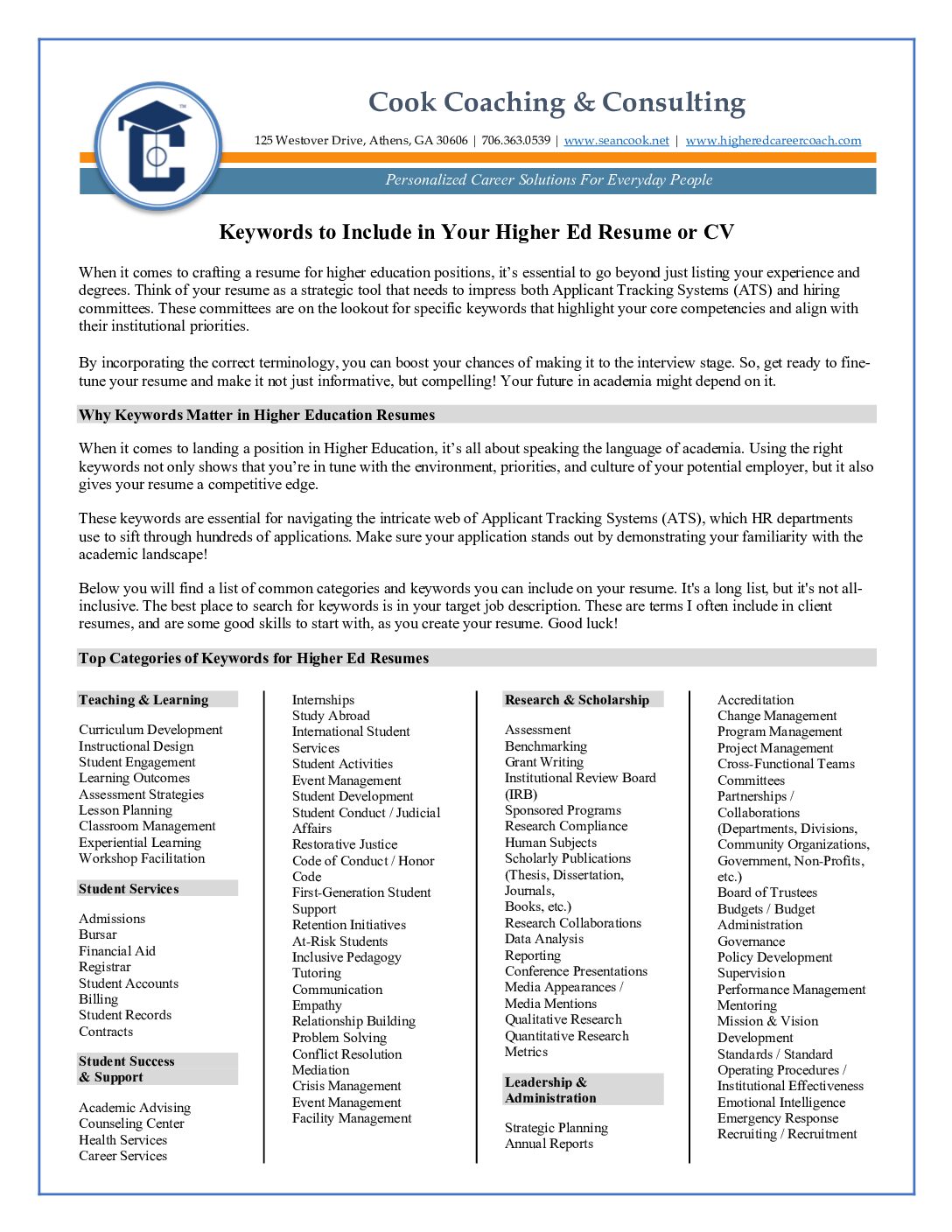
Work with Sean. I help higher ed professionals take control of their careers with tailored services including resume and CV development, LinkedIn profile optimization and networking strategy, interview coaching, and one-on-one career guidance.