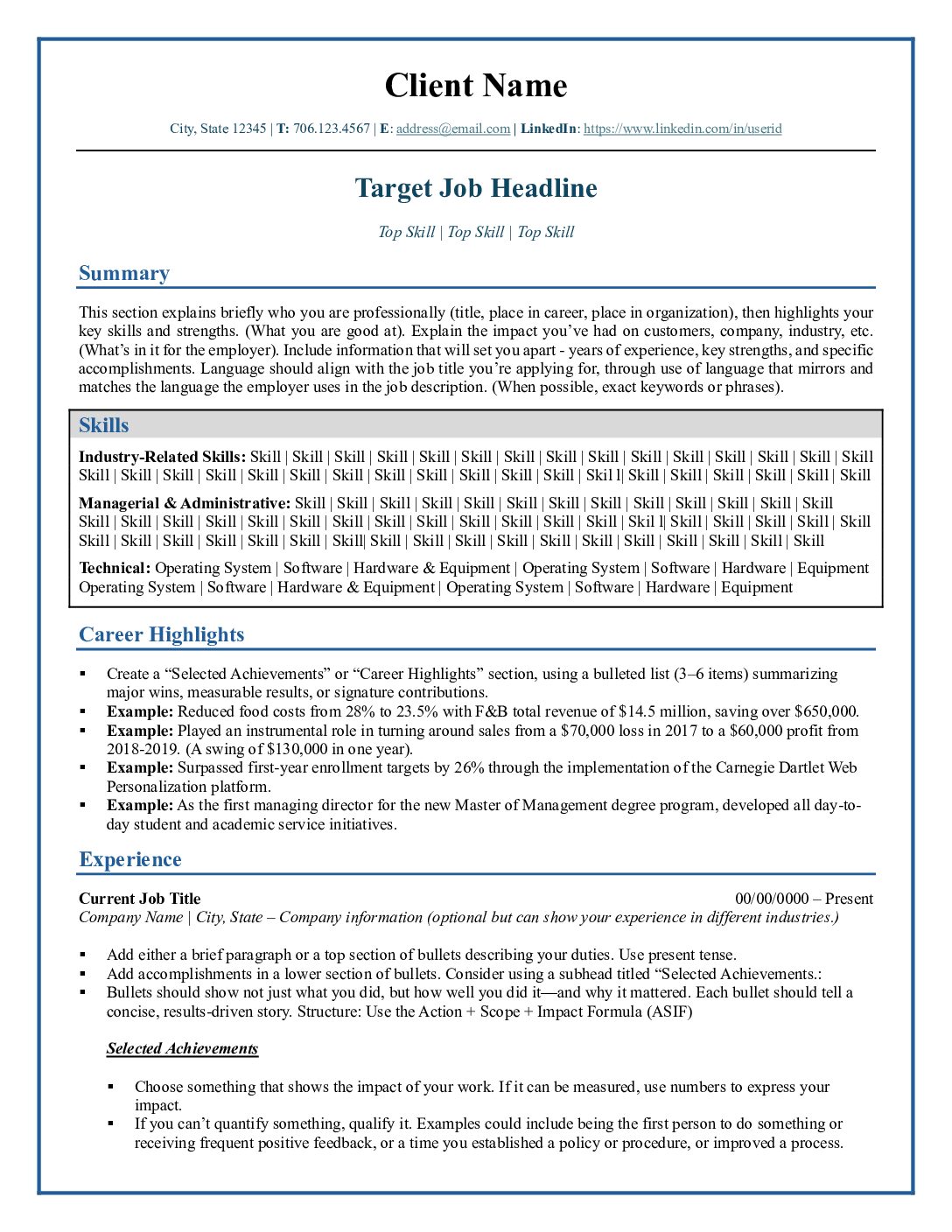
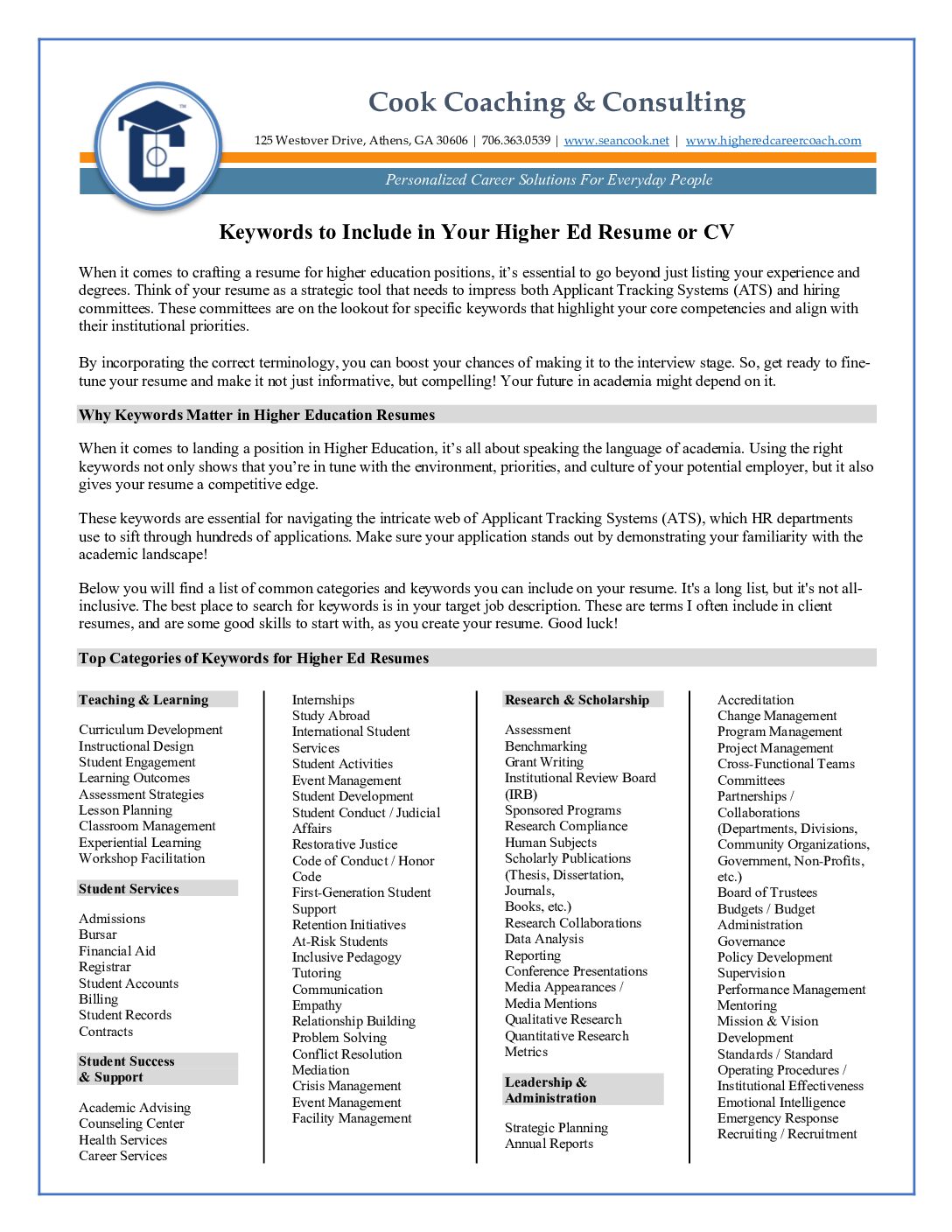
Is your résumé ready for job search season? Every spring, job searches across the country kick into high gear, as the cruel time called “Placement Season” begins in higher ed.
If you’re ready to start looking for the next step, but your résumé isn’t, attend a free webinar on “Creating a Killer Résumé” this Thursday at 12 noon EST.
We’ll cover some key elements that go into putting together a good résumé or CV: design, content and flow. The webinar will include a sample live coaching session by Higher Ed Career Coach Sean Cook for a current job-seeker. So if you’re thinking about brushing up your résumé or CV, register below for the webinar!
Sean Cook is a Certified Life Purpose and Career Coach, based in Athens, GA.
I am by trade a researcher. I’ve conducted research for award-winning documentaries, media agencies and for the heavy industrial industries.
Now, a researcher has to be patient. He has to believe that he will find an answer. An accountant knows his numbers and an engineer knows his machines.
But what does a researcher have? He has his tools. The best tools are simple, nimble and can be applied across a variety of subjects.
When I read Sean Cook’s Blog, Make a Career-Plan Mind-Map and Win An e-Book it got me thinking. What if I did this? What if I took one of my strengths and applied it to a new cause?
A Shift in Thinking
My approach to the mindmap was simple: it had to lay the foundation for success. A mindmap is a guide. It puts your job search in your hands. It gives you control.Your favorite pirate used a map to find his next great treasure. Your job is your next great treasure.
Look at the center of the mind-map. It’s exact: Landing the Job. That’s it. That’s my goal. Everything in this mind-map starts with the broad and gets very specific. I have a specific date. I have daily activities.
Maybe your goal is to uncover a target list of companies, find the names of hiring recruiters or discover your destination industry. Choose your target carefully. A thoughtful target will yield thoughtful results.
Atlanta based Johann Lohrmann is a research specialist with a passion for media. He is a German-American who speaks French. His love for media grew early, and by the time he was fourteen-years old he was writing for Children’s Express-an organization that teaches children how to write, interview, and research. There he interviewed sports heroes and politicians. In his senior year of high school, he produced his first short, An Era of Civil Rights. Later, he would write, direct, and produce documentaries for a PBS affiliate, serve as a media planner and research consultant to media companies, and conduct research throughout Belgium, France, Canada and the United States. Lohrmann was recently nominated for an Emmy for his documentary, How I Survived World War II. It explored how soldiers, children and those who lived and served during World War II survived. His work has appeared on PBS, BET, TimeWarner and online. He recently finished production on the award-winning documentary, Where Wealth Lives: An Exploration of the African-American Economic Experience. It has been green-lighted for national release on PBS. He currently serves as Director of Research & Development for Noodlehead Studios. Johann graduated in 2010 with a BA in Communications, summa cum laude from Ashford University.
For more information about mind-mapping, visit Mark Dykeman’s blog, Thoughtwrestling, or buy his e-book, Unstuck, Focused and Organized (affiliate link)
This has been a very interesting year.Student Affairs professionals have embraced social media in many new and different ways, and it’s been exciting to be a part of the changing higher ed webscape. Along the way, Higher Ed Career Coach has grown and developed as a resource for higher ed job seekers. On this last day of the year, let’s take a look back at some of the highlights of 2010.
In January, my post “personal branding in your job search” gave five quick links to articles on the topic. In January we began a series of articles related to the “placement” season in higher education. This began with a couple of articles on preparing for and conquering the placement conference.
In February, Shannon Healy became a regular guest blogger during the placement season. Her #jobhunt posts eventually became an 11–part series, chronicling her job search, her experiences at placement conferences, and the interviews (and rejection) that followed. She joined me on my blog talk radio show to discuss handling rejection and starting over, and was joined by her friend and mentor, Stacy Oliver, who introduced us to the concept of “parking lot pep talks.” But we eventually shared her joy at becoming a new staff member at, and joining Mickey Fitch and Beck Fick on the show to discuss getting started in the new position.
Also in February,Brian Koval beginners series of guest posts on the doctoral experience. Koval, who is also a periodic co-host for the podcast, and and a former staff member of mine at Penn State, shared his thoughts on applying to, being accepted by, and beginning a doctoral program with a distance education component. He has since begun a new position at Carnegie Mellon University in Pittsburgh.
In March, Mickey Fitch became a regular contributor to the blog, sharing tips on ways to make the job search entertaining, prepping your references, and how to deal with the pressures that come with negotiating and accepting a job offer.
We’ve also been lucky to have guest posters write about their perspectives on higher education through my periodic guest blogger series, entitled “Monday Morning Quarterback,” including a four article series entitled “What higher education needs to learn.”
In the spring, I joined the membership site Third Tribe and began learning about effective ways to run and market my business and to grow the readership of my blogs. Since that time, I’ve been fortunate to connect with other members of this community, who have appeared on my radio show and written guest posts for Higher Ed Career Coach.
In May, I offered my first hybrid short course, “8 Weeks to August,” which was geared toward helping job seekers who were “stuck” in their job search processes, and help them get back on track.
The Mortarboard "C" logo for Cook Coaching and Consulting.
In July, I introduced new logos and word marks as part of a branding campaign, geared toward creating a unified brand image across all sites owned and operated by my company, Cook Coaching and Consulting. July also brought several guest posts and the highest traffic the site had experienced to date.
August and September, however, brought some disappointment as readership dropped during the traditional staff training and new student orientation period, and my podcasting efforts became less regular, as I began a part-time position at Wesleyan College in Macon, Georgia. I began to concentrate more of my efforts on creating programs including webinars and my upcoming placement partner coaching program, and a multi-part e-course on planning your career in higher education, which is free to subscribers of my mailing list.
October, November, and December sped by in a blur. As we come to the end of the year, I am looking forward to ramping up the production of useful and relevant content that will assist job seekers during the busy spring semester and the 2011 placement season. Readers will also likely begin to see some changes in the format of this site, as I seek to re-position it to include more career resources site, with less emphasis on the blog. This change should happen gradually, as I seek to find the right balance between offering practical resources and tools, and sharing perspectives on what it means to work in higher education.
I will continue to network with others that can provide useful and informative content to our readers. Some of this may include reaching out to former guest contributors for additional content, as well as creating opportunities for new voices to share their perspectives.
As I look back upon the year, I am grateful for the many opportunities the year has brought me to connect with others, and to help job seekers move forward in their careers. My thanks go out to my loyal readers, my guest bloggers, my guests and cohosts for the podcasts, and to everyone else out there who is trying to create a supportive and caring environment or higher ed job seekers.
Every year, I start the holiday season with good intentions…making lists, coming up with the perfect ideas for each person on my list, and taking some time to get a good head-start on things.
And like many, I fall short.
I began writing this post the night of the 19th. At that point, I hadn’t begun my Christmas shopping. Yesterday morning I was going to go out, but all the sudden it was nearly 2 p.m. before I was finally heading out the door to do some shopping. I still have a few more things on my list, but they will have to wait. Today is my daughter Susie’s 2nd birthday and we are eating cake, opening presents, and (undoubtedly, because we do this every day) watching Team UmiZoomi about 20 times.
My wife, Sarah, is one of those people who buys ahead and finds all the great deals. So she and I periodically talk about ideas and she buys many of our children’s gifts early. And my siblings, parents and the other adults in our family have moved on to doing a “country gift exchange,” so I don’t really have all that many people to shop for, but the ones I do are pretty important to me.
If you are a last-minute gifter, and you have a higher ed job seeker on your list (or you are one, and hope to give yourself the gift of a new job in the coming year), here are a few ideas for last-minute gifts:
Buy the person a website to set up a job-seeker blog. If possible, register a .com address and use the person’s name, so they can stake out a “home base” for their personal brand. You can find plenty of good web hosts out there, and it’s really easy on most to set up a blog using WordPress. I use FatCow, which has a lot of nice features and add-ons, and a really affordable annual rate, with unlimited storage and bandwidth, as well as e-mail addresses for your domain. They are running a $4.67/month hosting special right now, which you can get by clicking on the link above or on the ad in the right-hand column. The deal includes hosting for one year, one domain, and a lot of easy-to-use tools. For example, easy set-up of a WordPress.Org blog like this one, photo galleries, forums, Moodle and Joomla sites, even an online store. Users also get ad credits on Google AdWords, Facebook, and Yahoo, which your job-seeker could use to place personal “Job Wanted” Ads.
If you self-host a WordPress blog, you can install a standard template or get a little fancy. My blogs run the Thesis theme framework, which has some built-in features that help with Search Engine Optimization. You need to have some confidence with technology to get it installed and set up, but once you do, the dashboard is pretty easy to master, and you will enjoy better search results without having to get a certificate in internet marketing.
Buy your job-seeker some assistance with writing and editing their job search materials (or if your job-seeker is going back to school, with admissions essays). I offer these services as part of my 1-on-1 coaching packages, and would be glad to speak to you or your job-seeker about what I can offer, but I also recently became an affiliate for ResumeEdge and EssayEdge, the leading resume and essay editing and assistance services on the internet, so please check them out as well.
Screen grab of Module 3 of the Placement Partner Program Moodle Course
Give the gift of coaching. I am opening a job seeker group for spring. I am offering first spots to people on my mailing lists, so sign up here to get information. There will be a limited number of spots for this program, because I want to offer members a quality experience and to give them personal attention, so list members get first crack. If there are available spaces in January, they will be opened up to the general public.There will be three levels of participation:
Value Edition: Online group with self-paced activities and forum discussions ($180 for 6 months access. You must register for this option to be offered the opportunity to upgrade to either of the other levels. The first five modules of this 26-module program are now live and available for those who are ready to get started with their exploration and planning over the holiday break. The rest will go live in sometime in early January.)
Standard Edition: Online group, plus free access to webinars and 2 1-on-1 meetings for resume assistance and mock interview practice, and e-mail coaching through the duration of your enrollment($300-with the option of paying for the upgrade all at once or in 6 monthly installments.)
Personalized Edition: All of the above, plus 6 additional coaching sessions. ($500-with the option to pay for the upgrade all at once or in 6 monthly installments.)
If you are looking just for 1-on-1 coaching, my rates for one-on-one coaching are reasonable, and depend on the length of the session. If you’re interested in 1-on-1 coaching, visit my public calendar to schedule a free initial consultation. There is no obligation to purchase anything. We’ll talk about what you are looking for in a coach. I will tell you a bit about my coaching methods and business practices, and we’ll discuss the going rates for the services that interest you. If you like, I will even give you a couple of other resources to check out. Every job seeker has different needs and the “fit” between coach and client is just as important as “fit” is to landing the right job. So the consultation will be an opportunity for both of us to assess whether we might be able to work together on your job search.
Or you can buy a gift certificate (that can be used at my webstore toward any of the programs above, or 1-on-1 coaching, or other products and services to be offered soon, including e-books, webinars, and job-seeker tools and resources.
Whatever you end up getting your friends, your loved ones, or yourself, I wish you the best this holiday season, and good luck in your job search!
The hardest part of doing anything is just getting started.
If you are considering a job search this year, you probably all too aware that the hardest part of doing anything is just getting started. This can be especially true for projects that involve putting yourself out there in the public sphere and being judged.
As an academic job seeker, your job search may follow the academic cycle, with a majority of positions being posted by March, followed by interview periods from April to August, and start dates in August or September. So it’s important to a avoid stumbling out of the gate.
Mark Dykeman, creator of the Unstuck, Focused and Organized System
Mark Dykeman, my guest this morning at 11:00 a.m. on the Higher Ed Career Coach Show on BlogTalkRadio, has a good method for getting your plan together: mind-mapping. Mark is the creator of the blogs Thoughtwrestling and the Broadcasting Brain. I met him through Third Tribe (affiliate link), a membership site put together by Brian Clark, Darren Rowse, Chris Brogan and Sonia Simone and dedicated to helping small business owners authentically market their products and businesses.
Mark is a well-known and well-connected social media entrepreneur, and a really nice guy. He’s known for helping people get unstuck, focused and organized, and he’s a strong proponent of the idea of mind-mapping to clear out your mental clutter, unlock your creativity, and move forward with new ideas and plans.
I recently bought his new product, Unstuck, Focused and Organized, because I’ve been looking for ways to get more organized and stay on task. I’ve been getting much busier lately, and needed some fresh perspectives on how to organize my ideas and thoughts. I liked it so much that I joined his affiliate program, and invited him to talk about how job seekers can use mind-mapping to move forward in their search.
In today’s BlogTalkRadio show, Mark and I will talk about using Mind-Mapping to et unstuck in your job search and plan your way forward. I was able to ask Mark a few initial questions ahead of time about his program and ways that job seekers could use his approach.
Unstuck, Focused and Organized: Mind-Mapping for Higher Ed Job Seekers
(Questions are in bold, Mark’s answers are inset and italicized.)
How could someone use mind-mapping to plan their career?
Mind mapping could be used in a number of different ways. For example, if there are different stages of your intended career and different milestones, you could use the mind map to examine each stage. Here’s a simple example: have major categories or branches of the mind map to correspond to different levels of corporate hierarchy:
consultant/team member
team leader
manager
director
vice-president
You could explore each role in detail, including key education requirements, work experience, networking, mentors, and so on. This would be a useful first step in coming up with a plan. You could also do something similar with the type of companies that you would want to work at as well, focusing on both functional experience and industry segment experience.
If you were planning a job search during the next year, how could mind-mapping help you focus your efforts?
There’s several different ways that you could plan your job search. You could conduct a SWOT analysis using a separate branch for each aspect. You could use a mind map to compare your skills and experience to different types of jobs about there: the mind map could help you find key skills to emphasize in your job search as well as important gaps or shortfalls to consider.
You could also use the mind map to explore all possible ways to network and search for the job, which is much better than firing resumes into the ether and hoping for the best.
What’s the best way to start?
The best way to start mind mapping, if you’ve never done it before, is to use a pencil and a huge piece of paper. Write your central or core idea that you want to explore in the center of the paper. Then start writing down every thought or idea that you can think of around the center of the paper. When you’ve gotten everything out that you can think of, take a few minutes and look at it. Look for connections between things. See if you can group similar things together into major categories. Draw lines between things that could be connected. Doodle and draw on it, if you feel like it, in ways that would be meaningful. Look for holes – things that are missing.
The reason for using a pencil? Because you’ll probably want to redraw the mind map after this first try!
We’ll discuss the features and benefits of Mark’s UFO program and different ways to use mind-mapping to plan your job search and your career in general. He’ll also announce a special promotion he’s running next week.
Please join us at 11 a.m. today (Friday, November 5) for the podcast, and call in with your questions and comments to (347) 989-0055 or via Skype click-to-talk.
Work with Sean. I help higher ed professionals take control of their careers with tailored services including resume and CV development, LinkedIn profile optimization and networking strategy, interview coaching, and one-on-one career guidance.

 Look at the center of the mind-map. It’s exact: Landing the Job. That’s it. That’s my goal. Everything in this mind-map starts with the broad and gets very specific. I have a specific date. I have daily activities.