by sean@higheredcareercoach.com | Sep 16, 2025 | Career Skills, Higher Education, Job Search, Job Search, optimization, Resumes and CVs, transferable skills
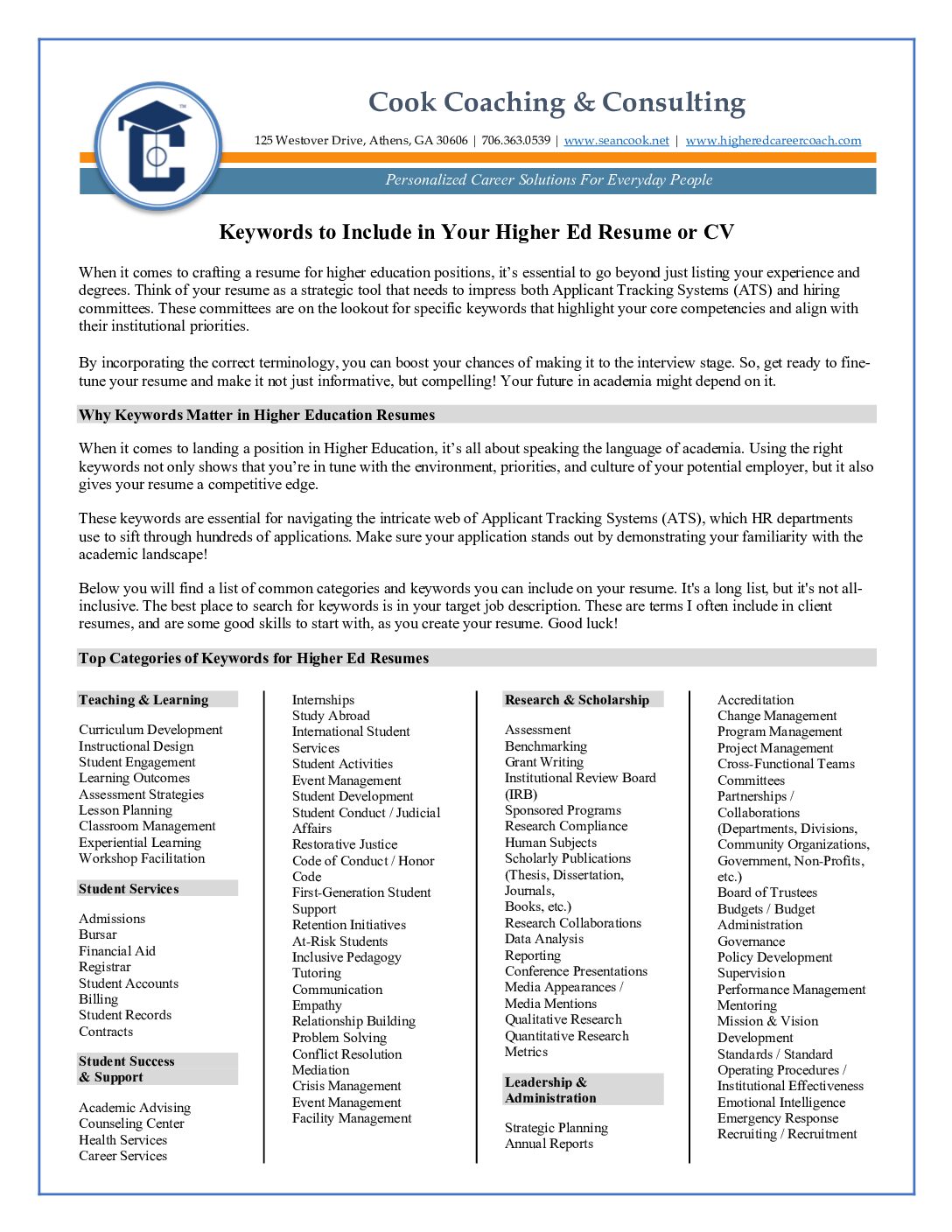
When it comes to crafting a resume for higher education positions, it’s essential to go beyond just listing your experience and degrees. Think of your resume as a strategic tool that needs to impress both Applicant Tracking Systems (ATS) and hiring committees. These committees are on the lookout for specific keywords that highlight your core competencies and align with their institutional priorities.
By incorporating the correct terminology, you can boost your chances of making it to the interview stage. So, get ready to fine-tune your resume and make it not just informative, but compelling! Your future in academia might depend on it.
Why Keywords Matter in Higher Education Resumes
When it comes to landing a position in Higher Education, it’s all about speaking the language of academia. Using the right keywords not only shows that you’re in tune with the environment, priorities, and culture of your potential employer, but it also gives your resume a competitive edge.
These keywords are essential for navigating the intricate web of Applicant Tracking Systems (ATS), which HR departments use to sift through hundreds of applications. Make sure your application stands out by demonstrating your familiarity with the academic landscape!
Below you will find a list of common categories and keywords you can include on your resume. It’s a long list, but it’s not all-inclusive. The best place to search for keywords is in your target job description. These are terms I often include in client resumes, and they are some good skills to start with, as you create your resume. Good luck!
Top Categories of Keywords for Higher Ed Resumes
Teaching & Learning
- Curriculum Development
- Instructional Design
- Student Engagement
- Learning Outcomes
- Assessment Strategies
- Lesson Planning
- Classroom Management
- Experiential Learning
- Workshop Facilitation
Student Success & Support
- Academic Advising
- Counseling Center
- Health Services
- Career Services
- Internships
- Study Abroad
- International Student Services
- Student Activities
- Event Management
- Student Development
- Student Conduct / Judicial Affairs
- Restorative Justice
- Code of Conduct / Honor Code
- First-Generation Student Support
- Retention Initiatives
- At-Risk Students
- Inclusive Pedagogy
- Tutoring
- Communication
- Empathy
- Relationship Building
- Problem Solving
- Conflict Resolution
- Mediation
- Crisis Management
- Event Management
- Facility Management
Student Services
- Admissions
- Bursar
- Financial Aid
- Registrar
- Student Accounts
- Billing
- Student Records
- Contracts
Research & Scholarship
- Assessment
- Benchmarking
- Grant Writing
- Institutional Review Board (IRB)
- Sponsored Programs
- Research Compliance
- Human Subjects
- Scholarly Publications (Thesis, Dissertation, Journals, Books, etc.)
- Research Collaborations
- Data Analysis
- Reporting
- Conference Presentations
- Media Appearances / Media Mentions
- Qualitative Research
- Quantitative Research
- Metrics
Leadership & Administration
- Strategic Planning
- Annual Reports
- Accreditation
- Change Management
- Program Management
- Project Management
- Cross-Functional Teams
- Committees
- Partnerships / Collaborations (Departments, Divisions, Community Organizations, Government, Non-Profits, etc.)
- Board of Trustees
- Budgets / Budget Administration
- Governance
- Policy Development
- Supervision
- Performance Management
- Mentoring
- Mission & Vision Development
- Standards / Standard Operating Procedures / SOPs
- Institutional Effectiveness
- Emotional Intelligence (EQ)
- Emergency Response
- Recruiting / Recruitment
Advancement & External Relations
- Alumni Relations / Alumni Affairs
- Community Outreach
- Corporate Relations
- Development
- Donor Relations
- Fundraising
- Government Relations
- Legal Affairs
- Public Relations
- Regulatory Compliance (ADA, FERPA, Title IX, EEO, etc.)
Diversity, Equity, & Inclusion (DEI)
- Inclusive Excellence
- Multicultural Programming
- Equity Initiatives
- Accessibility
- Community Engagement
- Cultural Sensitivity
- Intercultural Communication
- Culturally Responsive
- Bias Mitigation
- Employee Resource Groups
- Campus Climate
- Learning Environment
- Work Environment
- Stakeholder Engagement / Stakeholder Relations
Auxiliary & Business Services
- Athletics
- Bookstore
- Campus Dining / Food Services
- Catering
- Housing / Residence Life / On-Campus Living
- Marketing
- Public Safety
- Parking
- Recreation / Intramurals
- Document Services / Printing Services
- Purchasing
- Human Resources
- Training / Training & Development
- Facility Management
Technology & Innovation
- Learning Management Systems (LMS) – Blackboard, Canvas, Moodle, Etc.
- Online Course Design
- Educational Technology
- Data-Informed Decision Making
- Virtual Learning Environments
- Database Management
- User Experience (UX)
- Dashboard Development
- Social Media Management
- Google Analytics
Common Software and Web Platforms
- Microsoft Office – Microsoft Word, Excel, PowerPoint, SharePoint, Teams, Microsoft 365
- Google Apps (Google Workspace) – Google Docs, Sheets, Slides, Google Drive, Google Classroom
- Design – Canva, Figma, Affinity Designer, Adobe Creative Suite – InDesign, Adobe Illustrator, Photoshop, Acrobat, Acrobat Reader, etc.
- Meeting Platforms – Zoom, Google Meet, WebEx, Skype, GoToMeeting
- Website Development: HTML, WordPress, Squarespace, Wix
- Data Visualization – Tableau, PowerBI, Qlik, Google Looker
- Data Collection and Management – Qualtrics, Access, SurveyMonkey, TypeForm
- CRM: Slate, Salesforce Education Cloud, Ellucian CRM, Element 451, TargetX
- Student Information Systems – Ellucian (Banner, Student), Workday Student, Jenzabar One, Salesforce Education Cloud, PeopleSoft Campus Solutions
- Housing & Residence Life Platforms: StarRez, Entrata, eRezLife, Roompact, Creatrix Campus, SpaceBasic
Other Common Keywords
- Adaptability
- Analytical Mindset
- Growth Mindset
- Attention to Detail
- Collaboration
- Coordination
- Critical Thinking
- Time Management
- Customer Service
- Teamwork
- Leadership
- Team Leadership
- Operations
- Planning
- Organizing / Organizational Skills
- Continuous Improvement / Process Improvement / Process Optimization
- Alignment
- Negotiation
- Assess(ed)
- Manage(d)
- Create(d)
- Implement(ed)
- Execute(d)
- Develop(ed), Development
- Critical Thinking
- Increased
- Decreased
- Drove / Drive
- Facilitate
- Create(d) / Creative / Creativity
- Networking
- Present(ed) / Presentation(s)
- Flexible
- Work Independently / Minimal Supervision / Self-Directed/ Self-Motivated
How to Use These Keywords Effectively
- Mirror the job posting: Adapt your resume by weaving in the exact terminology used in the description.
- Be authentic: Only use keywords that accurately reflect your skills and experience.
- Show impact: Combine keywords with measurable achievements (e.g., “Led curriculum development initiative that improved retention rates by 12%”).
- Balance ATS and human readers: Don’t overstuff your resume; ensure it reads naturally and flows smoothly.
Final Thoughts:
Unlocking the next step in your higher education career begins with the right keywords—your ticket to capturing attention and making your resume shine. By crafting your document with intention and authenticity, you not only meet the expectations of today’s institutions but also showcase the unique value you bring. Approach your job search with confidence, knowing that each strategically chosen word brings you closer to new opportunities and professional growth. You’ve got this!
Great Resources for Higher Education Career Advice
If you would like this article as a handout, please support Higher Ed Career Coach by purchasing a PDF version below for $1.
Keywords to Include in Your Higher Ed Resume or CV
When it comes to crafting a resume for higher education positions, it’s essential to go beyond just listing your experience and degrees. Think of your resume as a strategic tool that needs to impress both Applicant Tracking Systems (ATS) and hiring committees. This document includes common categories and keywords you can include on your resume. If you would like to support this site, buy this document for $1.
Work with Sean Cook – Intelligent Career Strategies for Higher Education Professionals
. I help higher ed professionals take control of their careers with tailored services including resume and CV development, LinkedIn profile optimization and networking strategy, interview coaching, and one-on-one career guidance. Whether you’re pursuing advancement in academia or exploring opportunities beyond the campus, I provide the tools and strategies you need to thrive in today’s competitive job market. For more information, visit https://www.seancook.net/. You can read recommendations from previous clients on my LinkedIn profile at https://www.linkedin.com/in/seanccook/. To schedule your complimentary 30-minute consultation, please use the Calendly widget below.
Like this:
Like Loading...

by sean@higheredcareercoach.com | Oct 27, 2011 | Career Skills, Job Search, life purpose, Social Networking, transferable skills, Who-Dos, Workplace
Motivation is sometimes hard to come by, but it’s essential to keeping forward momentum in your career.
If anyone knows this, it’s online marketing strategist Tommy Walker, who went from being fired over pair of pants 3 years ago to writing a magnum-opus guest post “106 Excuses That Prevent You From Ever Being Great” on Chris Brogan’s web site. Brogan, known for almost never accepting guest posts, took a chance on Walker’s piece, and in the process threw any editorial guidelines he might have had out the window, posting all 7,000+ words of it.
The response the post received so far has been phenomenal, with 329 retweets and 1,260 likes on Facebook as this is being written. We’ll talk to Walker about his journey from fired cell phone salesman to successful online marketing strategist and guest blogger, and get tips for knocking down excuses and staying motivated.
This segment was pre-recorded, and will air Friday, October 28, 2011 at 11:00 a.m. ET. To listen, follow this link or use the player in the right sidebar.
Like this:
Like Loading...

by sean@higheredcareercoach.com | Oct 18, 2011 | Career Skills, Job Search, transferable skills
At some point, many educators find themselves looking at career options outside of academia. There are many reasons one might consider doing so…feeling stuck in a career rut, a change in interests, new opportunities that arise through networking, or perceptions of “greener grass” just beyond the academy walls.
But how should you go about deciding on a career outside of higher education? What do you need to consider in putting together a plan for making a successful transition?
In this week’s edition of the podcast, we’ll get perspectives from Dr. Laurence Shatkin, who made a successful transition to the corporate world after several years as an adjunct.
In his current position as Senior Product Developer for JIST Publishing, Shatkin researches career topics and writes books, including “The Sequel: How to Change Your Career Without Starting Over.” You can find more information about Dr. Shatkin and his books at shatkin.com and you can follow him on Twitter at @LaurenceShatkin
The episode will air at 11 a.m. ET this Friday. The interview with Shatkin is being pre-recorded due to a scheduling conflict, but the rest of the show will be hosted live. Please call in with your questions and comments. The call in line is (347) 989-0055 or you can connect via Skype from the episode page, once the show is on the air, by clicking on the Skype “S” click-to-talk logo.
Check out The Sequel and other titles on Dr. Shatkin’s page on Amazon.Com (affiliate link).
Like this:
Like Loading...

by sean@higheredcareercoach.com | Jul 1, 2011 | Career Skills, Higher Education, interviews, Job Search, Student Affairs, transferable skills
Understanding how skills you have gained in Student Affairs will benefit you in any position is critical if you plan to advance in your career. I serve on the steering committee for AthFest, a non-profit organization that plans the local music and arts festival each summer, the Athens GA Half-Marathon in the Fall, and year-round art and music education events for local children. The festival was last week and I put many of the skills I gained working in Student Affairs to good use.
Candidates will often be asked to give examples of times when they planned a program, dealt with a difficult person or situation, or responded to a crisis. This week, I will give some examples from my recent experiences during AthFest. I will do my best to explain them in a loose P-A-R (Problem-Action-Resolution) style, to emulate the way that candidates should use in their interviews.
Part 3: Crisis Management
One of my favorite questions to ask Residence Life candidates is related to crisis management. Sure, Residence Life is a “generalist” role in many ways, but if we specialize in anything, it’s crisis management. The ability to respond quickly and calmly to potentially dangerous situations and ensure the safety of students and staff supersedes everything else. This was a running theme throughout my career. I dealt with suicidal students, guns in the residence halls, a riot, drug dealers, sexual assaults, suicide attempts and completed suicides, power outages, bats in the residence halls, and multiple facility issues. I was trained by the Red Cross in Emergency Shelter Operations and for a while, I was responsible for oversight of Residence Life’s Emergency Plan and related training for all the professional staff and RAs. As a result, handling crises comes as a second nature to me.
Good thing, too, because emergencies come on their own schedule, and they don’t usually announce themselves ahead of time. This was the case last Friday, when lightning struck a column on the corner of the Trappeze Pub on Washington Street, and rained bricks onto the street and three people below: the manager of the pub, a man on the patio of the neighboring pub, and one of our business vendors.
People were screaming and running away through the rain, and I heard one lady yell to me “You’ve gotta call the festival! You’ve gotta call it!’ She kept running away, but like most people who handle emergencies, I ran toward the commotion. First, I went to the volunteer area to see if other staff knew what had happened, because it wasn’t clear where the lightning had struck. Someone said they heard it had struck Trappeze, so I rushed back, to find gawkers looking up at loose bricks that might fall at any minute, and scavengers (some adult, some children, some drunk, and some just curious) collecting the bricks. I went in and asked Aaron, the Trappeze manager, if he was aware of the situation (he looked confused, which I later learned from him was the result of him being one of the people bricks rained on. We laughed about that, and he asked why I hadn’t noticed the cement dust in his hair.) I then told him I would like to barricade the area off, and would try to keep scavengers from stealing bricks. He agreed it was a good idea and thanked me. I went out, got one volunteer to stand in the area and shoo people away, and two others to help me get barricades.
We returned, and I ordered onlookers away, telling them the area was unsafe, and worked with staff and police to secure the area and later, to get signs posted. I made two newspapers, talked to a nice reporter from the Red and Black, and as is common when talking to student reporters, got slightly misquoted, but not badly enough to ask for a retraction. Then I spent the next three hours talking to the bar owner, the people hit by bricks, Athfest central staff and the Police.
Student Affairs Skills Used:
- The ability to remain calm and move quickly into assessing the situation and taking action to ensure safety of people and security of the area first.
- Thinking on my feet about who should know about a situation, and reporting the details to proper authorities.
- Following up about the safety of those involved.
- Answering questions when approached by the media and referring them to the proper persons.
- Having a sense of humor after the fact, and appreciating that the situation could have been worse, but that the response was the best one available at the time.
- Looking forward, I plan to ask the steering committee to debrief the incident and to consider writing up an emergency plan (which I will offer to coordinate.)
Questions for Your Consideration
- Do you have a good example of a time when you handled a crisis?
- What did you do to respond?
- How was the problem resolved?
- What questions are important to ask yourself, when deciding how to respond to a crisis?
Like this:
Like Loading...

by sean@higheredcareercoach.com | Jun 30, 2011 | Career Skills, Higher Education, Job Search, Student Affairs, transferable skills
Applying transferable skills you have gained in Student Affairs will benefit you in any position as you advance in your career. I serve on the steering committee for AthFest, a non-profit organization that plans the local music and arts festival each summer, the Athens GA Half-Marathon in the Fall, and year-round art and music education events for local children. The festival was last week and I applied many of the skills I gained working in Student Affairs.
Candidates are often asked to give examples of times when they planned a program, dealt with a difficult person or situation, or responded to a crisis. This week, I will give some examples from my recent experiences during AthFest. I will do my best to explain them in a loose P-A-R (Problem-Action-Resolution) style, to emulate the way that candidates should approach describing their transferable skills in their interviews.
Part 2: Dealing with Difficult People and Situations
It probably won’t surprise anyone that I encountered the most difficult situations (and the most difficult people) during artist and vendor arrival and departure. The first area I addressed in planning the artist market was to introduce barricade passes for all artists, vendors, and staff, and to explain the rules, and have all of these people fill out a brief web form saying they understood and would comply with the rules before sending them the passes. Barricade duty was a major logjam in the past. This year, it wasn’t, and things went very smoothly. I borrowed this idea from the Welcome Week Committee at Penn State, which started doing something similar a few years back to help sort out traffic and help filter it to the appropriate zones and residence halls. I knew everyone wouldn’t follow instructions but that many would. The result: smooth move-in and move out for all but a few vendors. (The difficult people were the ones that didn’t follow instructions.) Here are a couple of situations I dealt with and how the problems were resolved.
People Parking in the Wrong Area
There are a few universal truths to any parking equation. First, parking is always limited to an amount below the expectation of the people parking. Second, for most event planners, it’s also beyond our control, so we get put in the awkward position of apologizing for how things are, because we can’t apologize to the person complaining for how unrealistic their expectations are, and even if we could, they would find it insulting.
Some problems I dealt with during the festival:
- People parking in someone else’s spot while unloading. In these cases, it wasn’t that there wasn’t another place for the other person to park. On several occasions, people parked in the assigned booth space of another artist. Imagine the complaints you’d get during arrival if some student went into their room and found someone had parked their VW Beetle on one side of the room while setting up the other side (invariably the one with the bigger closet, or nearer to the window.) Just like I would do when I was in Residence Life, I gently pointed out the issue and asked the offender to move as soon as possible, and the offended party to be patient as the problem was really just a result of congestion, and not of intentional ill-will or a desire to take over their territory.
- People blocking the main entry and fire lane, and abandoning their cars, thereby causing a logjam of angry people. For the most part, people had the barricade passes in their windows and were easy to find, so I found them and asked them to move, or enlisted other staff to help do so. The result: no major delays in loading and unloading, once inside the festival area.
People confused about or unhappy with their booth assignment
Anyone who ever worked in Residence Life can tell you that the most stressful and time-consuming situations that happen on arrival day have to do with assignments. This is also true for festivals. Some examples:
- People being confused about their assignment. I dealt with several artists who couldn’t find their spaces, or who moved into the wrong space. Some of these were accidents, due to people misreading the painted and chalked-in lines on the pavement. In these cases, I offered the parties involved the option to trade spots or to have assistance moving their tent, displays and art to the correct location.
- People unhappy about their assignment. One artist was upset about another accidentally taking her spot, and even more unhappy that the other artist’s spot was by the porta-potties. Her answer? Pick another spot altogether, and express frustration at our intern. I was called in to speak with her and offered her help to move to either of the assigned spots. She asked why she couldn’t move to the third spot, and I told her that I wasn’t bringing an uninvolved third party into the scenario. She unhappily accepted help moving, and expressed her frustrations toward me. I explained that I had offered her help, and that if she was unhappy with the options I could give her, I would happily refund her money and help her pack up and leave. This is one of the great differences from Residence Life, where I would have had to refer difficult people like her to my supervisor. How nice would it have been if I’d been able to tell every student who tried to game the system over my 15 years in Residence Life that I’d help them pack and give them a refund for the pleasure of not having to deal with bad behavior and insults? The artist relented and later I apologized anyway, and gave her some free beer tickets, and we were copacetic. You can’t do that in Residence Life, either. (But wouldn’t it be great?)
Some Take-Aways
- Most people will try to follow directions if you give them ahead of time and make it convenient and easy. The barricade passes were the best example of this. Almost every artist and vendor had theirs and passed through smoothly. Those who didn’t were apologetic. This was a nice change from previous years, when artists and vendors got in frequent arguments with the barricade worker. We didn’t have a single incident like that this year.
- No matter how much you plan ahead of time and explain something, there will be difficult people who ignore it, don’t understand what to do, or simply decide to do their own thing. You can’t control what other people do, only how you respond. Those who ignored directions were the cause of most of the issues we experienced. Most of these situations were resolved easily and quickly once I explained them. Those that weren’t were resolved later with beer tickets and apologies for the inconvenience (not for the issue itself.)
- It’s nice when you can resolve a difficult situation at the lowest possible level of an organization. Remember this during fall arrival and give your student staff and entry-level professionals some latitude. You’ll probably be pleased with the results.
Questions for Your Consideration
- Do you have any good examples of times you dealt with difficult people or situations?
- What did you do to resolve these issues?
- What were the results? How was the issue was resolved?
- How do you relate your transferable skills when applying for new positions?
Like this:
Like Loading...
by sean@higheredcareercoach.com | Jun 30, 2011 | Career Skills, Student Affairs, transferable skills, Uncategorized

Understanding how skills you have gained in one position will benefit you in another is critical to anyone seeking career advancement. I serve on the steering committee for a local non-profit organization, AthFest, which plans the local music and arts festival each summer, the Athens GA Half-Marathon in the Fall, and year-round art and music education events for local children. The festival was last week and I put many of the skills I gained working in Student Affairs to good use.
Candidates will often be asked to give examples of times when they planned a program, dealt with a difficult person or situation, or responded to a crisis. This week, I will give some examples from my recent experiences during AthFest. I will do my best to explain them in a loose P-A-R (Problem-Action-Resolution) style, to emulate the way that candidates should use in their interviews.
Part 1: Event Planning and Coordination
The AthFest Music and Arts Festival is a multi-day event, featuring an Artist Market with over 50 vendors, a business and food area with about the same number of vendors, two main stages, two beer tents, a kid’s festival with inflatables, arts and crafts, a comedy night, a film festival and music video awards, and a “club crawl” with over 150 bands during the week of the festival. Planning for the festival occurs year-round.
Problem: Select Approximately 50 artists, Assign Booths Spaces and Keep Them Happy
I serve as the Artist Market Chair. In this capacity, I recruited 2 jury members to review artist applications, and facilitated the jury process using online resources (mostly Google Apps) due to the difficulty of coordinating schedules.
Actions:
- I fielded a few hundred inquiries, some of which were clearly not fine art, but commercial products, hobby crafts, or materials made by persons other than the applicant. These I notified of their status, and forwarded to the business vendor contact.
- From the rest, we reviewed submissions, debated each on their merits, and accepted over 50 artists to exhibit their work in 47 tent spaces. I coordinated the notification of the artists, their payments to the festival, and their assignment to particular booth spaces, taking into account special requests, and trying to vary the assignments so that artists were not directly beside or across from their direct competition.
- I also worked with the business vendor chair and her team to keep business vendors separate from the artist market, and to ensure that we maintained legally mandated fire lanes and points of entry and exit. I coordinated the timing and flow of artist and vendor loading and unloading, traffic control and barricade passes.
- During the festival, I worked with two judges to select award recipients and managed all aspects of the market, and other festival “duties as assigned or became necessary.”
Experiences from Student Affairs Used:
- Jury: My experience serving on award and scholarship committees in Residence Life and at the Smeal College of Business served me well. It’s always interesting to see how groups come together to work out a process for reviewing applications. I worked with my fellow Judges Pat McCaffrey and Susan Staley to review artist applications and the art samples submitted. I scanned samples of the art and saved pdf files to a Google Docs space and set up a Google spreadsheet for the judges to enter their thoughts. Working from there, I coordinated an e-mail conversation and we accepted some artists, and referred the rest to our business vendor contact, in case they still wanted to show their wares, outside of the juried market.
- Booth Assignments: I met with our talented intern, Regan Mulcrone, who did a CAD drawing of the festival using Google Sketchup. We created 3 zones for the booths and designated them according to their placement on upper Washington Street, the area of the festival where all of the Artist Market and KidsFest would be located. During the assignment process, we varied assignments by categories and tried to assure that artists were not right by their direct competition. These are skills I developed in helping with Involvement Fairs, Career Days and of course, roommate assignments.
- Traffic Control: At Penn State, I was responsible for a while for Residence Life’s Welcome Week events and for a time, I was directly responsible for managing the logistics involved with getting about 6,500 first-year students, their 240 RAs, nearly 500 Welcome Week Leaders, and the appropriate professional staff to their hall meetings and hall dinners, and then over to the President’s Convocation, and after that, to Late Night Penn State, our alcohol-alternative programming. I was the first person in the history of the event to get all these people to the Bryce Jordan Center on time, so that President Spanier could start his dog-and-pony show, and so that Residence Life could be praised for managing the process, instead of roundly criticized for not doing so. I am extremely proud of that accomplishment, and of the fact that the model I designed is still being used. It has been modified a bit, but the larger framework I built still stands. And Residence Life doesn’t get slammed anymore for being late to the President’s party.
Some Take-Aways
- Everything you do teaches you something worthwhile, if you remember it and can integrate it into your skill set.
- Your ability to appreciate the skills you have gained and to apply them in new ways is critical toward success in any position.
- Even things that seem to be minor accomplishments, 0r footnotes in your career history, can hint at areas of expertise you might develop and apply later in your career.
Questions
- What transferable skills have you gained from your work in Higher Education?
- How can you explain your experience in ways that show that you appreciate the skills you have gained, and are ready to apply them?
- How do you explain your ability to get results?
- Do you have appropriate examples of your experiences to discuss in your interviews?
Like this:
Like Loading...