September marks the beginning of a new academic year. It's also when Career Directors International observes Update Your Résumé Month. For higher education professionals, this is an especially useful time to review your résumé or curriculum vitae and ensure it reflects where you are now and where you may want to go next.
Many student affairs and administrative professionals begin new positions during the summer or early fall. Faculty members may also be settling into a new academic year just as institutions begin searches for positions starting the following fall.
Whether you recently changed roles or have begun wondering if it is time for a change in venue, title, compensation, or responsibilities, do not wait for the perfect opening to appear before updating your materials. Opportunities can surface unexpectedly as institutions respond to summer and fall departures.
Here are five important steps you can take now.
1. Add Your New Position—or Update Your Current One
If you started the academic year in a new role, add your title, institution, division or department, location, and start date to your résumé or CV.
You may not have accomplishments to report yet, but you can briefly establish the position’s scope.
Consider including:
The students, programs, or academic units you serve
The size and composition of your staff
Your budgetary or operational responsibilities
The programs, services, courses, or research you oversee
Your role in assessment, accreditation, retention, enrollment, or institutional initiatives
Any committees, task forces, or cross-campus partnerships you have joined
If you remained in the same position but absorbed new duties, determine whether your current job description still reflects the work you are actually doing. Increased responsibility does not always come with a new title. Your résumé should still capture that growth.
2. Start an Accomplishment Record for the New Academic Year
Do not wait until next summer to reconstruct what happened this year. Create a simple document or spreadsheet and update it regularly.
Track new responsibilities, projects, problems solved, positive feedback, presentations, committee work, program results, publications, grants, awards, and other contributions. Record useful details while they are still available, including:
Numbers of students, faculty members, staff, programs, or departments served
Changes in participation, retention, completion, enrollment, or satisfaction
Budgets administered or funding secured
Programs developed, expanded, or improved
Processes made more efficient
Partnerships created across departments or with external organizations
Interim assignments or duties performed beyond your formal position
Faculty members should also record new courses and preparations, publications and manuscripts, conference activity, grants, research progress, student mentoring, service, and leadership contributions.
The goal is not to inflate your record. It is to capture enough context to explain the significance of your work later.
3. Decide Whether This Academic Year Should Be a Transition Year
The beginning of a new academic year can clarify what you want—and what you no longer want—from your career.
You may be ready for a different institution, a higher-level title, better compensation, broader leadership responsibilities, a healthier environment, or work that is more closely aligned with your interests and values.
Ask yourself:
What do I want to be different by the start of the next academic year?
Which parts of my current role energize me?
Which responsibilities have I outgrown?
What evidence demonstrates that I am ready for the next level?
What gaps might I need to address before applying?
You do not have to decide immediately that you are leaving. Updating your materials gives you options. It also helps you identify experiences you should pursue now to strengthen your candidacy later.
4. Optimize Your Résumé for Applicant Tracking Systems
Higher education may value tradition, but its hiring systems are increasingly digital. Many institutions use applicant tracking systems to collect applications and help search committees or human resources staff review candidate materials.
To make your résumé easier for both technology and people to evaluate:
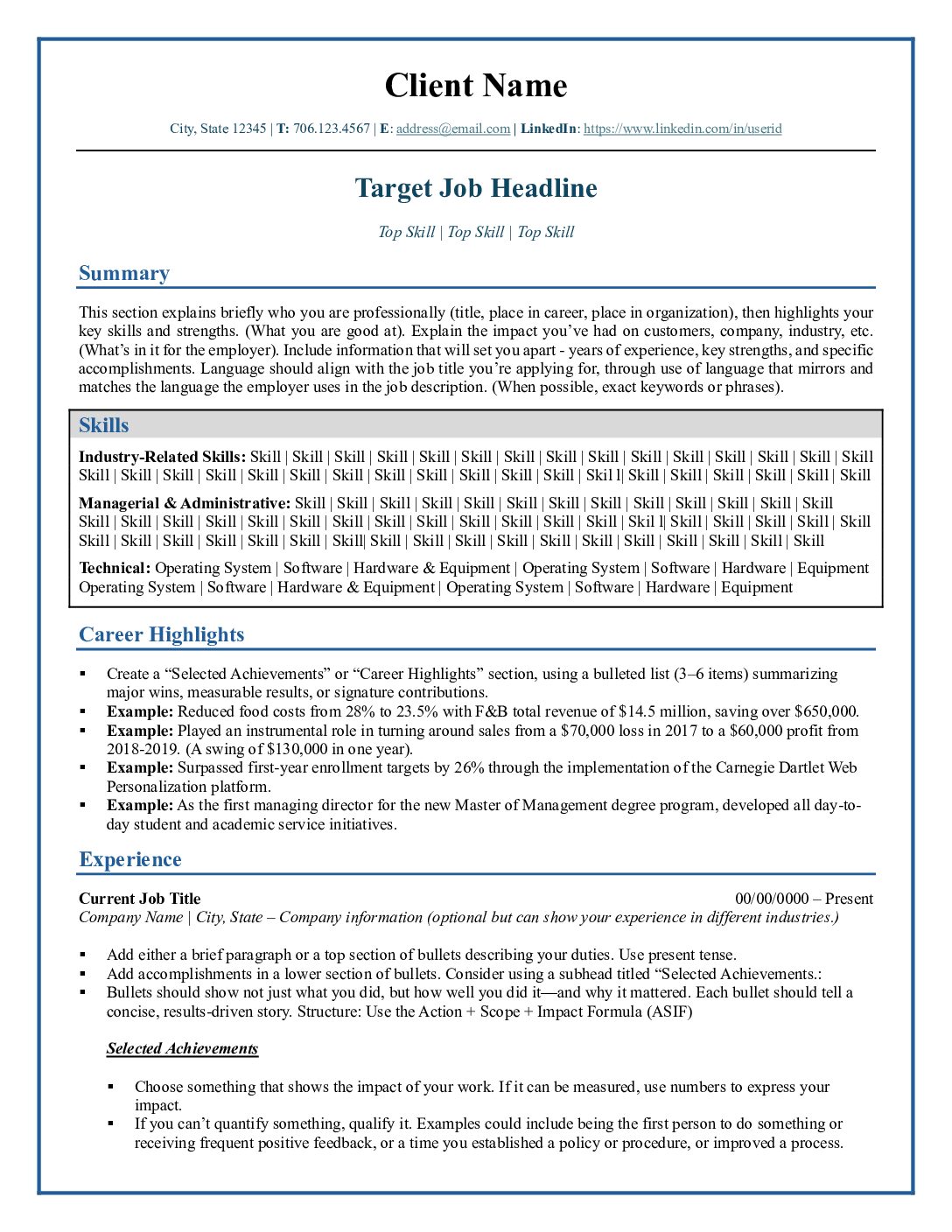
Use familiar headings such as Summary, Skills, Professional Experience, and Education.
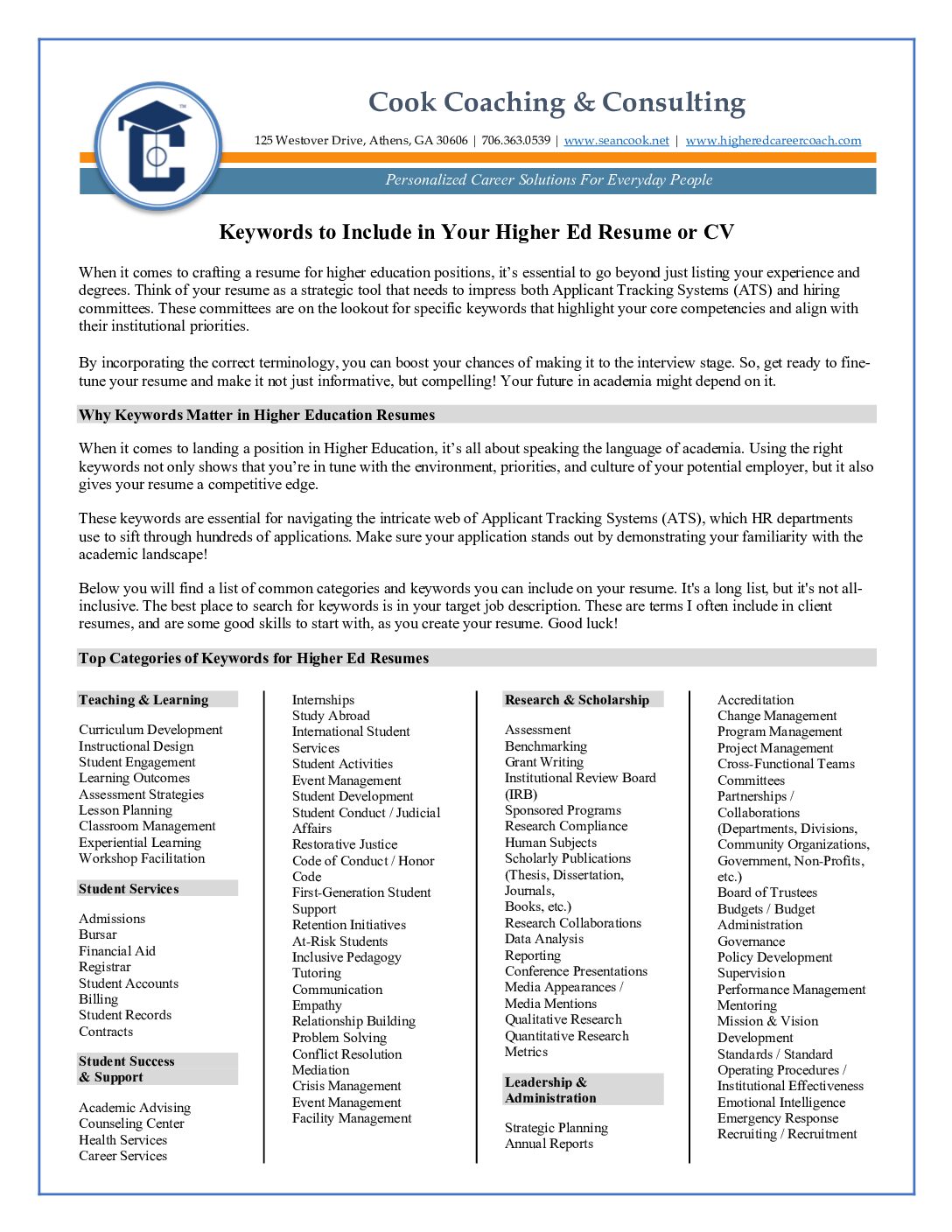
Incorporate relevant terminology from the position announcement naturally.
Connect your experience directly to the institution’s stated responsibilities and qualifications.
Use a clean, consistent structure.
Avoid placing essential information only inside graphics, text boxes, headers, or footers.
Spell out important higher education abbreviations at least once.
Follow the institution’s application instructions carefully.
ATS optimization is not keyword stuffing. It means using the employer’s language to accurately describe qualifications you genuinely possess.
Faculty applicants should also carefully distinguish among the documents requested. A CV, cover letter, research statement, teaching statement, and diversity or student-success statement serve different purposes and should not simply repeat the same information.
5. Prepare Your Faculty CV Before Search Season Accelerates
Many institutions begin faculty searches in the fall for appointments starting the following academic year. This longer timeline allows departments to conduct national searches, bring promising candidates to campus, complete approvals, and give the selected candidate time to make a clean transition.
That means faculty members should have their CVs ready now.
Review the organization and completeness of your:
Education and academic appointments
Publications and works in progress
Research interests and projects
Grants and funded activity
Teaching experience and course development
Presentations and invited talks
Student mentoring
Academic and professional service
Awards, honors, and professional affiliations
Departmental, institutional, and disciplinary leadership
A strong faculty CV does more than list activity. Its organization should make the trajectory and significance of your scholarship, instruction, research, service, and leadership easier to recognize.
Prepare Before the Opportunity Appears
You may not know when a colleague’s departure, a newly funded position, a reorganization, or an unexpected vacancy will create the right opening. Preparing now allows you to evaluate that opportunity thoughtfully, rather than rushing to update years of material before a deadline.
Choose one manageable step this month:
Add your new role
Revise your current position
Create an accomplishment tracker
Review three target announcements, or
Update one major section of your CV.
If your résumé or CV no longer reflects the scope of your work—or if you are having difficulty translating a complex higher-education career into a clear, compelling message—I can help.
For more than 16 years, I have helped higher education professionals and faculty members update their résumés and CVs, clarify their career direction, and highlight significant achievements in scholarship, instruction, research, administration, and leadership. My services can help you assemble your materials efficiently, position your experience appropriately, and prepare for opportunities that may emerge throughout the academic year.
Visit SeanCook.net to learn more about my professional résumé and CV writing, coaching, LinkedIn, and interview coaching packages.
Refine your message. Prove your impact. Get hired.
Join the Intelligent Career Strategies List and Receive My Higher Ed Achievement Tracker and More!
Thanks for reading! Join my mailing list, Intelligent Career Strategies, to receive career planning articles, resources, and strategies, including my Higher Ed Achievement Tracker.
When You Sign Up, You'll Receive:
My Higher Ed Achievement Tracker
A 12-part Welcome Series, with messages on
Resume writing and optimization
Understanding applicant tracking systems,
PLanning a career change,
Using LinkedIn effectively, preparing for job interviews,
And MORE!
It's also packed with activities and worksheets to help you prepare your job search materials, hone your interview answers, and tell your professional story.
Once you complete the Welcome Series, you'll continue to receive articles from HigherEdCareerCoach.Com members-only resources, and regular opportunities to interact with me, one-on-one. Use the form below to receive the Career Achievement Tracker and the Welcome Series.
Join Our Mailing List
Receive articles, career strategies, and career planning resources,
including the Higher Education Achievement Tracker.
Finding the right job in higher education requires a strategic approach, focus, and access to the best platforms. Whether you are a faculty member, administrator, or student affairs professional, knowing where to look is half the battle. Here’s a curated list of highly effective higher education job boards, complete with links, target audiences, features, and publishers.
Pro Tip: Bookmark the boards most aligned with your career goals and set up job alerts to never miss a posting.
General Higher Education Job Boards
These boards cover a wide range of positions across faculty, administrative, and executive roles.
HERC Jobs URL:hercjobs.org Publisher: Higher Education Recruitment Consortium (HERC) Audience: Faculty, administrators, and executives with a focus on diversity and inclusive hiring. Features: Faculty, staff, and executive listings; dual-career support; resources for inclusive hiring.
HigherEdJobs URL:higheredjobs.com Publisher: HigherEdJobs, Inc. Audience: Job seekers at all levels, from adjuncts to senior administrators. Features: Comprehensive listings, resume upload, and career advice.
Inside Higher Ed – Careers URL:careers.insidehighered.com Publisher: Inside Higher Ed Audience: Faculty, administrators, and student affairs staff. Features: Job listings combined with news, commentary, and research on hiring institutions.
UniversityJobs.com URL:universityjobs.com Publisher: JobTarget, Inc. Audience: Academics, researchers, and administrators worldwide. Features: Faculty, post-doc, staff, and administrative positions with international listings.
AcademicKeys URL:academickeys.com Publisher: AcademicKeys, Inc. Audience: Discipline-specific faculty and research professionals. Features: Job listings by discipline; research, post-doc, and faculty opportunities.
HigherEd360 URL:highered360.com Publisher: HigherEd360 Audience: Faculty, staff, PhD candidates, and post-docs exploring academic careers. Features: Job listings, institutional directories (2,600+ colleges/universities), CV/resume resources, and career advice.
Specialized and Niche Boards
These boards are ideal for targeting specific audiences, such as diversity hires, international educators, or discipline-specific roles.
HigherEd-Diversity – highered-diversity.com Publisher: HigherEd-Diversity, Inc. Audience: Underrepresented faculty and administrators. Features: Diversity-focused postings, unlimited posting plans for institutions.
AAHHE Job Board – aahhe.mcjobboard.net Publisher: Association of American Hispanics in Higher Education (AAHHE) Audience: Hispanic/Latino higher-ed professionals. Features: Filterable faculty and administrative positions; job alerts.
HERS Network Job Board – hersnetwork.org Publisher: HERS Institute Audience: Women and gender-diverse professionals in senior leadership. Features: Leadership and executive positions; career development resources.
AHEPPP Job Board – aheppp.memberclicks.net Publisher: Association of Higher Education Parent/Family Programs & Personnel (AHEPPP) Audience: Student affairs, family/parent programs, enrollment, and alumni relations professionals. Features: Parent/family engagement, orientation, enrollment, and alumni roles.
NACUBO Career HQ – careerhq.nacubo.org Publisher: National Association of College and University Business Officers (NACUBO) Audience: Business, finance, and administrative professionals. Features: Campus business officer roles; resume submission; mid- to senior-level positions.
AERA Online Job Board – careers.aera.net Publisher: American Educational Research Association (AERA) Audience: Education researchers, policy scholars, and doctoral/post-doc candidates. Features: Academic research positions with resume upload and job alerts.
CommunityCollegeJobs.com – communitycollegejobs.com Publisher: CommunityCollegeJobs.com Audience: Two-year college faculty, staff, administrators, and executives. Features: State-by-state search; faculty and administrative postings.
AdjunctWorld – adjunctworld.com Publisher: AdjunctWorld, Inc. Audience: Online adjunct instructors and remote teaching professionals. Features: Curated online teaching jobs and certificate courses to strengthen applications.
Student Affairs Job Boards
Student affairs professionals need specialized resources for leadership, engagement, and student support roles.
The Placement Exchange – https://www.theplacementexchange.org/ Publisher: NASPA (Student Affairs Administrators in Higher Education) and ACUHO-I (Association of College and University Housing Officers - International). Audience: Early to mid-career student affairs professionals. Features:Job board, resources for job seekers and employers, communication, and interview scheduling features.
ACPA Career Center – careers.myacpa.org Publisher: American College Personnel Association (ACPA) Audience: Campus life and student development staff. Features: Student affairs, counseling, diversity, inclusion, and engagement roles.
StudentAffairs.Com Job Board – https://www.studentaffairs.com/jobs/ Publisher: StudentAffairs.Com Audience: Residence life, orientation, student engagement, and other Student Affairs job seekers Features:Student Affairs job postings, Free Resume Posting Service
SEO & Engagement Tips
Bookmark your favorites: Focus on the boards that align most closely with your career goals.
Set up job alerts: Don’t wait—get notified instantly when relevant positions post.
Network within associations: Many boards (NASPA, ACPA, AAHHE, NACUBO) offer exclusive career development and networking opportunities.
Keep your CV current: Tailor it for faculty, administrative, or student affairs roles depending on the board.
Next Step: Create accounts on 3–5 of these boards today and subscribe to email alerts. You’ll be ahead of other candidates in landing your next higher education role.
Download a version of this information in an Excel Workbook (contains hyperlinks).
Earlier this month, we covered the importance of understanding typical academic hiring cycles when searching for faculty roles. It's equally important while searching for a job in Student Affairs, but the rhythm of the year is a bit different.
As noted in the previous article, academia operates on a relatively predictable schedule, and job postings are tied closely to the academic calendar. Most institutions plan their staffing needs well in advance of the upcoming academic year.
Open Season: The Job Hunt Begins! Late Winter to Early Spring (January – May)
While fall is the peak season for faculty jobs, late winter to early spring (January through May) is the busiest hiring period for employment in Student Affairs. Most institutions examine their staffing needs between the end of one year and the beginning of the next, and plan to fill vacancies by late summer and early fall.
Job seekers can expect to start seeing job postings for the next academic year by January or February. Working backward, this means that individuals seeking a new role should refine their resumes and LinkedIn profiles, line up their references, and begin planning and budgeting in late fall or early winter (October through December) for a busy interview season, which typically picks up in March and April. Professional Associations like NASPA and ACPA hold their annual conferences, providing opportunities for networking. Some regional associations also post career resources and events on their websites, for those with geographic preferences.
TPE, The Placement Exchange, a joint venture of NASPAand ACUHO-I, is a virtual platform where job seekers can research opportunities, apply for vacancies, and have multiple interviews. Marketed as a resource for graduate students and early-to-mid-career professionals, TPE enables employers to set up virtual career booths and offer recruiting information, videos, documents, and links to institution-specific resources, including their institution's job posting site and benefits information. Employers can post open jobs, receive applications, view applicants, message them, and schedule and conduct interviews through the TPE platform.
Candidates participating in TPE can attend a virtual career fair, schedule interviews during a designated scheduling week, and participate in interviews during a dedicated interview week. Registration for 2026 Virtual Placement begins on December 1, and TPE Virtual Placement dates are February 13 and February 23-27, 2026. For more information, visit the Virtual Placement page on the TPE website.
Phase 2: Interview Season (March and April)
The next phase of the annual Student Affairs hiring cycle begins in March and April. By this time, many institutions have conducted initial screening interviews and started inviting candidates for second-round interviews. The way interviews unfold during this phase varies. For some positions, particularly early-career roles, the second interview may be the final interview. For more specialized roles and senior positions, the interview process may include different stages and include meetings with various campus stakeholders, including senior management. If an employer doesn't provide clear explanations of the interview process and hiring timeline, candidates should request this information so they can plan their travel and work around other interview opportunities.
Phase 3: Offers and Acceptances (May through June)
For candidates, the next phase begins and (hopefully) rewards them for all their hard work. By May and June, many employers extend offers, especially for roles that start onboarding and staff training in July. This is common for Residence Life and other areas that welcome students to campus and support student activities and events that take place early in the academic year, such as Orientation, Student Activities, and Greek Life.
The Second Wave: July Through October
What happens next? A second wave occurs in response to the departure of staff who accepted new opportunities. Many universities begin their fiscal years on July 1st and some do not advertise positions until the new fiscal year starts. Institutions will continue to post new vacancies in late summer through early fall (July through October).
In July and August, "Just-in-Time" hiring takes place to fill positions created by last-minute resignations or newly approved roles before the start of the fall semester. When I worked in Residence Life, I referred to this stage as the time we had a "warm body problem": we needed to start the year strong, and (facetiously) this meant that we would hire any "warm body" to fill the vacancy. This is an oversimplification. Res Life folks often use sardonic comments to survive the challenges of the professional staff training-student staff training- orientation leader training-residence hall opening-welcome-week-and-everything-else season that ramps up in July and ends in exhaustion (or at some point in October).
Anyway, we wouldn't take just any "warm body." We would, however, consider less experienced candidates who showed promise, seemed trainable, and were ready and raring to go. Many of my best staff members joined the department during this time. If you end up being a "second wave" hire, don't beat yourself up. You weren't hired late because you weren't competitive. You were hired late because you had the endurance to keep going.
The End
At the end of this phase, in September and October, there are fewer job postings, many of which are for specialized roles or unexpected vacancies. The academic year gathers steam, and eventually, the hiring cycle for the following year's vacancies begins. If you are still looking for a job, know that being the best available option is a good thing. Keep the faith, and your opportunity will come. You'll know your final destination when you get to the "end of the line."
Some Final Thoughts
Be prepared for a long process. Due to committee approvals, university bureaucracy, and the need to coordinate multiple schedules, the timeline from application to an offer can take 4 to 6 weeks or longer.
October through December: Prepare your resume and optimize your LinkedIn profile. Line up your references. Plan your budget to be prepared for networking, placement events, and travel.
Begin your active search in January and prioritize high-volume application submissions and conference attendance through May to hit the primary cycle
If you can afford to attend conferences early in the year, use them as opportunities to meet other professionals, support other job seekers, and network. New connections can lead to new opportunities.
Participate in TPE. It is a structured, high-volume environment where candidates can complete multiple screening interviews with institutions in just a few days.
Be on the lookout for regional placement events or conferences. Smaller events may offer you opportunities to stand out in a smaller crowd. This is especially important if you are regionally bound.
If you are interested in a specific institution, visit their hiring page frequently in late Spring and early Summer. Many universities begin their fiscal years on July 1 and typically do not advertise positions until the new fiscal year starts.
Like most people who end up working in Student Affairs, I didn’t imagine my career when I was a child. I wasn’t even aware that Student Affairs was a career. And, once I chose it as a career, I realized that many people still think it isn’t one.
Texas A & M’s Department of Educational Administration and Human Resource Development has a great humor page, where I found the Top 10 reasons you became a Student Affairs professional, and I particularly connected with #3 . . .
“You enjoy the challenge of trying to tell people what you do for a living.”
The last time I think my parents really understood what I did for a living, I was a resident assistant. And for many of my friends and acquaintances, that is pretty much what they thought I did, up until I left my last formal position in Student Affairs (Assistant Director of Residence Life at Penn State University.) I was in college for a living, and I settled roommate problems and busted people for drinking. (Which many acquiantainces thought was irony in action, on both counts, but that is a story for another day.)
Academics and “serious” professionals don’t know what to make of us, either. For example, Wikipedia’s current entry for Student Affairs has a section on criticism of the field which reads, in part…
“The field of Student Affairs has been criticized for its emphasis on formal, professional training, calling into question whether the field is theoretical or practical. Complicating this criticism is the question of the role of student development theories in student affairs practice. It is claimed that student development theories are used to “proactively identify and address student needs, design programs, develop policies, and create healthy…environments that encourage positive growth in students.”
“Yet, often student affairs practices often bear little resemblance or connection to student development theories. As Paul Bloland (1979) wrote in an article in the NASPA Journal, “We have cultivated an expertise that was not requested, is not sought out, and for which there is little recognition or demand. Many entry-level and (many) seasoned professionals know little of student development theory and practice and, in fact, do not really need such expertise to meet the role expectations of their supervisors or, in too many instances, their institutions.”
Yet, for almost 20 years now, I have planned my life around the idea that Student Affairs is a career. In 2009, I left a stable job to venture out on my own, and establish a career coaching practice dedicated to helping others pursue their passions for working with students and find their own niche in Student Affairs. My perspective is that Student Affairs is actually a calling, within which you will find many career tracks. And it isn’t for everybody. I actually think it is the responsibility of those in the field to both recruit people with potential, and to “counsel out” out those who don’t have the passion and the fortitude to do the work. It’s no kindness to someone to show only the benefits, and none of the sacrifices, that go along with the profession.
In his song “Mr. Bad Example,” Warren Zevon recalled many career exploits of the song’s protagonist, and like those who work in Student Affairs, the protagonist clearly wore many hats, including the following…
“…worked in hair replacements, swindling the bald, where very few are chosen, and fewer still are called.”
The same could be said about Student Affairs. Very few are chosen, and fewer still are called. And I don’t think that a love of student development theory is required for success. I don’t care much about academics, or about student development theory, but I do know that Student Affairs is a calling, and that you can make a great career in it, if you are passionate about working with young people, and believe that helping people find their way is a worthy pursuit, you may be cut of the right material. But only if you have the strength of will and character to ignore the assaults on your dignity, your professional worth and your profession. They come with this line of work. The only thing that is truly important is that you know who you are and what you are about. If you are meant to serve students, you will. It’s just a matter of time. And in many cases, of strategy. If it’s meant to be, you will find your way. Just know, in the meantime, that many are in your corner, and have been in your place, before you. And we are here to help.
October is Careers in Student Affairs month. In honor of this, I am offering a coaching package for new professionals, to help them get off to a good start. It includes the following:
A professionally written resume, geared toward your preferred target positions ($85 value)
Access to an online job search group, with activities, lessons, and a private discussion board): $50 value
Purchased separately, this package would be $355, but this deal gives you nearly 30% off! For only $250, you get all of the above, including 6 months of access to the group, and any additional workshops or activities added to the job search group.
I’m opening this deal up only to new professionals (either those finishing school and looking for their first job, or with less than 5 years of professional experience). Availability is limited, and this special will not be repeated.
A while back I posted that I was looking for someone to help with some of the site development tasks and social media efforts related to Higher Ed Career Coach and my other websites (Primarily AthensGACareerCoach.Com). The initial interest and buzz on Twitter soon gave way to the sound of crickets chirping, and the application deadline passed without anyone applying. (Insert sad face here.)
I set the idea aside for a while, because I have been busy with clients, their resumes, and other issues, figuring that if there wasn’t any interest, I would just keep doing what I have been doing, and hope for the best. Then, in late January, I received a tweet from Melissa Judy, asking if the position had been filled. We struck up a conversation over Twitter and then e-mail and I told her how she might apply.
Not long after, I received her application and interviewed her over Skype, and I can honestly say she is exactly what I have been looking for in an intern. Melissa brings experience as a writer and content developer, as well as the perspectives of a somewhat non-traditional learner to the table.
Melissa graduated from George Mason University with a bachelor of arts in English in 2004. She
continues to support her fraternity, Zeta Tau Alpha, as an alumna member. Upon graduating, she spent time in the Army, but was injured in basic training and unfortunately had to be chaptered out. She then spent 4 years as an emergency veterinary technician before rediscovering her love of academia. While working in veterinary medicine, she met and married an Army officer before moving to Daytona Beach, FL. While there, Melissa worked in the Alumni Relations office at Embry-Riddle Aeronautical University as a Communications Specialist. In addition to her alumni duties, she consistently volunteered to work with the Student Activities Office there and greatly enjoyed working with undergraduate students.
In the fall of 2010, Melissa began pursuing an online master of science in higher education administration at Drexel University and expects to complete her degree in August, 2012. Her interests lie in Greek Life, student leadership, alumni relations, communications, orientation and first year programs.
Over the remainder of the semester, I’ll be working with Melissa to develop some new resource pages and anchor content, and teaching her the ins and outs of running a small business blog. Please welcome Melissa and congratulate her on her new position. She can be reached at melissa@higheredcareercoach.com
In higher education, as in any industry, credentials and certifications are sought after by professionals hoping to get an advantage over their competition. In an interesting post that entered my tweet stream on Friday, Kenny Silva explored the weight we often place on credentials in the hiring process, in contrast to potential. This is especially pertinent at this time of year, when the academic year is beginning, and the hiring season slows to a crawl.
Back when I was working at Penn State, I often found myself in the awkward position of filling a vacancy or two late in the summer. In part, this was due to the area being mostly populated by upper-class students and returning staff. The priority spots in our large residence hall system were to make sure that the first-year areas were adequately staffed first. When approximately half of your 14,000 students are first-year students, and about 4500 of those live in one area, you must have priorities.
Working with first-year students is, in general, more exciting to many staff, because, well...they need you in a different way. It's more validating. Upperclassmen don't get in nearly as much trouble, and mostly, they want to be left alone to do their own thing. So there were several occasions when someone left or was transferred to a new area or got promoted when we had to fill a vacancy post-haste and pronto, and many of the more highly credentialed new hires had already been placed. These are the times when it is especially important to look for potential.
In my time as Assistant Director, I cared more about potential than credentials, and honestly, I still do, because, for the most part, my least credentialed staff were easiest to work with, related better to students, and were more motivated to prove themselves. I always appreciated that perspective, because I have always had to prove myself.
I was the last male resident assistant hired at Clemson during my junior year, and they put me on the top floor of a building where no one ever went unless they had a reason to be there. I went in knowing they expected me to fail and that I had a lot to prove. I made the most of it and went on to win programming awards and have a generally good reputation on campus. Eventually, I made Student Affairs my life's work. Along the way, I met different mentors and colleagues who kept giving me chances. Like a "diamond in the rough," polishing up my portfolio and earning credentials took some time.
When I decided to leave the university setting, I had to sort through the value of becoming credentialed as a certified coach, and recently, as a professional résumé writer. I worked with college students for 15 years, had a master's degree already, and had been coaching young professionals and colleagues on their job search materials and strategy the whole time. I didn't really think I needed a couple more pieces of paper to prove I could do this, but I got them anyway. I did so because that is the way our field works for some people, and I felt that the credentialing would remove some potential obstacles from my path.
Oddly enough, I can't remember a single time I've been practicing when a client even asked about my credentials. Instead, they ask, "How can you help me?" and "What benefits will I see from working with you?" And they weigh these against other options, many of which are free or available at a lower cost. I end up working with many of people who inquire, and when I don't, I know that I haven't distinguished myself in the right way, or shown the value of the relationship. When I do get a new client, it's because they believe I can help them, and because we connected as people who potentially could work well together.
As Silva points out:
"Our ability to succeed in any endeavor, whether it's a business or non-profit, is dictated by potential, not credential. It is only potential energy that can be tapped into in order for us to push forward. If you don’t hire the right people to bring that potential energy into your business, you will not move forward."
I've always told my student leaders aspiring to go straight into student affairs that the time period we are currently in, from mid-August to the end of September, is a great time to look for a job, if you work hard to show your potential. Time and again, this worked for me as a supervisor, and I got some great staff members out of the deal.
If you still have staff vacancies, do yourself and the universe a favor: take a chance on a candidate you have a good gut feeling about. Look for the "diamonds in the rough" and help them learn to shine!
Work with Sean. I help higher ed professionals take control of their careers with tailored services including resume and CV development, LinkedIn profile optimization and networking strategy, interview coaching, and one-on-one career guidance.



 Free Download