Faculty job postings can feel overwhelming—long, technical, and packed with academic jargon. But they’re not random. Every section is intentional, and together they tell a clear story about what the institution needs, values, and prioritizes. Learning how to decode these signals is one of the most important skills in an academic job search.
Start With the Position Context
The title and rank (e.g., Assistant Professor, Associate Professor, Lecturer, Clinical Faculty) immediately signal expectations around teaching load, research productivity, and service. Tenure-track roles typically emphasize scholarship and long-term institutional contribution, while non-tenure-track roles often prioritize teaching, advising, or professional practice. Understanding this context helps you calibrate how heavily to emphasize research, pedagogy, or applied experience in your materials.
Required vs. Preferred Qualifications Matter More Than You Think
Search committees often use required qualifications as an initial screening tool. If you do not clearly meet—and explicitly address—each required item, your application may never move forward. Preferred qualifications indicate areas where candidates can differentiate themselves. Treat these as strategic opportunities to show added value rather than optional extras. The Chronicle of Higher Education notes that many strong candidates are eliminated simply because they fail to clearly demonstrate how they meet the stated requirements (Chronicle of Higher Education – Career Advice).
Decode the Teaching Expectations
Pay close attention to how teaching is described. Mentions of course load, undergraduate versus graduate instruction, online or hybrid delivery, or specific pedagogical approaches signal instructional priorities. Language around student populations—such as first-generation students or adult learners—points to institutional mission and should shape how you frame your teaching philosophy. Resources from Inside Higher Ed emphasize that teaching statements are most effective when they clearly align with the institution’s instructional context (Inside Higher Ed – Career Advice).
Read Between the Lines on Research and Scholarship
Research expectations are often embedded in subtle language. References to grant activity, collaborative research, or specific subfields suggest what kinds of scholarship are most valued. Some institutions prioritize steady publication; others emphasize externally funded research or interdisciplinary work. Tailor your research statement to mirror this emphasis rather than using a one-size-fits-all approach.
Service Is Not an Afterthought
Terms like “committee work,” “program development,” or “student advising” signal expectations for institutional citizenship. Especially at teaching-focused institutions, service can carry significant weight. Demonstrating a realistic understanding of service expectations shows maturity and fit—qualities search committees consistently value.
Pay Attention to Mission and Values Language
Statements about diversity, equity, community engagement, or access are not filler. They indicate priorities you should directly address in your cover letter and statements. HigherEdJobs recommends explicitly connecting your experience to an institution’s mission to strengthen perceived fit (HigherEdJobs – Career Resources).
Final Takeaway
A faculty posting isn’t just a checklist—it’s a narrative about what the institution values most. The strongest candidates don’t just meet the qualifications; they respond to the underlying story the posting tells. By mirroring the language, emphasizing key points, and aligning your materials with institutional values, you position yourself as a thoughtful, prepared, and mission-aligned candidate.
Finding the right job in higher education requires a strategic approach, focus, and access to the best platforms. Whether you are a faculty member, administrator, or student affairs professional, knowing where to look is half the battle. Here’s a curated list of highly effective higher education job boards, complete with links, target audiences, features, and publishers.
Pro Tip: Bookmark the boards most aligned with your career goals and set up job alerts to never miss a posting.
General Higher Education Job Boards
These boards cover a wide range of positions across faculty, administrative, and executive roles.
HERC Jobs URL:hercjobs.org Publisher: Higher Education Recruitment Consortium (HERC) Audience: Faculty, administrators, and executives with a focus on diversity and inclusive hiring. Features: Faculty, staff, and executive listings; dual-career support; resources for inclusive hiring.
HigherEdJobs URL:higheredjobs.com Publisher: HigherEdJobs, Inc. Audience: Job seekers at all levels, from adjuncts to senior administrators. Features: Comprehensive listings, resume upload, and career advice.
Inside Higher Ed – Careers URL:careers.insidehighered.com Publisher: Inside Higher Ed Audience: Faculty, administrators, and student affairs staff. Features: Job listings combined with news, commentary, and research on hiring institutions.
UniversityJobs.com URL:universityjobs.com Publisher: JobTarget, Inc. Audience: Academics, researchers, and administrators worldwide. Features: Faculty, post-doc, staff, and administrative positions with international listings.
AcademicKeys URL:academickeys.com Publisher: AcademicKeys, Inc. Audience: Discipline-specific faculty and research professionals. Features: Job listings by discipline; research, post-doc, and faculty opportunities.
HigherEd360 URL:highered360.com Publisher: HigherEd360 Audience: Faculty, staff, PhD candidates, and post-docs exploring academic careers. Features: Job listings, institutional directories (2,600+ colleges/universities), CV/resume resources, and career advice.
Specialized and Niche Boards
These boards are ideal for targeting specific audiences, such as diversity hires, international educators, or discipline-specific roles.
HigherEd-Diversity – highered-diversity.com Publisher: HigherEd-Diversity, Inc. Audience: Underrepresented faculty and administrators. Features: Diversity-focused postings, unlimited posting plans for institutions.
AAHHE Job Board – aahhe.mcjobboard.net Publisher: Association of American Hispanics in Higher Education (AAHHE) Audience: Hispanic/Latino higher-ed professionals. Features: Filterable faculty and administrative positions; job alerts.
HERS Network Job Board – hersnetwork.org Publisher: HERS Institute Audience: Women and gender-diverse professionals in senior leadership. Features: Leadership and executive positions; career development resources.
AHEPPP Job Board – aheppp.memberclicks.net Publisher: Association of Higher Education Parent/Family Programs & Personnel (AHEPPP) Audience: Student affairs, family/parent programs, enrollment, and alumni relations professionals. Features: Parent/family engagement, orientation, enrollment, and alumni roles.
NACUBO Career HQ – careerhq.nacubo.org Publisher: National Association of College and University Business Officers (NACUBO) Audience: Business, finance, and administrative professionals. Features: Campus business officer roles; resume submission; mid- to senior-level positions.
AERA Online Job Board – careers.aera.net Publisher: American Educational Research Association (AERA) Audience: Education researchers, policy scholars, and doctoral/post-doc candidates. Features: Academic research positions with resume upload and job alerts.
CommunityCollegeJobs.com – communitycollegejobs.com Publisher: CommunityCollegeJobs.com Audience: Two-year college faculty, staff, administrators, and executives. Features: State-by-state search; faculty and administrative postings.
AdjunctWorld – adjunctworld.com Publisher: AdjunctWorld, Inc. Audience: Online adjunct instructors and remote teaching professionals. Features: Curated online teaching jobs and certificate courses to strengthen applications.
Student Affairs Job Boards
Student affairs professionals need specialized resources for leadership, engagement, and student support roles.
The Placement Exchange – https://www.theplacementexchange.org/ Publisher: NASPA (Student Affairs Administrators in Higher Education) and ACUHO-I (Association of College and University Housing Officers – International). Audience: Early to mid-career student affairs professionals. Features:Job board, resources for job seekers and employers, communication, and interview scheduling features.
ACPA Career Center – careers.myacpa.org Publisher: American College Personnel Association (ACPA) Audience: Campus life and student development staff. Features: Student affairs, counseling, diversity, inclusion, and engagement roles.
StudentAffairs.Com Job Board – https://www.studentaffairs.com/jobs/ Publisher: StudentAffairs.Com Audience: Residence life, orientation, student engagement, and other Student Affairs job seekers Features:Student Affairs job postings, Free Resume Posting Service
SEO & Engagement Tips
Bookmark your favorites: Focus on the boards that align most closely with your career goals.
Set up job alerts: Don’t wait—get notified instantly when relevant positions post.
Network within associations: Many boards (NASPA, ACPA, AAHHE, NACUBO) offer exclusive career development and networking opportunities.
Keep your CV current: Tailor it for faculty, administrative, or student affairs roles depending on the board.
Next Step: Create accounts on 3–5 of these boards today and subscribe to email alerts. You’ll be ahead of other candidates in landing your next higher education role.
Download a version of this information in an Excel Workbook (contains hyperlinks).
Maximize Your Chances: Understanding the Academic Job Market Cycle
When you’re seeking a position as a lecturer, assistant professor, or researcher, timing your application is crucial. The academic job market has its unique rhythms, and understanding academic hiring cycles can give you a strategic edge. When is the best time of year to apply for academic jobs?
The Academic Job Market: An Overview
Unlike many industries that hire year-round, academia operates on a relatively predictable schedule. Academic job postings are tied closely to the academic calendar. Most institutions plan their staffing needs well in advance of the upcoming academic year. Understanding academic hiring cycles can help you target your efforts effectively.
Hiring Seasons
Fall (September–November): This is the primary hiring season for academic jobs, especially in the United States. Institutions typically begin posting positions in late summer and early fall, with application deadlines ranging from October to December. Most tenure-track faculty positions, including assistant and associate professorships, are advertised during this period. The timeline allows for campus visits and interviews before hiring departments make job offers.
Winter (December–February): While fall is the busiest time, some job postings continue into the winter months. These might include unfilled positions from the first round, replacement hires due to a faculty member resigning or retiring, or roles in departments with different hiring cycles. For example, universities won’t advertise grant-funded research positions until they receive the formal award of the grant.
Spring (March–May): While many institutions have filled positions by spring, opportunities still exist. Late openings occur due to unexpected retirements, resignations, or changes in funding. Temporary, adjunct, or visiting positions often appear in the spring as departments finalize their course offerings for the next academic year.
Summer (June–August): The summer months are typically the slowest for academic hiring. Most institutions are preparing for the fall semester, so few advertise new positions. However, you can sometimes find last-minute adjunct or part-time roles posted during this period. By the end of Summer, many institutions have what I call a “warm body problem.” They have students enrolled in classes and need instructors to prevent the cancellation of courses. If you are still looking, your immediate availability may give you a competitive edge over those who might not be able to wrap up current commitments in time to begin the new role.
International Considerations
Academic calendars vary by country. For example, in the United Kingdom and Australia, the academic year starts at different times, and hiring cycles align with their academic years. If you’re applying internationally, research the specific hiring patterns in your target region.
Tips for Academic Job Seekers
Start Early: Begin preparing your materials—CV, cover letters, teaching statements, and research proposals—in the summer, so you’re ready to apply as soon as you see promising vacancies posted.
Monitor Job Boards Regularly: Keep a close eye on major academic job boards, university HR pages, and professional association websites to spot new postings as soon as they appear.
Network: Attend academic conferences and workshops, which often coincide with the fall hiring season. These events can help you learn about upcoming openings and connect with potential colleagues.
Be Flexible: While the fall is the primary season, stay alert for off-cycle postings and be prepared to apply quickly if something fits your interests and expertise.
Conclusion
While it’s possible to find academic job openings throughout the year, the best time to apply is generally in the fall, when universities advertise the majority of their vacancies. By understanding academic hiring cycles and preparing in advance, you’ll maximize your chances of landing your ideal role and advancing your academic career.
Some excellent sources for job postings in academia include:
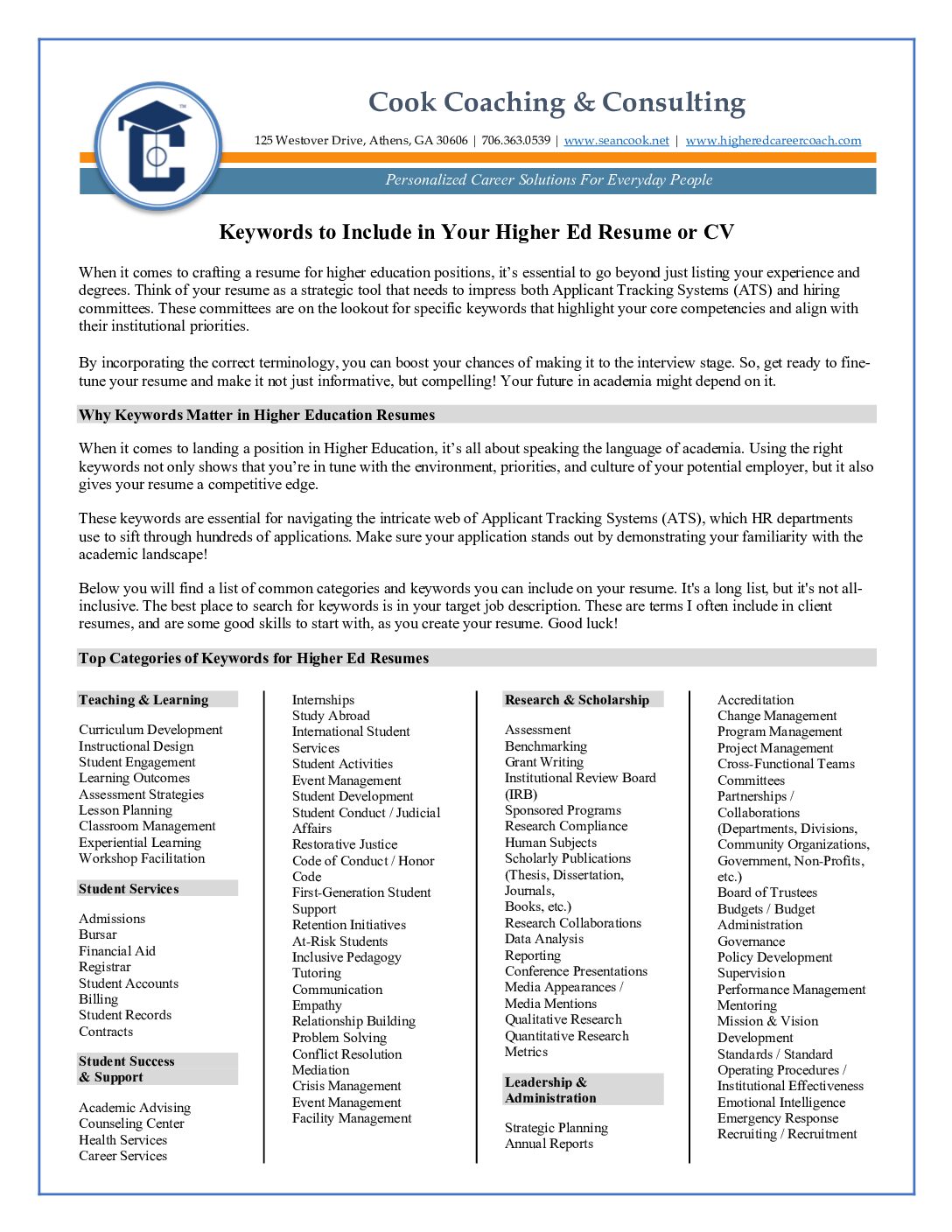
When it comes to crafting a resume for higher education positions, it’s essential to go beyond just listing your experience and degrees. Think of your resume as a strategic tool that needs to impress both Applicant Tracking Systems (ATS) and hiring committees. These committees are on the lookout for specific keywords that highlight your core competencies and align with their institutional priorities.
By incorporating the correct terminology, you can boost your chances of making it to the interview stage. So, get ready to fine-tune your resume and make it not just informative, but compelling! Your future in academia might depend on it.
Why Keywords Matter in Higher Education Resumes
When it comes to landing a position in Higher Education, it’s all about speaking the language of academia. Using the right keywords not only shows that you’re in tune with the environment, priorities, and culture of your potential employer, but it also gives your resume a competitive edge.
These keywords are essential for navigating the intricate web of Applicant Tracking Systems (ATS), which HR departments use to sift through hundreds of applications. Make sure your application stands out by demonstrating your familiarity with the academic landscape!
Below you will find a list of common categories and keywords you can include on your resume. It’s a long list, but it’s not all-inclusive. The best place to search for keywords is in your target job description. These are terms I often include in client resumes, and they are some good skills to start with, as you create your resume. Good luck!
Continuous Improvement / Process Improvement / Process Optimization
Alignment
Negotiation
Assess(ed)
Manage(d)
Create(d)
Implement(ed)
Execute(d)
Develop(ed), Development
Critical Thinking
Increased
Decreased
Drove / Drive
Facilitate
Create(d) / Creative / Creativity
Networking
Present(ed) / Presentation(s)
Flexible
Work Independently / Minimal Supervision / Self-Directed/ Self-Motivated
How to Use These Keywords Effectively
Mirror the job posting: Adapt your resume by weaving in the exact terminology used in the description.
Be authentic: Only use keywords that accurately reflect your skills and experience.
Show impact: Combine keywords with measurable achievements (e.g., “Led curriculum development initiative that improved retention rates by 12%”).
Balance ATS and human readers: Don’t overstuff your resume; ensure it reads naturally and flows smoothly.
Final Thoughts:
Unlocking the next step in your higher education career begins with the right keywords—your ticket to capturing attention and making your resume shine. By crafting your document with intention and authenticity, you not only meet the expectations of today’s institutions but also showcase the unique value you bring. Approach your job search with confidence, knowing that each strategically chosen word brings you closer to new opportunities and professional growth. You’ve got this!
Great Resources for Higher Education Career Advice
Keywords to Include in Your Higher Ed Resume or CV
When it comes to crafting a resume for higher education positions, it’s essential to go beyond just listing your experience and degrees. Think of your resume as a strategic tool that needs to impress both Applicant Tracking Systems (ATS) and hiring committees. This document includes common categories and keywords you can include on your resume. If you would like to support this site, buy this document for $1.
Work with Sean Cook – Intelligent Career Strategies for Higher Education Professionals . I help higher ed professionals take control of their careers with tailored services including resume and CV development, LinkedIn profile optimization and networking strategy, interview coaching, and one-on-one career guidance. Whether you’re pursuing advancement in academia or exploring opportunities beyond the campus, I provide the tools and strategies you need to thrive in today’s competitive job market. For more information, visit https://www.seancook.net/. You can read recommendations from previous clients on my LinkedIn profile at https://www.linkedin.com/in/seanccook/. To schedule your complimentary 30-minute consultation, please use the Calendly widget below.
Job Seekers: Read the resources or download the PDF below.
In my work, I have found that clients often ask very similar questions about how to approach certain parts of their job search.
Sometimes, I write long email replies that I should turn into posts here or on my website. And then I customize an answer to the same question later. It takes a lot of time and isn’t very efficient.
I also find myself too bogged down to blog anymore. So I have taken some time to accept that I need not reinvent the wheel every time I’m asked a question. Also, there are so many good articles on the web that answer the questions effectively.
My new strategy is simple. I started making resource handouts with URLs for articles that answer common questions.
Sometimes people have a hard time keeping their job searches moving. Here is a new resource I made with articles about maintaining progress, dealing with emotions during a job search, and different approaches a jobseeker can take when searching.
Now that you’ve secured that job, you need to hurry up and move there! But, don’t be overwhelmed. We’ve compiled a list of sites to will help you remember what to add to your moving checklist, deduct the expenses on your taxes, staying positive throughout the process, and how to actually go about packing up your life and taking it to a new city.
Check out the links to the moving resources listed below and begin your new adventure!
Take 5 is a regular feature where we present links to some good articles and resources on job search topics. If you have ideas for future topics, send them to Melissa Judy, Content Development Intern at melissa@higheredcareercoach.com.
Work with Sean. I help higher ed professionals take control of their careers with tailored services including resume and CV development, LinkedIn profile optimization and networking strategy, interview coaching, and one-on-one career guidance.