Have a Question? Call Now.

(706) 363-0539

I Meet the Qualifications. Why Didn’t I Get An Interview?

I Meet the Qualifications. Why Didn’t I Get An Interview?

I Meet the Qualifications. Why Didn't I Get An Interview?

Seven Reasons Qualified Higher Education Professionals Get Overlooked

image of a metal question mark

You meet the qualifications for the jobs you’re seeking. You’ve worked hard on writing your resume and cover letters. You have a job search routine, and you’ve stuck with it. No matter what you try, you keep getting politely worded rejection emails that all sound the same. It’s early summer now, and you have very few interviews under your belt. It’s getting hard to “keep hope alive.”

Why didn’t you get an interview?

You might never know exactly why you weren’t chosen, since most employers don’t share detailed feedback. Often, they avoid this to protect themselves legally, even if their hiring process is fair. On top of that, larger issues such as bias, inflexible routines, and overreliance on technology can make it harder for qualified candidates. This leaves many applicants unsure why they were rejected, making it tough to learn from the experience and refine future applications.

The reality is that being qualified doesn’t always mean you’re interview-worthy. Search committees often get dozens or even hundreds of applications from people who could do the job. Their real task is to figure out which candidates seem most likely to succeed. The ones who get interviews are usually those who show this most clearly.

Next, we’ll look at common reasons qualified candidates might not get interviews and share practical ways to address each. By tackling these issues, you can make your applications stronger and improve your chances of landing an interview.

Some common mistakes candidates make during the application process include:


1. Your resume only lists your job duties; it doesn’t show the impact you made.

For example, instead of just saying “coordinated student events,” you could say, “coordinated student events that increased campus engagement, resulting in a 20% rise in student turnout over the previous year.” Employers usually know what common job titles involve, so you don’t need to list every task. If your job needs some explanation, keep it short. Describe your place in the organization, your main responsibilities, and then explain what makes you stand out from other candidates.

An ability to complete tasks probably shows that you are “qualified,” but being qualified is not enough. Employers screen for qualifications but hire people who can differentiate themselves from other candidates. If you want to stand out, explain your achievements, scope of responsibility (staff supervised, size of budgets, number of projects, etc.), and the impact of your work (did you complete projects on time, save money, or improve processes?) Then show that you have researched the opportunity and the organization, and explain how you will fit into their company culture and how you will improve their processes, products, and services.

Keep the acronym ASIF in mind: Achievements, Scope of Responsibility, Impact, and Fit. When you put your materials together, act “as if” you’re the best candidate and give proof in each of these areas. This helps the reader picture your potential success in the job

2. Your cover letters and interview answers are generic and focus more on your duties than your achievements.

You may think your accomplishments are minimal and fail to meet the level of achievement someone in the role should have. That may be true, but you can “only step from where you are standing.” Don’t waste any time discounting your experience. Study the position, explain your accomplishments and how they have prepared you to solve an employer’s problems or serve their clients.

Years ago, I was interviewing for a Director of Residence Life job.  With Residence Life at Penn State,  I supervised staff, held system-wide responsibilities, and managed multiple budgets and processes. I also managed a significant departmental budget in another job at the business college. The size of the staff and the budgets at the potential employer were much larger and more complex than what I had dealt with at that point in my career.

The interviewer told me the size of their department’s budget and asked how I would approach managing it. I explained how I organized my thoughts when managing a budget, the Penn State-specific processes I learned, and how I had successfully proposed, tracked, and defended budgets in the past. I gave examples of how I used technology to track my budgets and reconcile expenses, the times I justified spending, and the approaches I used to secure more funding when needed. I also mentioned that my budget reporting received recognition from the Associate Dean of the College of Business, who highlighted my approach as exemplary to academic department heads. My department was the only one to receive the exact funding requested that year. The interviewer appreciated my explanation of budgeting strategies and organizational methods, noting that these approaches were more important than the size of the budget itself.

Do not downplay your experience; instead, relate why it is relevant. In your cover letter, prioritize conveying your readiness for the role and potential for success by sharing clear, relevant examples of your skills and experience.

3. You failed to demonstrate that you meet all of the most important qualifications.

Typically, job postings are organized into four distinct sections: first, a description of the institution; second, an overview of the position itself; third, a list of the “basic qualifications” that are required for the role; and finally, an “ideal candidate” statement that outlines a series of “preferred qualifications.”

Many job seekers stop reading a posting once they see they meet the minimum requirements. But those are just the starting point. Meeting them might get you considered, but if someone else has the qualities and experience of the “ideal candidate,” the employer will likely choose them instead.

The good news is that the “ideal candidate” is as fictional as the “perfect job.” The employer may want a candidate who can walk on water, solve problems with the bat of an eye, pave the streets with gold, and never do anything wrong. They are not going to find that person, but that doesn’t mean they won’t try.

To see how you measure up, first make sure you meet all the basic qualifications or can demonstrate similar experience. Then, look at how many of the “ideal candidate” qualities you have. You’re not just competing with a perfect candidate on paper, but also with real people who may meet more of these requirements. If you don’t have any of the preferred qualifications, it’s unlikely you’ll get an interview, since other candidates probably do.

4. You are applying to too many unrelated positions.

Employers look for a coherent professional story. If you apply for a Dean of Students position on Monday, a Director of Admissions role on Tuesday, a Human Resources position on Wednesday, and a Marketing role on Thursday, you may see yourself as versatile. Employers may see you as unfocused.

Many job seekers apply to dozens or even hundreds of positions, expecting that one application will eventually be successful. While this strategy may sometimes produce results, it more often leads to frustration, burnout, and a low interview rate, as applications are rushed and present generic arguments that are poorly aligned with individual opportunities.

A more successful strategy is to think like a marksman. Marksmen carefully select their targets, study the conditions, take aim, and make each shot count. In a job search, that means focusing on positions that closely match your skills and experience, tailoring your application materials to each opportunity, and investing your time where you are most likely to succeed.

A focused, strategic search typically produces better results than a high-volume approach because employers are far more likely to respond to candidates who clearly demonstrate alignment with their needs.

Don’t apply to every job just because you think you could do it. Focus on the ones where you’re most likely to succeed.

5. You Are Ignoring Institutional Fit

Many job seekers focus almost exclusively on whether they meet the qualifications for a position and overlook an equally important factor: institutional fit. Colleges and universities are not interchangeable. A successful candidate at a large research university may struggle at a small liberal arts college, while someone who flourishes in a community college environment may not enjoy the culture or expectations of a highly selective institution.

Employers want to see that you understand their mission, values, students, and organizational culture. Have you worked with similar groups? Do you share their focus on areas such as access, research, workforce development, student success, faith-based education, or community engagement?

Your application should show not just that you can do the job, but that you get what matters to the institution and can help them reach their goals. In your cover letter, connect your past achievements to the institution’s values or initiatives. For example, if a university values diversity, mention how you increased participation from underrepresented students through targeted workshops. This shows you’re a good fit and strengthens your application, since schools want candidates who will thrive in their environment.

6. Your Leadership Narratives Are Weak. 

Many people who want leadership roles struggle to explain how they actually lead, often just listing committees or meetings rather than demonstrating real results. Real leadership means making a difference through decisions, building relationships, and using resources well. For example, instead of just saying you were on a student retention committee, explain how you spotted a problem, helped design solutions, and worked with others to make changes. If your efforts led to a 15% increase in student persistence, say so. This shows you take initiative and get results.

Good leadership stories go beyond listing your title or duties. They show how you found a problem, got others on board with a solution, balanced different priorities, influenced people, overcame challenges, and achieved real results.

Remember, leadership isn’t about your job title. It’s about your ability to make positive changes. Committees want to see that you can make decisions, solve problems, build relationships, and move projects forward. Leadership is about influence, not just your title. If your application only shows that you were involved, but not how you contributed or led, employers might doubt you’re ready for bigger roles.

7. You Make Poor Use of Keywords and Technology. 

Many job seekers don’t understand how important keywords and technology are in the hiring process. While most colleges and universities still rely primarily on human review, applicant tracking systems, search committee databases, and online screening tools can influence how applications are organized, searched, and evaluated.

A quick tip: skim the job posting and highlight words or phrases that describe key qualifications, skills, or responsibilities. Then, make sure these keywords appear naturally in your resume and cover letter where they match your experience. This helps both automated systems and human reviewers quickly see the alignment between your background and the job requirements. A common mistake is sending the same resume for every job without using the words from the job posting. If a job asks for experience in areas like student retention, enrollment management, or fundraising, make sure those terms show up in your materials if they match your experience.

Another mistake is expecting reviewers to figure out how your experience matches their needs. Don’t make them do that work—spell it out for them. Use the same terms in the job posting, organize your information clearly, and make it easy for both people and technology to see your qualifications. The point isn’t to trick the system or overload your resume with keywords, but to show your experience matches the job in ways that help reviewers quickly see why you’re a good fit.

Explaining your qualifications isn’t enough. In reality, employers also need to understand your achievements, scope of responsibility, impact, and fit, as well as how well you demonstrate your potential for success. That’s why I stress resume alignment in my teaching.

The most successful candidates don’t just send out applications—they tailor their experience, achievements, and stories to fit what the employer needs. Being qualified is just the first step. The real challenge is convincing employers that you’re one of the top candidates. Still, even with a closely aligned resume, you might not get an interview because factors such as institutional priorities or internal candidates can affect decisions. While aligning your resume helps a lot, it’s not the only answer to all challenges in the job search.

If you’re not getting interviews, now is the time to take clear, step-by-step action to improve your results.

Start by reviewing how well you show your qualifications and experience, using the strategies in this article as a guide. Check each application for proof of your achievements, responsibilities, impact, and fit with the institution, and update your materials with clear examples for each job. Ask trusted colleagues or career professionals for feedback to help you improve further. By using these targeted strategies, you’ll make yourself a stronger candidate and boost your chances of getting interviews. Take charge of the process, keep working to improve, and be intentional about showing your best self.

No matter how challenging the job search may feel, remember that each step forward builds your skills and resilience. Stay persistent, trust in your growth, and keep believing in your potential—you have what it takes to succeed!

If this article describes your experience, don’t assume you’re unqualified. More often than not, the issue isn’t whether you can do the job. The issue is whether your resume, cover letter, and overall application strategy are making a compelling case for why you should be interviewed.

Being qualified is only the beginning.

Refine your message. Prove your impact. Get hired.

Now Is the Time to Improve Your Resullts

To help you review your applications more effectively, download this simple checklist you can use before you submit each one.

Stuck in Your Job Search?

The good news is that most problems can be fixed. A stronger resume, a more targeted job search, and a clearer understanding of how employers evaluate candidates can dramatically improve your results.

If you’d like an objective assessment of your resume, cover letter, LinkedIn profile, or overall job search strategy, schedule a no-obligation intake meeting with me.

This is a deep-dive consultation where we review your materials, discuss issues in your job search, and explore what assistance you need.

The meeting is 90 minutes, and the cost is $50. There is no obligation to work with me afterward. While we will discuss what service might help you move forward in your job search, there will be no high-pressure sales pitch. No matter what you need, you will leave the meeting with a clearer understanding of how to improve your job search strategy.

How to Decode a Faculty Job Listing

How to Decode a Faculty Job Listing

Faculty job postings can feel overwhelming—long, technical, and packed with academic jargon. But they’re not random. Every section is intentional, and together they tell a clear story about what the institution needs, values, and prioritizes. Learning how to decode these signals is one of the most important skills in an academic job search.

Start With the Position Context

The title and rank (e.g., Assistant Professor, Associate Professor, Lecturer, Clinical Faculty) immediately signal expectations around teaching load, research productivity, and service. Tenure-track roles typically emphasize scholarship and long-term institutional contribution, while non-tenure-track roles often prioritize teaching, advising, or professional practice. Understanding this context helps you calibrate how heavily to emphasize research, pedagogy, or applied experience in your materials.

Required vs. Preferred Qualifications Matter More Than You Think

Search committees often use required qualifications as an initial screening tool. If you do not clearly meet—and explicitly address—each required item, your application may never move forward. Preferred qualifications indicate areas where candidates can differentiate themselves. Treat these as strategic opportunities to show added value rather than optional extras. The Chronicle of Higher Education notes that many strong candidates are eliminated simply because they fail to clearly demonstrate how they meet the stated requirements (Chronicle of Higher Education – Career Advice).

Decode the Teaching Expectations

Pay close attention to how teaching is described. Mentions of course load, undergraduate versus graduate instruction, online or hybrid delivery, or specific pedagogical approaches signal instructional priorities. Language around student populations—such as first-generation students or adult learners—points to institutional mission and should shape how you frame your teaching philosophy. Resources from Inside Higher Ed emphasize that teaching statements are most effective when they clearly align with the institution’s instructional context (Inside Higher Ed – Career Advice).

Read Between the Lines on Research and Scholarship

Research expectations are often embedded in subtle language. References to grant activity, collaborative research, or specific subfields suggest what kinds of scholarship are most valued. Some institutions prioritize steady publication; others emphasize externally funded research or interdisciplinary work. Tailor your research statement to mirror this emphasis rather than using a one-size-fits-all approach.

Service Is Not an Afterthought

Terms like “committee work,” “program development,” or “student advising” signal expectations for institutional citizenship. Especially at teaching-focused institutions, service can carry significant weight. Demonstrating a realistic understanding of service expectations shows maturity and fit—qualities search committees consistently value.

Pay Attention to Mission and Values Language

Statements about diversity, equity, community engagement, or access are not filler. They indicate priorities you should directly address in your cover letter and statements. HigherEdJobs recommends explicitly connecting your experience to an institution’s mission to strengthen perceived fit (HigherEdJobs – Career Resources).

Final Takeaway

A faculty posting isn’t just a checklist—it’s a narrative about what the institution values most. The strongest candidates don’t just meet the qualifications; they respond to the underlying story the posting tells. By mirroring the language, emphasizing key points, and aligning your materials with institutional values, you position yourself as a thoughtful, prepared, and mission-aligned candidate.

Higher Education Job Boards To Bookmark Today

Higher Education Job Boards To Bookmark Today

Finding the right job in higher education requires a strategic approach, focus, and access to the best platforms. Whether you are a faculty member, administrator, or student affairs professional, knowing where to look is half the battle. Here’s a curated list of highly effective higher education job boards, complete with links, target audiences, features, and publishers.


Higher Education Recruitment Consortium Logo

HERC Jobs
URL: hercjobs.org
Publisher: Higher Education Recruitment Consortium (HERC)
Audience: Faculty, administrators, and executives with a focus on diversity and inclusive hiring.
Features: Faculty, staff, and executive listings; dual-career support; resources for inclusive hiring.


HigherEdJobs
URL: higheredjobs.com
Publisher: HigherEdJobs, Inc.
Audience: Job seekers at all levels, from adjuncts to senior administrators.
Features: Comprehensive listings, resume upload, and career advice.


Inside Higher Ed – Careers
URL: careers.insidehighered.com
Publisher: Inside Higher Ed
Audience: Faculty, administrators, and student affairs staff.
Features: Job listings combined with news, commentary, and research on hiring institutions.

UniversityJobs.com
URL: universityjobs.com
Publisher: JobTarget, Inc.
Audience: Academics, researchers, and administrators worldwide.
Features: Faculty, post-doc, staff, and administrative positions with international listings.

Academic Keys Logo

AcademicKeys
URL: academickeys.com
Publisher: AcademicKeys, Inc.
Audience: Discipline-specific faculty and research professionals.
Features: Job listings by discipline; research, post-doc, and faculty opportunities.

Higher Ed 360 Logo

HigherEd360
URL: highered360.com
Publisher: HigherEd360
Audience: Faculty, staff, PhD candidates, and post-docs exploring academic careers.
Features: Job listings, institutional directories (2,600+ colleges/universities), CV/resume resources, and career advice.

Higher Ed Diversity Logo

HigherEd-Diversityhighered-diversity.com
Publisher: HigherEd-Diversity, Inc.
Audience: Underrepresented faculty and administrators.
Features: Diversity-focused postings, unlimited posting plans for institutions.

American Association of Hispanics in Higher Education Logo

AAHHE Job Boardaahhe.mcjobboard.net
Publisher: Association of American Hispanics in Higher Education (AAHHE)
Audience: Hispanic/Latino higher-ed professionals.
Features: Filterable faculty and administrative positions; job alerts.

Higher Education Resource Services logo

HERS Network Job Boardhersnetwork.org
Publisher: HERS Institute
Audience: Women and gender-diverse professionals in senior leadership.
Features: Leadership and executive positions; career development resources.

AHEPPP logo

AHEPPP Job Boardaheppp.memberclicks.net
Publisher: Association of Higher Education Parent/Family Programs & Personnel (AHEPPP)
Audience: Student affairs, family/parent programs, enrollment, and alumni relations professionals.
Features: Parent/family engagement, orientation, enrollment, and alumni roles.

NACUBO logo

NACUBO Career HQcareerhq.nacubo.org
Publisher: National Association of College and University Business Officers (NACUBO)
Audience: Business, finance, and administrative professionals.
Features: Campus business officer roles; resume submission; mid- to senior-level positions.

American Educational Research Association logo

AERA Online Job Boardcareers.aera.net
Publisher: American Educational Research Association (AERA)
Audience: Education researchers, policy scholars, and doctoral/post-doc candidates.
Features: Academic research positions with resume upload and job alerts.

CommunityCollegeJobs.comcommunitycollegejobs.com
Publisher: CommunityCollegeJobs.com
Audience: Two-year college faculty, staff, administrators, and executives.
Features: State-by-state search; faculty and administrative postings.

AdjunctWorldadjunctworld.com
Publisher: AdjunctWorld, Inc.
Audience: Online adjunct instructors and remote teaching professionals.
Features: Curated online teaching jobs and certificate courses to strengthen applications.


The Placement Exchange – https://www.theplacementexchange.org/
Publisher: NASPA (Student Affairs Administrators in Higher Education) and ACUHO-I (Association of College and University Housing Officers – International).
Audience: Early to mid-career student affairs professionals.
Features: Job board, resources for job seekers and employers, communication, and interview scheduling features.

ACPA Career Centercareers.myacpa.org
Publisher: American College Personnel Association (ACPA)
Audience: Campus life and student development staff.
Features: Student affairs, counseling, diversity, inclusion, and engagement roles.

StudentAffairs.Com Job Boardhttps://www.studentaffairs.com/jobs/
Publisher: StudentAffairs.Com
Audience: Residence life, orientation, student engagement, and other Student Affairs job seekers
Features: Student Affairs job postings, Free Resume Posting Service


Next Step:
Create accounts on 3–5 of these boards today and subscribe to email alerts.
You’ll be ahead of other candidates in landing your next higher education role.

Download a version of this information in an Excel Workbook (contains hyperlinks).

Navigating Academic Hiring Cycles

Navigating Academic Hiring Cycles

Maximize Your Chances: Understanding the Academic Job Market Cycle

When you’re seeking a position as a lecturer, assistant professor, or researcher, timing your application is crucial. The academic job market has its unique rhythms, and understanding academic hiring cycles can give you a strategic edge. When is the best time of year to apply for academic jobs?

The Academic Job Market: An Overview

Unlike many industries that hire year-round, academia operates on a relatively predictable schedule. Academic job postings are tied closely to the academic calendar. Most institutions plan their staffing needs well in advance of the upcoming academic year. Understanding academic hiring cycles can help you target your efforts effectively.

Hiring Seasons
  • Fall (September–November):  This is the primary hiring season for academic jobs, especially in the United States. Institutions typically begin posting positions in late summer and early fall, with application deadlines ranging from October to December. Most tenure-track faculty positions, including assistant and associate professorships, are advertised during this period. The timeline allows for campus visits and interviews before hiring departments make job offers.
  • Winter (December–February): While fall is the busiest time, some job postings continue into the winter months. These might include unfilled positions from the first round, replacement hires due to a faculty member resigning or retiring, or roles in departments with different hiring cycles. For example, universities won’t advertise grant-funded research positions until they receive the formal award of the grant.
  • Spring (March–May): While many institutions have filled positions by spring, opportunities still exist. Late openings occur due to unexpected retirements, resignations, or changes in funding. Temporary, adjunct, or visiting positions often appear in the spring as departments finalize their course offerings for the next academic year.
  • Summer (June–August): The summer months are typically the slowest for academic hiring. Most institutions are preparing for the fall semester, so few advertise new positions. However, you can sometimes find last-minute adjunct or part-time roles posted during this period. By the end of Summer, many institutions have what I call a “warm body problem.” They have students enrolled in classes and need instructors to prevent the cancellation of courses. If you are still looking, your immediate availability may give you a competitive edge over those who might not be able to wrap up current commitments in time to begin the new role.
International Considerations

Academic calendars vary by country. For example, in the United Kingdom and Australia, the academic year starts at different times, and hiring cycles align with their academic years. If you’re applying internationally, research the specific hiring patterns in your target region.

Tips for Academic Job Seekers
  1. Start Early: Begin preparing your materials—CV, cover letters, teaching statements, and research proposals—in the summer, so you’re ready to apply as soon as you see promising vacancies posted.
  2. Monitor Job Boards Regularly: Keep a close eye on major academic job boards, university HR pages, and professional association websites to spot new postings as soon as they appear.
  3. Network: Attend academic conferences and workshops, which often coincide with the fall hiring season. These events can help you learn about upcoming openings and connect with potential colleagues.
  4. Be Flexible: While the fall is the primary season, stay alert for off-cycle postings and be prepared to apply quickly if something fits your interests and expertise.
Conclusion

While it’s possible to find academic job openings throughout the year, the best time to apply is generally in the fall, when universities advertise the majority of their vacancies. By understanding academic hiring cycles and preparing in advance, you’ll maximize your chances of landing your ideal role and advancing your academic career.

Some excellent sources for job postings in academia include:

Some of these links can also be found on this page at Higher Ed Career Coach.

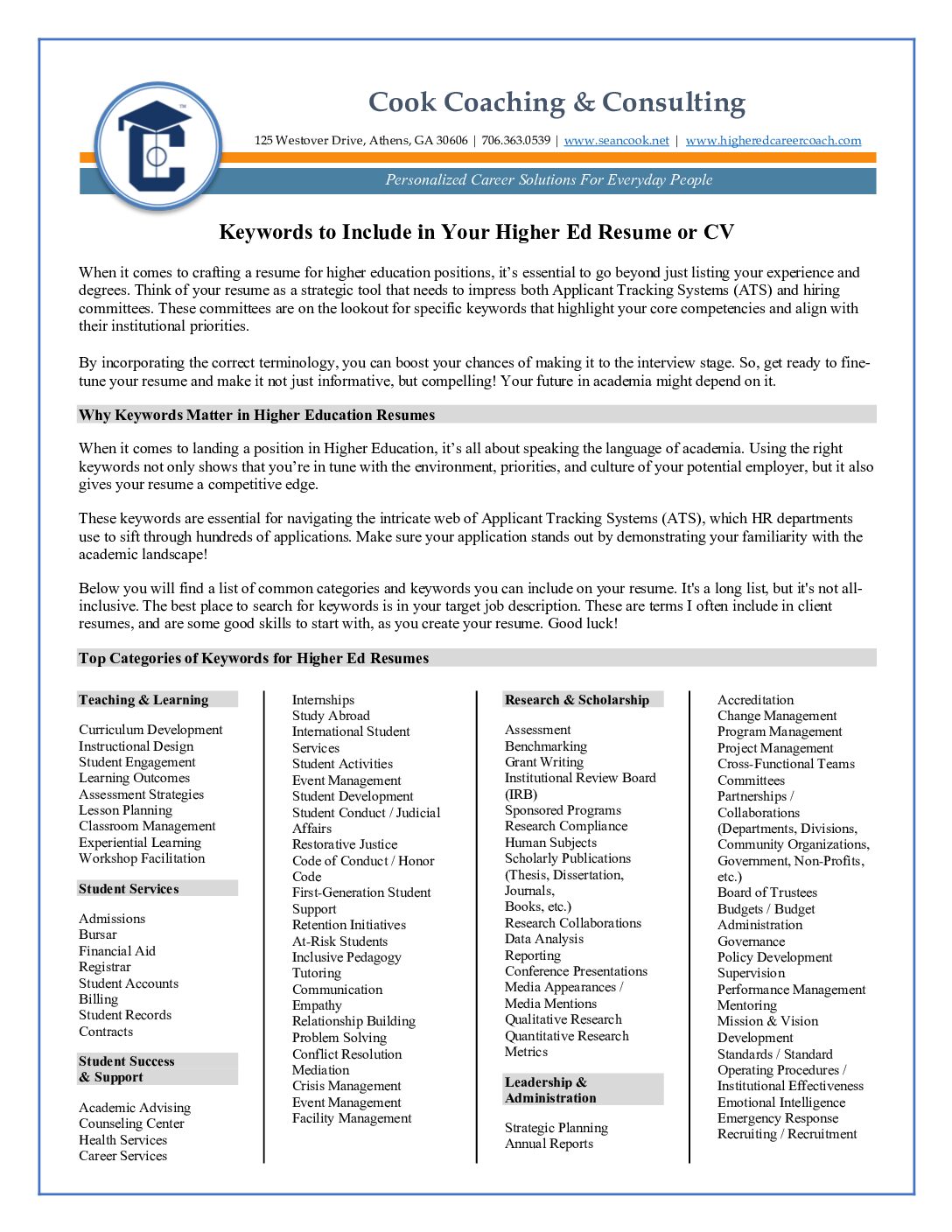
Keywords to Include in Your Higher Ed Resume or CV

Keywords to Include in Your Higher Ed Resume or CV

When it comes to crafting a resume for higher education positions, it’s essential to go beyond just listing your experience and degrees. Think of your resume as a strategic tool that needs to impress both Applicant Tracking Systems (ATS) and hiring committees. These committees are on the lookout for specific keywords that highlight your core competencies and align with their institutional priorities.

By incorporating the correct terminology, you can boost your chances of making it to the interview stage. So, get ready to fine-tune your resume and make it not just informative, but compelling! Your future in academia might depend on it.

Why Keywords Matter in Higher Education Resumes

When it comes to landing a position in Higher Education, it’s all about speaking the language of academia. Using the right keywords not only shows that you’re in tune with the environment, priorities, and culture of your potential employer, but it also gives your resume a competitive edge.

These keywords are essential for navigating the intricate web of Applicant Tracking Systems (ATS), which HR departments use to sift through hundreds of applications. Make sure your application stands out by demonstrating your familiarity with the academic landscape!

Below you will find a list of common categories and keywords you can include on your resume. It’s a long list, but it’s not all-inclusive. The best place to search for keywords is in your target job description. These are terms I often include in client resumes, and they are some good skills to start with, as you create your resume. Good luck!

Top Categories of Keywords for Higher Ed Resumes

Teaching & Learning

  • Curriculum Development
  • Instructional Design
  • Student Engagement
  • Learning Outcomes
  • Assessment Strategies
  • Lesson Planning
  • Classroom Management
  • Experiential Learning
  • Workshop Facilitation

Student Success & Support

  • Academic Advising
  • Counseling Center
  • Health Services
  • Career Services
  • Internships
  • Study Abroad
  • International Student Services
  • Student Activities
  • Event Management
  • Student Development
  • Student Conduct / Judicial Affairs
  • Restorative Justice
  • Code of Conduct / Honor Code
  • First-Generation Student Support
  • Retention Initiatives
  • At-Risk Students
  • Inclusive Pedagogy
  • Tutoring
  • Communication
  • Empathy
  • Relationship Building
  • Problem Solving
  • Conflict Resolution
  • Mediation
  • Crisis Management
  • Event Management
  • Facility Management

Student Services

  • Admissions
  • Bursar
  • Financial Aid
  • Registrar
  • Student Accounts
  • Billing
  • Student Records
  • Contracts

Research & Scholarship

  • Assessment
  • Benchmarking
  • Grant Writing
  • Institutional Review Board (IRB)
  • Sponsored Programs
  • Research Compliance
  • Human Subjects
  • Scholarly Publications (Thesis, Dissertation, Journals, Books, etc.)
  • Research Collaborations
  • Data Analysis
  • Reporting
  • Conference Presentations
  • Media Appearances / Media Mentions
  • Qualitative Research
  • Quantitative Research
  • Metrics

Leadership & Administration

  • Strategic Planning
  • Annual Reports
  • Accreditation
  • Change Management
  • Program Management
  • Project Management
  • Cross-Functional Teams
  • Committees
  • Partnerships / Collaborations (Departments, Divisions, Community Organizations, Government, Non-Profits, etc.)
  • Board of Trustees
  • Budgets / Budget Administration
  • Governance
  • Policy Development
  • Supervision
  • Performance Management
  • Mentoring
  • Mission & Vision Development
  • Standards / Standard Operating Procedures / SOPs
  • Institutional Effectiveness
  • Emotional Intelligence (EQ)
  • Emergency Response
  • Recruiting / Recruitment

Advancement & External Relations

  • Alumni Relations / Alumni Affairs
  • Community Outreach
  • Corporate Relations
  • Development
  • Donor Relations
  • Fundraising
  • Government Relations
  • Legal Affairs
  • Public Relations
  • Regulatory Compliance (ADA, FERPA, Title IX, EEO, etc.)

Diversity, Equity, & Inclusion (DEI)

  • Inclusive Excellence
  • Multicultural Programming
  • Equity Initiatives
  • Accessibility
  • Community Engagement
  • Cultural Sensitivity
  • Intercultural Communication
  • Culturally Responsive
  • Bias Mitigation
  • Employee Resource Groups
  • Campus Climate
  • Learning Environment
  • Work Environment
  • Stakeholder Engagement / Stakeholder Relations

Auxiliary & Business Services

  • Athletics
  • Bookstore
  • Campus Dining / Food Services
  • Catering
  • Housing / Residence Life / On-Campus Living
  • Marketing
  • Public Safety
  • Parking
  • Recreation / Intramurals
  • Document Services / Printing Services
  • Purchasing
  • Human Resources
  • Training / Training & Development
  • Facility Management

Technology & Innovation

  • Learning Management Systems (LMS) – Blackboard, Canvas, Moodle, Etc.
  • Online Course Design
  • Educational Technology
  • Data-Informed Decision Making
  • Virtual Learning Environments
  • Database Management
  • User Experience (UX)
  • Dashboard Development
  • Social Media Management
  • Google Analytics

Common Software and Web Platforms

  • Microsoft Office – Microsoft Word, Excel, PowerPoint, SharePoint, Teams, Microsoft 365
  • Google Apps (Google Workspace) – Google Docs, Sheets, Slides, Google Drive, Google Classroom
  • Design – Canva, Figma, Affinity Designer, Adobe Creative Suite – InDesign, Adobe Illustrator, Photoshop, Acrobat, Acrobat Reader, etc.
  • Meeting Platforms – Zoom, Google Meet, WebEx, Skype, GoToMeeting
  • Website Development: HTML, WordPress, Squarespace, Wix
  • Data Visualization – Tableau, PowerBI, Qlik, Google Looker
  • Data Collection and Management – Qualtrics, Access, SurveyMonkey, TypeForm
  • CRM: Slate, Salesforce Education Cloud, Ellucian CRM, Element 451, TargetX
  • Student Information Systems – Ellucian (Banner, Student), Workday Student, Jenzabar One, Salesforce Education Cloud, PeopleSoft Campus Solutions
  • Housing & Residence Life Platforms: StarRez, Entrata, eRezLife, Roompact, Creatrix Campus, SpaceBasic

Other Common Keywords

  • Adaptability
  • Analytical Mindset
  • Growth Mindset
  • Attention to Detail
  • Collaboration
  • Coordination
  • Critical Thinking
  • Time Management
  • Customer Service
  • Teamwork
  • Leadership
  • Team Leadership
  • Operations
  • Planning
  • Organizing / Organizational Skills
  • Continuous Improvement / Process Improvement / Process Optimization
  • Alignment
  • Negotiation
  • Assess(ed)
  • Manage(d)
  • Create(d)
  • Implement(ed)
  • Execute(d)
  • Develop(ed), Development
  • Critical Thinking
  • Increased
  • Decreased
  • Drove / Drive
  • Facilitate
  • Create(d) / Creative / Creativity
  • Networking
  • Present(ed) / Presentation(s)
  • Flexible
  • Work Independently / Minimal Supervision / Self-Directed/ Self-Motivated

How to Use These Keywords Effectively

  • Mirror the job posting: Adapt your resume by weaving in the exact terminology used in the description.
  • Be authentic: Only use keywords that accurately reflect your skills and experience.
  • Show impact: Combine keywords with measurable achievements (e.g., “Led curriculum development initiative that improved retention rates by 12%”).
  • Balance ATS and human readers: Don’t overstuff your resume; ensure it reads naturally and flows smoothly.

Final Thoughts:

Unlocking the next step in your higher education career begins with the right keywords—your ticket to capturing attention and making your resume shine. By crafting your document with intention and authenticity, you not only meet the expectations of today’s institutions but also showcase the unique value you bring. Approach your job search with confidence, knowing that each strategically chosen word brings you closer to new opportunities and professional growth. You’ve got this!

Great Resources for Higher Education Career Advice

If you would like this article as a handout, please support Higher Ed Career Coach by purchasing a PDF version below for $1.

Keywords to Include in Your Higher Ed Resume or CV

$1.00

Keywords to Include in Your Higher Ed Resume or CV

When it comes to crafting a resume for higher education positions, it’s essential to go beyond just listing your experience and degrees. Think of your resume as a strategic tool that needs to impress both Applicant Tracking Systems (ATS) and hiring committees. This document includes common categories and keywords you can include on your resume. If you would like to support this site, buy this document for $1.

Work with Sean Cook – Intelligent Career Strategies for Higher Education Professionals
. I help higher ed professionals take control of their careers with tailored services including resume and CV development, LinkedIn profile optimization and networking strategy, interview coaching, and one-on-one career guidance. Whether you’re pursuing advancement in academia or exploring opportunities beyond the campus, I provide the tools and strategies you need to thrive in today’s competitive job market. For more information, visit https://www.seancook.net/. You can read recommendations from previous clients on my LinkedIn profile at https://www.linkedin.com/in/seanccook/. To schedule your complimentary 30-minute consultation, please use the Calendly widget below.

Job Seeker Resources: Habits and Tactics

Job Seeker Resources: Habits and Tactics

Job Seekers: Read the resources or download the PDF below.

In my work, I have found that clients often ask very similar questions about how to approach certain parts of their job search.

 Sometimes, I write long email replies that I should turn into posts here or on my website. And then I customize an answer to the same question later. It takes a lot of time and isn’t very efficient.

I also find myself too bogged down to blog anymore. So I have taken some time to accept that I need not reinvent the wheel every time I’m asked a question. Also, there are so many good articles on the web that answer the questions effectively.

My new strategy is simple. I started making resource handouts with URLs for articles that answer common questions.

Sometimes people have a hard time keeping their job searches moving. Here is a new resource I made with articles about maintaining progress, dealing with emotions during a job search, and different approaches a jobseeker can take when searching.

#jobsearch #jobseeker #habits #tactics #careercoach #careeradvice #email #jobsearch #writing #coverletters #inquiryletters #followup

The text of the PDF and links are also included below.

Job Search Habits and Tactics

Tips to Keep Making Progress

5 Ways to Keep Your Job Search Progressing Despite A Shifting Market by Jessica Hernandez
https://www.linkedin.com/pulse/5-ways-keep-your-job-search-progressing-despite-jessica/?trk=pulse-articl

Five Steps You Can Take To Keep The Job Search Moving Forward Today by Scott Singer
https://www.insidercareerstrategies.com/blog/five-steps-you-can-take-to-keep-the-job-search-moving-forward-today

#OfficeHours: How to Get a Stalled Job Search Back on Track by Amanda Augustine
https://www.topresume.com/career-advice/how-to-get-a-stalled-job-search-unstuck

3 Great Activities To Keep Your Job Search Moving by Jessica Holbrook Hernandez and Aaron Sanborn
https://www.workitdaily.com/job-search-activities

Job Searching? 4 Steps To Take Before Diving In by TandyMGroup
https://blog.tandymgroup.com/career-job-search/job-searching-4-steps-to-take-before-diving-in/

14 Proven Job Search Tips for Finding a New Job [FAST!] by Yuri Khlystov
https://jobsandcareer.tips/job-search-tips-for-finding-new-job/

Dealing with Your Emotions

9 Tips to Help Reduce Job Search Anxiety by Jennifer Parris
https://www.flexjobs.com/blog/post/conquer-job-search-anxiety/

9 Tips for Finding Motivation for Your Job Search by Indeed Editorial Team
https://www.indeed.com/career-advice/finding-a-job/motivation-for-job-search

How To Stay Positive During A Long And Exhausting Job Search by Jack Kelly
https://www.forbes.com/sites/jackkelly/2020/08/17/how-to-stay-positive-during-a-long-and-exhausting-job-search/?sh=2faf8cb77991

5 Ways to Stay Motivated in Your Job Search by Rachel Parnes
https://www.linkedin.com/business/learning/blog/job-seeking-tips/5-ways-to-stay-motivated-in-your-job-search

Job search depression is real: Here’s how to overcome it by Maggie Wooll
https://www.betterup.com/blog/job-search-depression

Different Ways to Approach Your Search

9 Ways to Find a New Job by Janet Fowler
https://www.investopedia.com/financial-edge/0711/9-different-ways-to-find-a-new-job.aspx

The Job Search Process: 10 Tips on How to Land Your Dream Job (+3 Resume Examples) by Jenny Romanchuk
https://blog.hubspot.com/marketing/job-search-process

This Is How You Get on a Headhunter’s Radar (and Find Awesome Jobs) by Christopher Taylor
https://www.themuse.com/advice/this-is-how-you-get-on-a-headhunters-radar-and-find-awesome-jobs

Job Search: How To Find a Headhunter in 6 Steps (With Tips)
https://www.indeed.com/career-advice/finding-a-job/how-to-find-a-headhunter-to-get-you-a-job

This resource sheet was up to date as of January 11, 2023. If you find that any links are incorrect or no longer available, please email sean@seancook.net so I can correct the document or find new resources.
© 2023 Cook Coaching & Consulting, Athens, GA


Download a PDF of This Resource