Have a Question? Call Now.

(706) 363-0539

Higher Education Job Boards To Bookmark Today

Higher Education Job Boards To Bookmark Today

Finding the right job in higher education requires a strategic approach, focus, and access to the best platforms. Whether you are a faculty member, administrator, or student affairs professional, knowing where to look is half the battle. Here’s a curated list of highly effective higher education job boards, complete with links, target audiences, features, and publishers.


Higher Education Recruitment Consortium Logo

HERC Jobs
URL: hercjobs.org
Publisher: Higher Education Recruitment Consortium (HERC)
Audience: Faculty, administrators, and executives with a focus on diversity and inclusive hiring.
Features: Faculty, staff, and executive listings; dual-career support; resources for inclusive hiring.


HigherEdJobs
URL: higheredjobs.com
Publisher: HigherEdJobs, Inc.
Audience: Job seekers at all levels, from adjuncts to senior administrators.
Features: Comprehensive listings, resume upload, and career advice.


Inside Higher Ed – Careers
URL: careers.insidehighered.com
Publisher: Inside Higher Ed
Audience: Faculty, administrators, and student affairs staff.
Features: Job listings combined with news, commentary, and research on hiring institutions.

UniversityJobs.com
URL: universityjobs.com
Publisher: JobTarget, Inc.
Audience: Academics, researchers, and administrators worldwide.
Features: Faculty, post-doc, staff, and administrative positions with international listings.

Academic Keys Logo

AcademicKeys
URL: academickeys.com
Publisher: AcademicKeys, Inc.
Audience: Discipline-specific faculty and research professionals.
Features: Job listings by discipline; research, post-doc, and faculty opportunities.

Higher Ed 360 Logo

HigherEd360
URL: highered360.com
Publisher: HigherEd360
Audience: Faculty, staff, PhD candidates, and post-docs exploring academic careers.
Features: Job listings, institutional directories (2,600+ colleges/universities), CV/resume resources, and career advice.

Higher Ed Diversity Logo

HigherEd-Diversityhighered-diversity.com
Publisher: HigherEd-Diversity, Inc.
Audience: Underrepresented faculty and administrators.
Features: Diversity-focused postings, unlimited posting plans for institutions.

American Association of Hispanics in Higher Education Logo

AAHHE Job Boardaahhe.mcjobboard.net
Publisher: Association of American Hispanics in Higher Education (AAHHE)
Audience: Hispanic/Latino higher-ed professionals.
Features: Filterable faculty and administrative positions; job alerts.

Higher Education Resource Services logo

HERS Network Job Boardhersnetwork.org
Publisher: HERS Institute
Audience: Women and gender-diverse professionals in senior leadership.
Features: Leadership and executive positions; career development resources.

AHEPPP logo

AHEPPP Job Boardaheppp.memberclicks.net
Publisher: Association of Higher Education Parent/Family Programs & Personnel (AHEPPP)
Audience: Student affairs, family/parent programs, enrollment, and alumni relations professionals.
Features: Parent/family engagement, orientation, enrollment, and alumni roles.

NACUBO logo

NACUBO Career HQcareerhq.nacubo.org
Publisher: National Association of College and University Business Officers (NACUBO)
Audience: Business, finance, and administrative professionals.
Features: Campus business officer roles; resume submission; mid- to senior-level positions.

American Educational Research Association logo

AERA Online Job Boardcareers.aera.net
Publisher: American Educational Research Association (AERA)
Audience: Education researchers, policy scholars, and doctoral/post-doc candidates.
Features: Academic research positions with resume upload and job alerts.

CommunityCollegeJobs.comcommunitycollegejobs.com
Publisher: CommunityCollegeJobs.com
Audience: Two-year college faculty, staff, administrators, and executives.
Features: State-by-state search; faculty and administrative postings.

AdjunctWorldadjunctworld.com
Publisher: AdjunctWorld, Inc.
Audience: Online adjunct instructors and remote teaching professionals.
Features: Curated online teaching jobs and certificate courses to strengthen applications.


The Placement Exchange – https://www.theplacementexchange.org/
Publisher: NASPA (Student Affairs Administrators in Higher Education) and ACUHO-I (Association of College and University Housing Officers – International).
Audience: Early to mid-career student affairs professionals.
Features: Job board, resources for job seekers and employers, communication, and interview scheduling features.

ACPA Career Centercareers.myacpa.org
Publisher: American College Personnel Association (ACPA)
Audience: Campus life and student development staff.
Features: Student affairs, counseling, diversity, inclusion, and engagement roles.

StudentAffairs.Com Job Boardhttps://www.studentaffairs.com/jobs/
Publisher: StudentAffairs.Com
Audience: Residence life, orientation, student engagement, and other Student Affairs job seekers
Features: Student Affairs job postings, Free Resume Posting Service


Next Step:
Create accounts on 3–5 of these boards today and subscribe to email alerts.
You’ll be ahead of other candidates in landing your next higher education role.

Download a version of this information in an Excel Workbook (contains hyperlinks).

More on Hiring Cycles: Planning Your Student Affairs Job Search

More on Hiring Cycles: Planning Your Student Affairs Job Search

Earlier this month, we covered the importance of understanding typical academic hiring cycles when searching for faculty roles. It’s equally important while searching for a job in Student Affairs, but the rhythm of the year is a bit different.

As noted in the previous article, academia operates on a relatively predictable schedule, and job postings are tied closely to the academic calendar. Most institutions plan their staffing needs well in advance of the upcoming academic year.

Open Season: The Job Hunt Begins! Late Winter to Early Spring (January – May)

While fall is the peak season for faculty jobs, late winter to early spring (January through May) is the busiest hiring period for employment in Student Affairs. Most institutions examine their staffing needs between the end of one year and the beginning of the next, and plan to fill vacancies by late summer and early fall.

Job seekers can expect to start seeing job postings for the next academic year by January or February. Working backward, this means that individuals seeking a new role should refine their resumes and LinkedIn profiles, line up their references, and begin planning and budgeting in late fall or early winter (October through December) for a busy interview season, which typically picks up in March and April. Professional Associations like NASPA and ACPA hold their annual conferences, providing opportunities for networking. Some regional associations also post career resources and events on their websites, for those with geographic preferences.

TPE, The Placement Exchange, a joint venture of NASPA and ACUHO-I, is a virtual platform where job seekers can research opportunities, apply for vacancies, and have multiple interviews. Marketed as a resource for graduate students and early-to-mid-career professionals, TPE enables employers to set up virtual career booths and offer recruiting information, videos, documents, and links to institution-specific resources, including their institution’s job posting site and benefits information. Employers can post open jobs, receive applications, view applicants, message them, and schedule and conduct interviews through the TPE platform.

Candidates participating in TPE can attend a virtual career fair, schedule interviews during a designated scheduling week, and participate in interviews during a dedicated interview week. Registration for 2026 Virtual Placement begins on December 1, and TPE Virtual Placement dates are February 13 and February 23-27, 2026. For more information, visit the Virtual Placement page on the TPE website.


Phase 2: Interview Season
(March and April)

The next phase of the annual Student Affairs hiring cycle begins in March and April. By this time, many institutions have conducted initial screening interviews and started inviting candidates for second-round interviews. The way interviews unfold during this phase varies. For some positions, particularly early-career roles, the second interview may be the final interview. For more specialized roles and senior positions, the interview process may include different stages and include meetings with various campus stakeholders, including senior management. If an employer doesn’t provide clear explanations of the interview process and hiring timeline, candidates should request this information so they can plan their travel and work around other interview opportunities.

Phase 3: Offers and Acceptances (May through June)

For candidates, the next phase begins and (hopefully) rewards them for all their hard work. By May and June, many employers extend offers, especially for roles that start onboarding and staff training in July. This is common for Residence Life and other areas that welcome students to campus and support student activities and events that take place early in the academic year, such as Orientation, Student Activities, and Greek Life.

The Second Wave:
July Through October

What happens next? A second wave occurs in response to the departure of staff who accepted new opportunities. Many universities begin their fiscal years on July 1st and some do not advertise positions until the new fiscal year starts. Institutions will continue to post new vacancies in late summer through early fall (July through October).

In July and August, “Just-in-Time” hiring takes place to fill positions created by last-minute resignations or newly approved roles before the start of the fall semester. When I worked in Residence Life, I referred to this stage as the time we had a “warm body problem”: we needed to start the year strong, and (facetiously) this meant that we would hire any “warm body” to fill the vacancy. This is an oversimplification. Res Life folks often use sardonic comments to survive the challenges of the professional staff training-student staff training- orientation leader training-residence hall opening-welcome-week-and-everything-else season that ramps up in July and ends in exhaustion (or at some point in October).

Anyway, we wouldn’t take just any “warm body.” We would, however, consider less experienced candidates who showed promise, seemed trainable, and were ready and raring to go. Many of my best staff members joined the department during this time. If you end up being a “second wave” hire, don’t beat yourself up. You weren’t hired late because you weren’t competitive. You were hired late because you had the endurance to keep going.

The End

At the end of this phase, in September and October, there are fewer job postings, many of which are for specialized roles or unexpected vacancies. The academic year gathers steam, and eventually, the hiring cycle for the following year’s vacancies begins. If you are still looking for a job, know that being the best available option is a good thing. Keep the faith, and your opportunity will come. You’ll know your final destination when you get to the “end of the line.”

Some Final Thoughts


      • Be prepared for a long process. Due to committee approvals, university bureaucracy, and the need to coordinate multiple schedules, the timeline from application to an offer can take 4 to 6 weeks or longer.

      • October through December: Prepare your resume and optimize your LinkedIn profile. Line up your references. Plan your budget to be prepared for networking, placement events, and travel.

      • Begin your active search in January and prioritize high-volume application submissions and conference attendance through May to hit the primary cycle

      • If you can afford to attend conferences early in the year, use them as opportunities to meet other professionals, support other job seekers, and network. New connections can lead to new opportunities.

      • Participate in TPE. It is a structured, high-volume environment where candidates can complete multiple screening interviews with institutions in just a few days.

      • Be on the lookout for regional placement events or conferences. Smaller events may offer you opportunities to stand out in a smaller crowd. This is especially important if you are regionally bound.

      • If you are interested in a specific institution, visit their hiring page frequently in late Spring and early Summer. Many universities begin their fiscal years on July 1 and typically do not advertise positions until the new fiscal year starts.

    Job Seeker Resources: Habits and Tactics

    Job Seeker Resources: Habits and Tactics

    Job Seekers: Read the resources or download the PDF below.

    In my work, I have found that clients often ask very similar questions about how to approach certain parts of their job search.

     Sometimes, I write long email replies that I should turn into posts here or on my website. And then I customize an answer to the same question later. It takes a lot of time and isn’t very efficient.

    I also find myself too bogged down to blog anymore. So I have taken some time to accept that I need not reinvent the wheel every time I’m asked a question. Also, there are so many good articles on the web that answer the questions effectively.

    My new strategy is simple. I started making resource handouts with URLs for articles that answer common questions.

    Sometimes people have a hard time keeping their job searches moving. Here is a new resource I made with articles about maintaining progress, dealing with emotions during a job search, and different approaches a jobseeker can take when searching.

    #jobsearch #jobseeker #habits #tactics #careercoach #careeradvice #email #jobsearch #writing #coverletters #inquiryletters #followup

    The text of the PDF and links are also included below.

    Job Search Habits and Tactics

    Tips to Keep Making Progress

    5 Ways to Keep Your Job Search Progressing Despite A Shifting Market by Jessica Hernandez
    https://www.linkedin.com/pulse/5-ways-keep-your-job-search-progressing-despite-jessica/?trk=pulse-articl

    Five Steps You Can Take To Keep The Job Search Moving Forward Today by Scott Singer
    https://www.insidercareerstrategies.com/blog/five-steps-you-can-take-to-keep-the-job-search-moving-forward-today

    #OfficeHours: How to Get a Stalled Job Search Back on Track by Amanda Augustine
    https://www.topresume.com/career-advice/how-to-get-a-stalled-job-search-unstuck

    3 Great Activities To Keep Your Job Search Moving by Jessica Holbrook Hernandez and Aaron Sanborn
    https://www.workitdaily.com/job-search-activities

    Job Searching? 4 Steps To Take Before Diving In by TandyMGroup
    https://blog.tandymgroup.com/career-job-search/job-searching-4-steps-to-take-before-diving-in/

    14 Proven Job Search Tips for Finding a New Job [FAST!] by Yuri Khlystov
    https://jobsandcareer.tips/job-search-tips-for-finding-new-job/

    Dealing with Your Emotions

    9 Tips to Help Reduce Job Search Anxiety by Jennifer Parris
    https://www.flexjobs.com/blog/post/conquer-job-search-anxiety/

    9 Tips for Finding Motivation for Your Job Search by Indeed Editorial Team
    https://www.indeed.com/career-advice/finding-a-job/motivation-for-job-search

    How To Stay Positive During A Long And Exhausting Job Search by Jack Kelly
    https://www.forbes.com/sites/jackkelly/2020/08/17/how-to-stay-positive-during-a-long-and-exhausting-job-search/?sh=2faf8cb77991

    5 Ways to Stay Motivated in Your Job Search by Rachel Parnes
    https://www.linkedin.com/business/learning/blog/job-seeking-tips/5-ways-to-stay-motivated-in-your-job-search

    Job search depression is real: Here’s how to overcome it by Maggie Wooll
    https://www.betterup.com/blog/job-search-depression

    Different Ways to Approach Your Search

    9 Ways to Find a New Job by Janet Fowler
    https://www.investopedia.com/financial-edge/0711/9-different-ways-to-find-a-new-job.aspx

    The Job Search Process: 10 Tips on How to Land Your Dream Job (+3 Resume Examples) by Jenny Romanchuk
    https://blog.hubspot.com/marketing/job-search-process

    This Is How You Get on a Headhunter’s Radar (and Find Awesome Jobs) by Christopher Taylor
    https://www.themuse.com/advice/this-is-how-you-get-on-a-headhunters-radar-and-find-awesome-jobs

    Job Search: How To Find a Headhunter in 6 Steps (With Tips)
    https://www.indeed.com/career-advice/finding-a-job/how-to-find-a-headhunter-to-get-you-a-job

    This resource sheet was up to date as of January 11, 2023. If you find that any links are incorrect or no longer available, please email sean@seancook.net so I can correct the document or find new resources.
    © 2023 Cook Coaching & Consulting, Athens, GA


    Download a PDF of This Resource

    The Applicant’s Role in the Screening Process

    The Applicant’s Role in the Screening Process

    What can a candidate do to affect the outcome of the screening process? Not much. You can’t set the search criteria for an employer. You can’t make screeners meticulously follow the criteria they have. And you can’t eliminate bias.

    You can only present a coherent argument and make sure that it highlights what you have to offer in relation to the position and the needs of an employer.

    How can you describe, explain, or imply a high degree of fit between you/your skills and the needs of your potential employer?
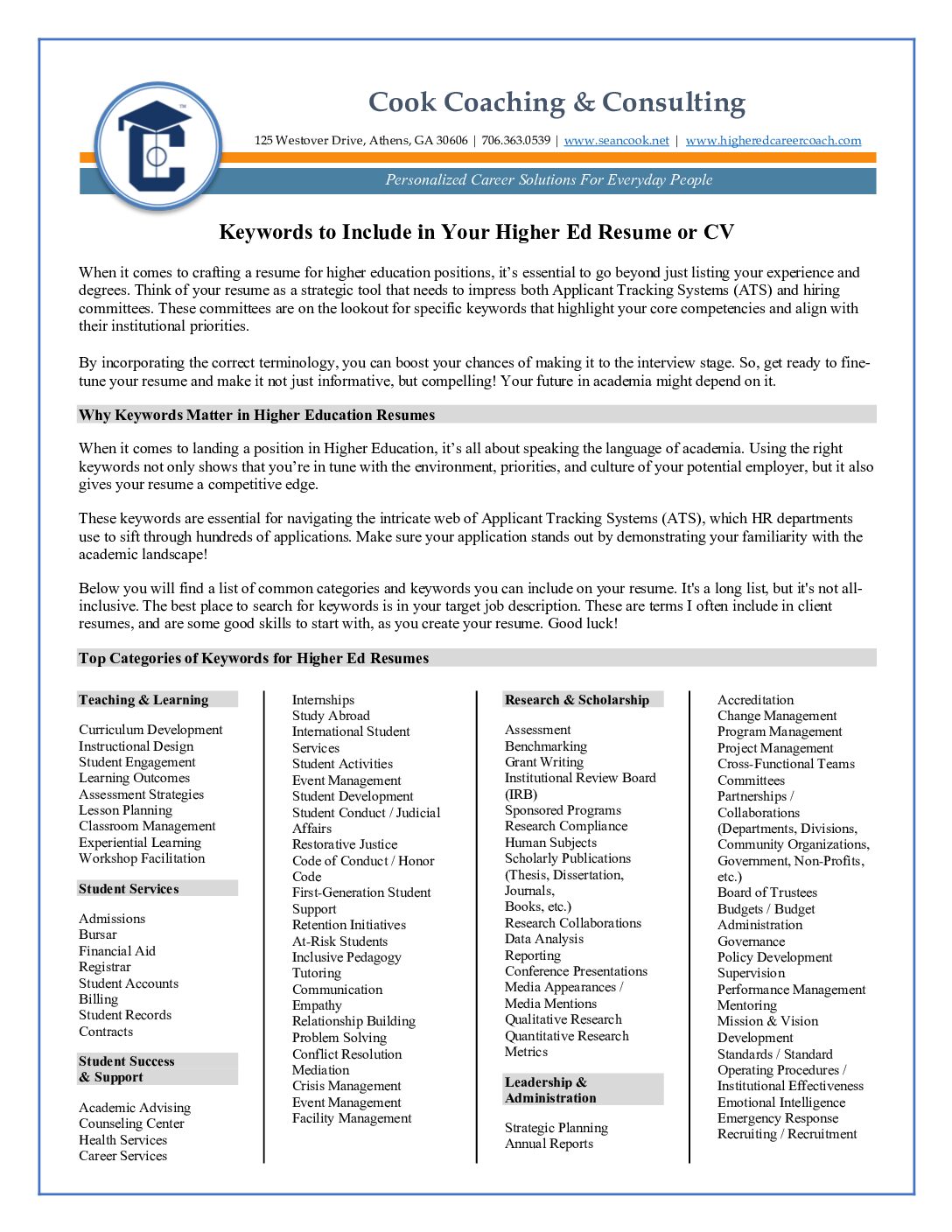
    It will not be through the use of buzzwords. It will be through the use of keywords. And the best way to discover the most relevant keywords is to study the employer, read the position description or advertisement carefully, and pull out those elements that seem most important. This introduces the value of “word-farming.”

    There are some great tools out there that can help you distill a job description down to the most important keywords. We’ll delve into them in a later post. For now, let’s start at the beginning. If you are going to make a coherent argument, you have to do one thing first…

    Know Your Goal

    Have you ever heard the term “He couldn’t hit the side of a barn?”
     It implies a lack of precision and lack of focus.

    How about “shooting from the hip?”
    It implies that a person engages in hasty, gut-level reactions, rather than taking carefully-considered and well-planned actions in an attempt to reach a goal.
    Let’s consider these metaphors and attempt to apply them to our thinking about the job search process.

    How specific is your job target? Is it the side of a barn, or the barn window?

    You see, shooting at the side of a barn is a really aimless activity. It doesn’t take much talent. You could almost do so by accident. Bored teenagers shoot paintballs at the side of a barn for something to do. A serious marksman wouldn’t bother. A marksman would shoot out the windows (or maybe the lights!)

    If you ever shot from the hip, it was probably during a moment of reaction, when you had your guard down, felt attacked or confronted, and responded immediately, in a way designed to help you deflect the arguments of your attacker, or to escape from an unpleasant situation. Is that really any way to approach your job search? Some job seekers browse job postings without specific job titles, employers, roles, or responsibilities in mind, taking an “I’ll know the right job when I see it” sort of attitude. If you aren’t imagining an ideal job or ideal roles, you’ll be less able to coherently present your arguments, and when interview time comes (if you are that lucky), you’ll be responding to questions in the same way. Shooting from the hip is a terrible way to interview.

    Aimless is as Aimless Does.

    I have a piece of paper tacked to the bulletin board above my desk that reads “Aimless is as aimless does.” It reminds me to set specific goals to hold myself accountable for reaching them.

    Notice that the key point is that your goal must be specific.

    Aim for a bullseye, not a barn.

    Would you really be happy just having any random job? Probably not.

    You might get by. You might pay your bills. You might even be able to do so for quite a while. But don’t you deserve more?

    Know Yourself First

    You are a unique person. No one else has seen the world through your eyes. No one else can bring the exact same mix of qualities to the table.

    There is a job out there that you are a perfect match for. And you aren’t going to find it if you view every opportunity equally.

    If you are going to have a great résumé, you need to have a goal in mind. My belief is that your goal should be to find an ideal job. Not just any job, but a job that is a good match for your education, skills, interests, and motivation.

    When I talk to clients who have been looking for an extended period, I usually see a common thread: lack of focus. They are shooting at the side of a barn, and wondering why no one’s giving out marksmanship trophies!

    So set a good goal. Make it as specific as possible (we’ll talk more about how to do this in a later post). And understand that you may not reach it.

    But, as Benjamin May once said:
    “The tragedy in life does not lie in not reaching your goal. The tragedy lies in having no goal to reach.”

    The FreeNote: Thoughts on Working in Student Affairs (Podcast)

    The FreeNote: Thoughts on Working in Student Affairs (Podcast)

    Retro MicrophoneThe Higher Ed Career Coach Show with Sean Cook returns today with a “freenote” (free keynote) for student affairs professionals. Suitable for using in training meetings or team development, if you don’t have the time or money to hire me or another speaker to kick off your fall training. Look for a video version and downloadable handouts and script soon here at the site.

    Based on parting thoughts I shared with colleagues in Residence Life upon my departure in Fall 2009, the “FreeNote” gives a dozen brief lessons culled from over 15 years working in student affairs.

    Professionals (new and not-so-new) will appreciate the perspectives and hopefully the humor herein. If not, they may at least find something worth disagreeing with.

    This episode features pre-recorded content. The live show will return later in July or early August.

    Notice: This episode is best suited to adult listeners and contains a couple of instances of mildly coarse language. Nothing too crazy, but it’s probably best to listen yourself before playing for the whole staff.

    A Note From the Author:

    Hello Student Affairs Colleagues. Right now many of you are either planning or starting your professional staff training, depending on your institution’s academic calendar. I remember how tough it was to fill the schedule with worthwhile activities, so over the next month or so, I’m going to share content on my website and podcast that you can hopefully use in staff training. The first piece is this week’s podcast, which I am calling a “FreeNote” (free keynote), where I share some thoughts and perspectives on working in Student Affairs. I also plan to post outlines for some of the better staff discussions I had during training, and maybe even later, I might share some RA training and orientation activities. I hope you can use this stuff. I’ll be making some downloads available soon, and possibly a brief video of this same talk.
    (Length: 10 minutes)