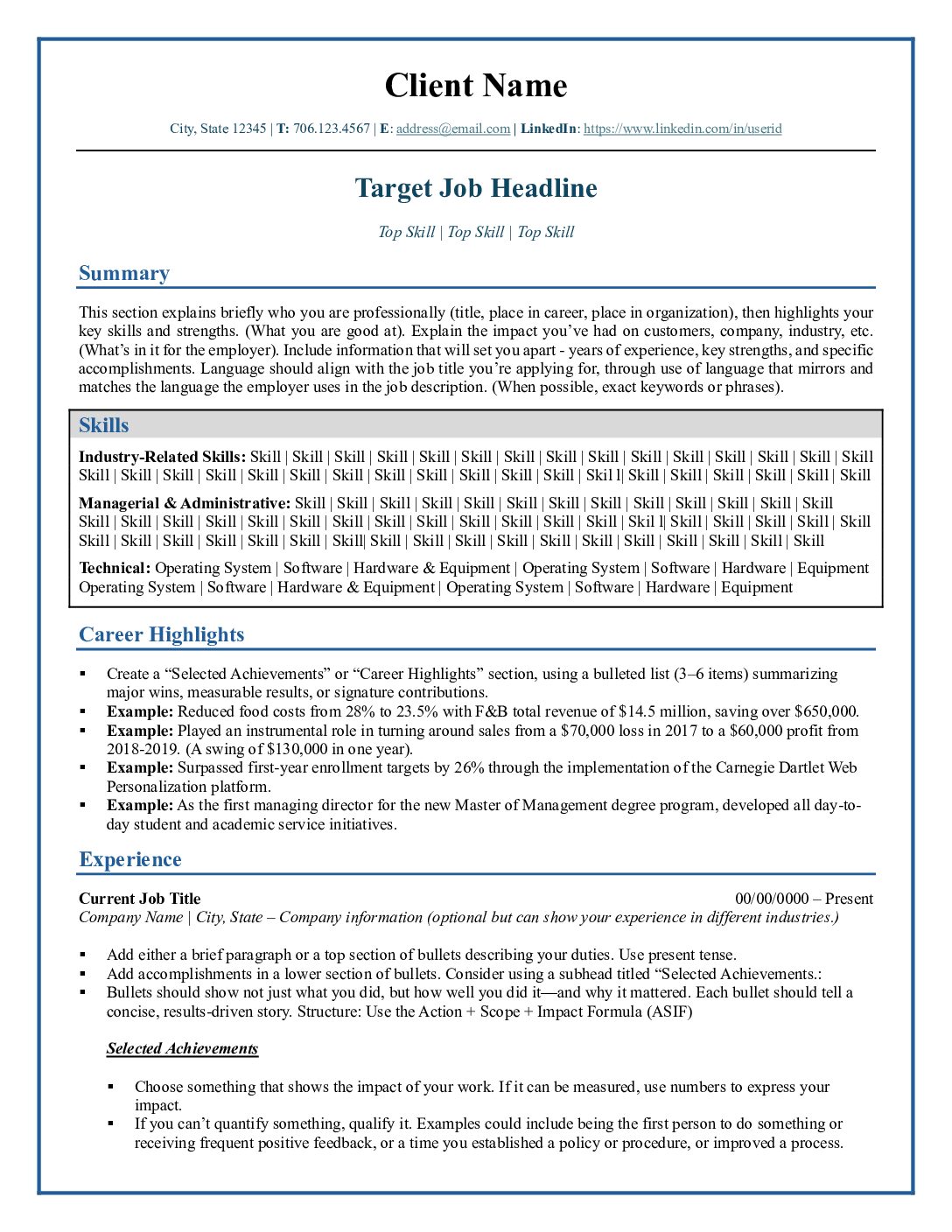
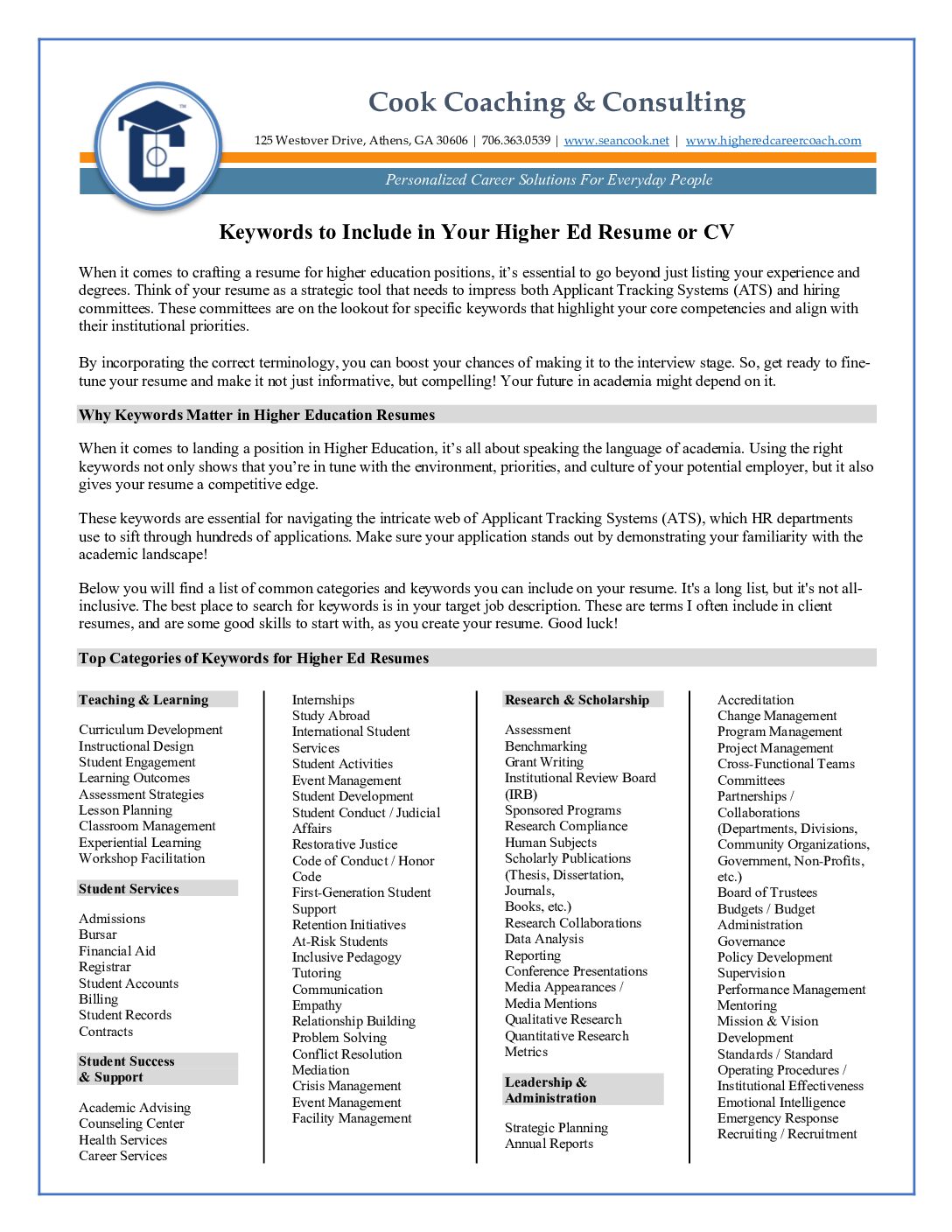
September marks the beginning of a new academic year. It's also when Career Directors International observes Update Your Résumé Month. For higher education professionals, this is an especially useful time to review your résumé or curriculum vitae and ensure it reflects where you are now and where you may want to go next.
Many student affairs and administrative professionals begin new positions during the summer or early fall. Faculty members may also be settling into a new academic year just as institutions begin searches for positions starting the following fall.
Whether you recently changed roles or have begun wondering if it is time for a change in venue, title, compensation, or responsibilities, do not wait for the perfect opening to appear before updating your materials. Opportunities can surface unexpectedly as institutions respond to summer and fall departures.
Here are five important steps you can take now.
1. Add Your New Position—or Update Your Current One
If you started the academic year in a new role, add your title, institution, division or department, location, and start date to your résumé or CV.
You may not have accomplishments to report yet, but you can briefly establish the position’s scope.
Consider including:
The students, programs, or academic units you serve
The size and composition of your staff
Your budgetary or operational responsibilities
The programs, services, courses, or research you oversee
Your role in assessment, accreditation, retention, enrollment, or institutional initiatives
Any committees, task forces, or cross-campus partnerships you have joined
If you remained in the same position but absorbed new duties, determine whether your current job description still reflects the work you are actually doing. Increased responsibility does not always come with a new title. Your résumé should still capture that growth.
2. Start an Accomplishment Record for the New Academic Year
Do not wait until next summer to reconstruct what happened this year. Create a simple document or spreadsheet and update it regularly.
Track new responsibilities, projects, problems solved, positive feedback, presentations, committee work, program results, publications, grants, awards, and other contributions. Record useful details while they are still available, including:
Numbers of students, faculty members, staff, programs, or departments served
Changes in participation, retention, completion, enrollment, or satisfaction
Budgets administered or funding secured
Programs developed, expanded, or improved
Processes made more efficient
Partnerships created across departments or with external organizations
Interim assignments or duties performed beyond your formal position
Faculty members should also record new courses and preparations, publications and manuscripts, conference activity, grants, research progress, student mentoring, service, and leadership contributions.
The goal is not to inflate your record. It is to capture enough context to explain the significance of your work later.
3. Decide Whether This Academic Year Should Be a Transition Year
The beginning of a new academic year can clarify what you want—and what you no longer want—from your career.
You may be ready for a different institution, a higher-level title, better compensation, broader leadership responsibilities, a healthier environment, or work that is more closely aligned with your interests and values.
Ask yourself:
What do I want to be different by the start of the next academic year?
Which parts of my current role energize me?
Which responsibilities have I outgrown?
What evidence demonstrates that I am ready for the next level?
What gaps might I need to address before applying?
You do not have to decide immediately that you are leaving. Updating your materials gives you options. It also helps you identify experiences you should pursue now to strengthen your candidacy later.
4. Optimize Your Résumé for Applicant Tracking Systems
Higher education may value tradition, but its hiring systems are increasingly digital. Many institutions use applicant tracking systems to collect applications and help search committees or human resources staff review candidate materials.
To make your résumé easier for both technology and people to evaluate:
Use familiar headings such as Summary, Skills, Professional Experience, and Education.
Incorporate relevant terminology from the position announcement naturally.
Connect your experience directly to the institution’s stated responsibilities and qualifications.
Use a clean, consistent structure.
Avoid placing essential information only inside graphics, text boxes, headers, or footers.
Spell out important higher education abbreviations at least once.
Follow the institution’s application instructions carefully.
ATS optimization is not keyword stuffing. It means using the employer’s language to accurately describe qualifications you genuinely possess.
Faculty applicants should also carefully distinguish among the documents requested. A CV, cover letter, research statement, teaching statement, and diversity or student-success statement serve different purposes and should not simply repeat the same information.
5. Prepare Your Faculty CV Before Search Season Accelerates
Many institutions begin faculty searches in the fall for appointments starting the following academic year. This longer timeline allows departments to conduct national searches, bring promising candidates to campus, complete approvals, and give the selected candidate time to make a clean transition.
That means faculty members should have their CVs ready now.
Review the organization and completeness of your:
Education and academic appointments
Publications and works in progress
Research interests and projects
Grants and funded activity
Teaching experience and course development
Presentations and invited talks
Student mentoring
Academic and professional service
Awards, honors, and professional affiliations
Departmental, institutional, and disciplinary leadership
A strong faculty CV does more than list activity. Its organization should make the trajectory and significance of your scholarship, instruction, research, service, and leadership easier to recognize.
Prepare Before the Opportunity Appears
You may not know when a colleague’s departure, a newly funded position, a reorganization, or an unexpected vacancy will create the right opening. Preparing now allows you to evaluate that opportunity thoughtfully, rather than rushing to update years of material before a deadline.
Choose one manageable step this month:
Add your new role
Revise your current position
Create an accomplishment tracker
Review three target announcements, or
Update one major section of your CV.
If your résumé or CV no longer reflects the scope of your work—or if you are having difficulty translating a complex higher-education career into a clear, compelling message—I can help.
For more than 16 years, I have helped higher education professionals and faculty members update their résumés and CVs, clarify their career direction, and highlight significant achievements in scholarship, instruction, research, administration, and leadership. My services can help you assemble your materials efficiently, position your experience appropriately, and prepare for opportunities that may emerge throughout the academic year.
Visit SeanCook.net to learn more about my professional résumé and CV writing, coaching, LinkedIn, and interview coaching packages.
Refine your message. Prove your impact. Get hired.
Join the Intelligent Career Strategies List and Receive My Higher Ed Achievement Tracker and More!
Thanks for reading! Join my mailing list, Intelligent Career Strategies, to receive career planning articles, resources, and strategies, including my Higher Ed Achievement Tracker.
When You Sign Up, You'll Receive:
My Higher Ed Achievement Tracker
A 12-part Welcome Series, with messages on
Resume writing and optimization
Understanding applicant tracking systems,
PLanning a career change,
Using LinkedIn effectively, preparing for job interviews,
And MORE!
It's also packed with activities and worksheets to help you prepare your job search materials, hone your interview answers, and tell your professional story.
Once you complete the Welcome Series, you'll continue to receive articles from HigherEdCareerCoach.Com members-only resources, and regular opportunities to interact with me, one-on-one. Use the form below to receive the Career Achievement Tracker and the Welcome Series.
Join Our Mailing List
Receive articles, career strategies, and career planning resources,
including the Higher Education Achievement Tracker.
Earlier this month, we covered the importance of understanding typical academic hiring cycles when searching for faculty roles. It's equally important while searching for a job in Student Affairs, but the rhythm of the year is a bit different.
As noted in the previous article, academia operates on a relatively predictable schedule, and job postings are tied closely to the academic calendar. Most institutions plan their staffing needs well in advance of the upcoming academic year.
Open Season: The Job Hunt Begins! Late Winter to Early Spring (January – May)
While fall is the peak season for faculty jobs, late winter to early spring (January through May) is the busiest hiring period for employment in Student Affairs. Most institutions examine their staffing needs between the end of one year and the beginning of the next, and plan to fill vacancies by late summer and early fall.
Job seekers can expect to start seeing job postings for the next academic year by January or February. Working backward, this means that individuals seeking a new role should refine their resumes and LinkedIn profiles, line up their references, and begin planning and budgeting in late fall or early winter (October through December) for a busy interview season, which typically picks up in March and April. Professional Associations like NASPA and ACPA hold their annual conferences, providing opportunities for networking. Some regional associations also post career resources and events on their websites, for those with geographic preferences.
TPE, The Placement Exchange, a joint venture of NASPAand ACUHO-I, is a virtual platform where job seekers can research opportunities, apply for vacancies, and have multiple interviews. Marketed as a resource for graduate students and early-to-mid-career professionals, TPE enables employers to set up virtual career booths and offer recruiting information, videos, documents, and links to institution-specific resources, including their institution's job posting site and benefits information. Employers can post open jobs, receive applications, view applicants, message them, and schedule and conduct interviews through the TPE platform.
Candidates participating in TPE can attend a virtual career fair, schedule interviews during a designated scheduling week, and participate in interviews during a dedicated interview week. Registration for 2026 Virtual Placement begins on December 1, and TPE Virtual Placement dates are February 13 and February 23-27, 2026. For more information, visit the Virtual Placement page on the TPE website.
Phase 2: Interview Season (March and April)
The next phase of the annual Student Affairs hiring cycle begins in March and April. By this time, many institutions have conducted initial screening interviews and started inviting candidates for second-round interviews. The way interviews unfold during this phase varies. For some positions, particularly early-career roles, the second interview may be the final interview. For more specialized roles and senior positions, the interview process may include different stages and include meetings with various campus stakeholders, including senior management. If an employer doesn't provide clear explanations of the interview process and hiring timeline, candidates should request this information so they can plan their travel and work around other interview opportunities.
Phase 3: Offers and Acceptances (May through June)
For candidates, the next phase begins and (hopefully) rewards them for all their hard work. By May and June, many employers extend offers, especially for roles that start onboarding and staff training in July. This is common for Residence Life and other areas that welcome students to campus and support student activities and events that take place early in the academic year, such as Orientation, Student Activities, and Greek Life.
The Second Wave: July Through October
What happens next? A second wave occurs in response to the departure of staff who accepted new opportunities. Many universities begin their fiscal years on July 1st and some do not advertise positions until the new fiscal year starts. Institutions will continue to post new vacancies in late summer through early fall (July through October).
In July and August, "Just-in-Time" hiring takes place to fill positions created by last-minute resignations or newly approved roles before the start of the fall semester. When I worked in Residence Life, I referred to this stage as the time we had a "warm body problem": we needed to start the year strong, and (facetiously) this meant that we would hire any "warm body" to fill the vacancy. This is an oversimplification. Res Life folks often use sardonic comments to survive the challenges of the professional staff training-student staff training- orientation leader training-residence hall opening-welcome-week-and-everything-else season that ramps up in July and ends in exhaustion (or at some point in October).
Anyway, we wouldn't take just any "warm body." We would, however, consider less experienced candidates who showed promise, seemed trainable, and were ready and raring to go. Many of my best staff members joined the department during this time. If you end up being a "second wave" hire, don't beat yourself up. You weren't hired late because you weren't competitive. You were hired late because you had the endurance to keep going.
The End
At the end of this phase, in September and October, there are fewer job postings, many of which are for specialized roles or unexpected vacancies. The academic year gathers steam, and eventually, the hiring cycle for the following year's vacancies begins. If you are still looking for a job, know that being the best available option is a good thing. Keep the faith, and your opportunity will come. You'll know your final destination when you get to the "end of the line."
Some Final Thoughts
Be prepared for a long process. Due to committee approvals, university bureaucracy, and the need to coordinate multiple schedules, the timeline from application to an offer can take 4 to 6 weeks or longer.
October through December: Prepare your resume and optimize your LinkedIn profile. Line up your references. Plan your budget to be prepared for networking, placement events, and travel.
Begin your active search in January and prioritize high-volume application submissions and conference attendance through May to hit the primary cycle
If you can afford to attend conferences early in the year, use them as opportunities to meet other professionals, support other job seekers, and network. New connections can lead to new opportunities.
Participate in TPE. It is a structured, high-volume environment where candidates can complete multiple screening interviews with institutions in just a few days.
Be on the lookout for regional placement events or conferences. Smaller events may offer you opportunities to stand out in a smaller crowd. This is especially important if you are regionally bound.
If you are interested in a specific institution, visit their hiring page frequently in late Spring and early Summer. Many universities begin their fiscal years on July 1 and typically do not advertise positions until the new fiscal year starts.
The question of whether working in higher education is “worth it” has never been more complex. Academia has long been considered a bastion of stability—a place where skilled educators and administrators could build long, secure careers.
Today's shifting landscape, marked by declining enrollment, funding hurdles, and a rapidly changing academic job market, has many educators and administrators questioning whether the traditional promise of a secure career still holds true. This shifting reality raises pressing concerns and makes the future of careers in higher ed feel more uncertain than ever before.
According to the Bureau of Labor Statistics, employment of postsecondary education administrators is projected to grow 3 percent from 2023 to 2033, slightly below the average for all occupations at 4%. On average, about 15,200 openings for postsecondary education administrators are projected each year from now until 2033. At the current pace, only 6,200 new positions are expected to be added by 2033. In contrast, the BLS projects that the growth of other management occupations during the same period will be double that rate, at 6%, resulting in 227,600 new positions. For context, the total number of postsecondary education administrators in the U.S. in 2023 was 216,400. For educators ready for a change, the opportunities are out there.
The Erosion of Traditional Stability.
Tenure-track positions once represented the gold standard in job security. Today, institutions increasingly rely on adjunct faculty and temporary contracts. This trend, driven in part by budget cuts and institutional restructuring, has created uncertainty about job security, even for those with long-established roles.
According to a “data snapshot” in Academe Magazine, the U.S. academic workforce has undergone a significant shift, transitioning from a majority of full-time, tenured, or tenure-track faculty to a primarily contingent workforce. This includes full-time non-tenure-track instructors, those in positions with no tenure system, and part-time faculty. In Fall 2021, over two-thirds (68 percent) of faculty members at U.S. colleges and universities held contingent positions, compared to about 47 percent in Fall 1987. Furthermore, nearly half (48 percent) of faculty members were employed part-time in Fall 2021, up from about 33 percent in 1987. Only 24 percent of faculty members held full-time tenured appointments in Fall 2021, down from about 39 percent in Fall 1987. This shift underscores the need for professionals to be adaptable and open to new opportunities.
Similarly, technological advancements, shifting demographics, and changing economic conditions are driving the need for analysts who can evaluate trends and develop strategies for student enrollment and retention.
As higher education institutions rely more on data to enhance student outcomes, optimize resource allocation, and improve overall efficiency, the demand for Institutional Research Analysts is projected to grow by 23% by 2033.
The Importance of Transferable Skills
Transferable skills are your secret weapon in the ever-changing job market. These are abilities and knowledge that can be applied across various roles and work environments. Examples of these skills include communication, problem-solving, leadership, and adaptability. Employers highly value transferable skills because they demonstrate a candidate's potential to succeed in different positions and handle new challenges effectively.
In today's ever-changing job market, adaptability is crucial. Many skills developed in academia, including critical thinking, project management, research, and communication, easily translate into roles in corporate, nonprofit, and government sectors. Identifying and promoting these abilities can significantly broaden career opportunities beyond the campus gates.
Questions to Ask Yourself
Am I prepared to pivot if my role changes or disappears?
What skills do I have that are in demand outside academia?
Does my current position align with the future direction of higher ed?
Final Thoughts
Higher education can still be "worth it" for professionals who are proactive about career planning, continually developing their skill sets, and open to exploring roles both inside and outside the academy. The crucial point is not to rely on the old promise of security but to create your stability through strategic career management.
Data Science is one of the fastest-growing career fields.
The Bureau of Labor Statistics projects 35.8% employment growth for data scientists between 2021 and 2031. In that period, an estimated 40,500 jobs should open up. The median salary for a data scientist in the US is $100,910.
Like most people who end up working in Student Affairs, I didn’t imagine my career when I was a child. I wasn’t even aware that Student Affairs was a career. And, once I chose it as a career, I realized that many people still think it isn’t one.
Texas A & M’s Department of Educational Administration and Human Resource Development has a great humor page, where I found the Top 10 reasons you became a Student Affairs professional, and I particularly connected with #3 . . .
“You enjoy the challenge of trying to tell people what you do for a living.”
The last time I think my parents really understood what I did for a living, I was a resident assistant. And for many of my friends and acquaintances, that is pretty much what they thought I did, up until I left my last formal position in Student Affairs (Assistant Director of Residence Life at Penn State University.) I was in college for a living, and I settled roommate problems and busted people for drinking. (Which many acquiantainces thought was irony in action, on both counts, but that is a story for another day.)
Academics and “serious” professionals don’t know what to make of us, either. For example, Wikipedia’s current entry for Student Affairs has a section on criticism of the field which reads, in part…
“The field of Student Affairs has been criticized for its emphasis on formal, professional training, calling into question whether the field is theoretical or practical. Complicating this criticism is the question of the role of student development theories in student affairs practice. It is claimed that student development theories are used to “proactively identify and address student needs, design programs, develop policies, and create healthy…environments that encourage positive growth in students.”
“Yet, often student affairs practices often bear little resemblance or connection to student development theories. As Paul Bloland (1979) wrote in an article in the NASPA Journal, “We have cultivated an expertise that was not requested, is not sought out, and for which there is little recognition or demand. Many entry-level and (many) seasoned professionals know little of student development theory and practice and, in fact, do not really need such expertise to meet the role expectations of their supervisors or, in too many instances, their institutions.”
Yet, for almost 20 years now, I have planned my life around the idea that Student Affairs is a career. In 2009, I left a stable job to venture out on my own, and establish a career coaching practice dedicated to helping others pursue their passions for working with students and find their own niche in Student Affairs. My perspective is that Student Affairs is actually a calling, within which you will find many career tracks. And it isn’t for everybody. I actually think it is the responsibility of those in the field to both recruit people with potential, and to “counsel out” out those who don’t have the passion and the fortitude to do the work. It’s no kindness to someone to show only the benefits, and none of the sacrifices, that go along with the profession.
In his song “Mr. Bad Example,” Warren Zevon recalled many career exploits of the song’s protagonist, and like those who work in Student Affairs, the protagonist clearly wore many hats, including the following…
“…worked in hair replacements, swindling the bald, where very few are chosen, and fewer still are called.”
The same could be said about Student Affairs. Very few are chosen, and fewer still are called. And I don’t think that a love of student development theory is required for success. I don’t care much about academics, or about student development theory, but I do know that Student Affairs is a calling, and that you can make a great career in it, if you are passionate about working with young people, and believe that helping people find their way is a worthy pursuit, you may be cut of the right material. But only if you have the strength of will and character to ignore the assaults on your dignity, your professional worth and your profession. They come with this line of work. The only thing that is truly important is that you know who you are and what you are about. If you are meant to serve students, you will. It’s just a matter of time. And in many cases, of strategy. If it’s meant to be, you will find your way. Just know, in the meantime, that many are in your corner, and have been in your place, before you. And we are here to help.
October is Careers in Student Affairs month. In honor of this, I am offering a coaching package for new professionals, to help them get off to a good start. It includes the following:
A professionally written resume, geared toward your preferred target positions ($85 value)
Access to an online job search group, with activities, lessons, and a private discussion board): $50 value
Purchased separately, this package would be $355, but this deal gives you nearly 30% off! For only $250, you get all of the above, including 6 months of access to the group, and any additional workshops or activities added to the job search group.
I’m opening this deal up only to new professionals (either those finishing school and looking for their first job, or with less than 5 years of professional experience). Availability is limited, and this special will not be repeated.
Does your role require direct service to students? If so, explain.
Yes, serving as an advisor to SGA, Allocations and various student focused committees.
How many persons in your department hold an equivalent rank? One.
How many people do you supervise? Are they Full-Time or Part-Time? Professional Staff, Trades/Custodial Staff, or StudentStaff? (Please list numbers for each.)
Directly – 2 Directors
Indirectly:
Full time – Masters level –10
Full time administrative – 5
Full time maintenance – 5
Grad students -5
Undergraduate students – 50+
What is the title of the person your report to? What is the title of that person’s immediate superior? Vice Chancellor for Student Affairs and Enrollment Management, and he reports to the Chancellor.
What is your typical day like? Your typical week?
That is hard to say because each day is different based on the time of year with the ebb and flow of the academic year.
What do you spend the majority of your time doing in your current role?
Clearly most of the time is in different meetings and following up on individual concerns, discipline or projects.
What did you think you would be doing more, when you applied for the job?
I’m not sure what I thought I would spend more time doing, but I have spent more time working on enrollment management type conversations, and how all we do engages us in the recruitment and retention of students.
What survival skill is most important in your current role?
Creating relationships with trusted colleagues is clearly the most important – and those colleagues may not be on your campus. As you move “up” you are more and more isolated on your campus. Having colleagues that you can connect with to bounce ideas, seek input and advice is critical. I have found that through my involvement with NASPA.
Do you serve on committees within your department? Division? University-Wide? What roles do you play on these committees?
ZIPCar and Transportation Launch Team (Chair)
Veterans Services Development Committee
Collected Rules and Regulations Review Committee
Academic Program Review Committee
New Student Convocation (Chair)
Divisional Customer Service Training Program (Chair)
Campus Safety Messaging Committee (Chair)
Case Management Team (Member)
Student Affairs and Enrollment Management Divisional Assessment Committee
LGBTQIA Partnership Committee (Chair)
Violence Prevention Task Force (member)
What advice do you have for persons seeking this type of position?
The piece that has been hard for me, but most important is to take your time. Many of us want Dean, VP roles, but the tradeoffs and politics need to be weighed as you move up – particularly as you balance life & job. That said, I do think there are a few things to remember that I will tell anyone that will listen.
If you say you are going to do something, do it. New and even seasoned professionals that forget or fail to follow through on commitments can quickly be chalked up to someone you can’t count on.
If you know something can’t be done in the time given, make sure you are honest in your statements. But again, if you say you can get it done, do it.
Do the things no one else wants to do. With a smile.
Don’t have one year of experience 5+ times, work to diversify your work to get a true 5+ years of experience.
Look for ways to volunteer and get involved with different offices on campus. Help with Bid Day, Orientation etc. Those are tangible experiences that you can use to guide your career path later.
Get involved with a regional or national organization. Whether reviewing proposals for a conference, volunteering at the conference, begin to build your network of friends and colleagues.
Don’t forget how small our profession is. If you grotesquely burn a bridge in one place, it is very hard to truly start over, unless you are willing to reflect, learn and share about that experience.
Learn technology. Twitter, web, etc. We don’t need more technophobes and serving our students will require it.
Engage authentically in diversity training at all opportunities. The more we know about ourselves, the better we are able to serve all of our students.
Read, Read, Read. The student development theories that we learned in grad school are great, but things are changing rapidly and the research is trying to catch up. Keep abreast of new ideas and concepts as it relates to retention and matriculation of students and bring those ideas (with appropriate citations/credit) to the table.
Work with Sean. I help higher ed professionals take control of their careers with tailored services including resume and CV development, LinkedIn profile optimization and networking strategy, interview coaching, and one-on-one career guidance.



 Free Download