Keeping track of your applications and all the related communications between yourself and potential employers is one of the biggest challenges of the job search. Some people use paper lists, some use Excel sheets, and for papers, mail, and important documents, some people use folders and pocket portfolios.
All of that is well and good, and you should definitely use whatever works for you. But there are so many tools available for free on the internet that will make it easier for you to keep track of information. One category of tools, called Social CRM tools, can help you track your communication, follow up with your contacts, and get more information about your contact or your target employer, so you can develop a more comprehensive profile.
I use one of these CRM (Customer Relationship Management or Contact Relationship Management systems) to keep track of information and learn more about my contacts: Gist. (Available at Gist.Com) Gist aggregrates information from your e-mail, calendar and social media interactions and searches the internet for public information to give you a better view of a person or company in your network. In the video, I provide an overview of how Gist works and some ideas about how you can use it to keep track of your job search.
If you like this video, please like it, leave a comment here, and share it with your networks. You can also subscribe to the higheredcareercoach channel to get new videos as I publish them.
Looking for a job in Student Affairs?
Join me and Laura McGivern from theSASearch.Org at 11:30 am ET today (Wednesday) for the #sasearch hashtag chat. We’re talking about keeping track of your job applications and following up with employers about your status. Use the hashtag #sasearch and join in, or use TweetChat or a similar tool to follow the chat.
The New Year is a time when many of us re-evaluate our goals and set new ones. The top resolution people make, according to an article at About.Com, is to spend more time with family and friends. (50% of us place that as our top priority.) Other common ones are to lose weight, get organized and get out of debt. And many of us, whether we say so or not on surveys, l0ok forward to moving on in our careers.
Spring is typically the “high season” for academic job searches, since many institutions begin the hiring season for the next fiscal year in July, and the next academic year in August. Associations sponsor placement conferences, and job boards start to fill with ads.
If you are searching in academia, it’s a great time to get your act together. Here are 5 tips for kick-starting your job search.
Write up all the major elements you will be looking for in a job, including type of institution, roles you would enjoy, salary range, geographic location, size of department, place within the organization, daily tasks, office environment. Don’t leave anything out that you consider important. Write toward the ideal job and let yourself imagine yourself in that ideal situation. Don’t filter yourself. This is about reflecting on your priorities. Later, you will gauge your opportunities against this ideal (and yes, non-existent) position.
Make a list of your top 5 “must haves” (things that a position must include) and top 5 “deal-breakers” (those aspects of a position that you are unwilling to perform). Gauge every position you consider against them. Do not apply for any job that doesn’t have your “must haves” or includes your “deal-breakers.” Trust yourself enough to know what you have to do, and will not do. If you do not find any jobs to apply for, then it’s time to sit with a coach, a mentor, a trusted colleague, or a counselor to figure out it you have realistic expectations for your job search.
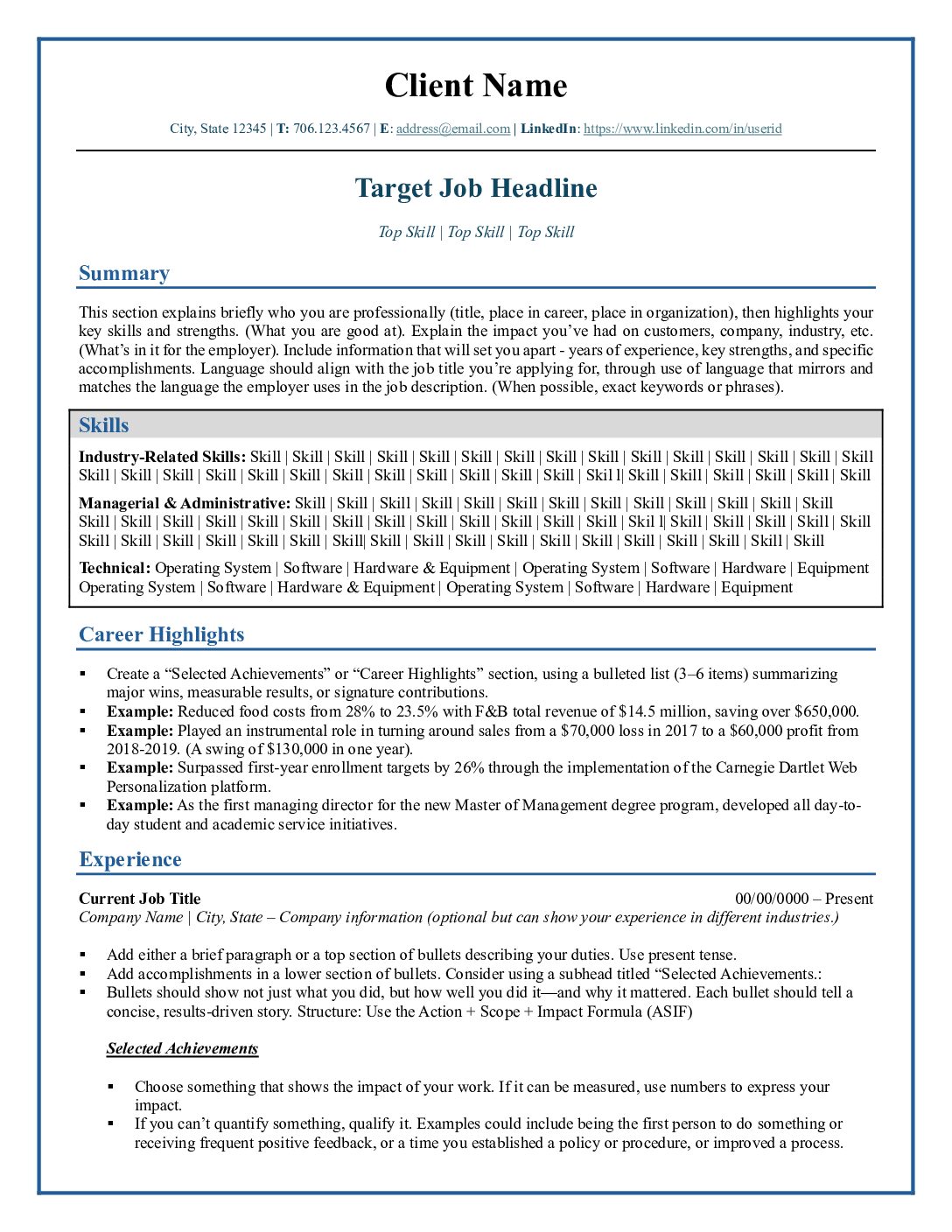
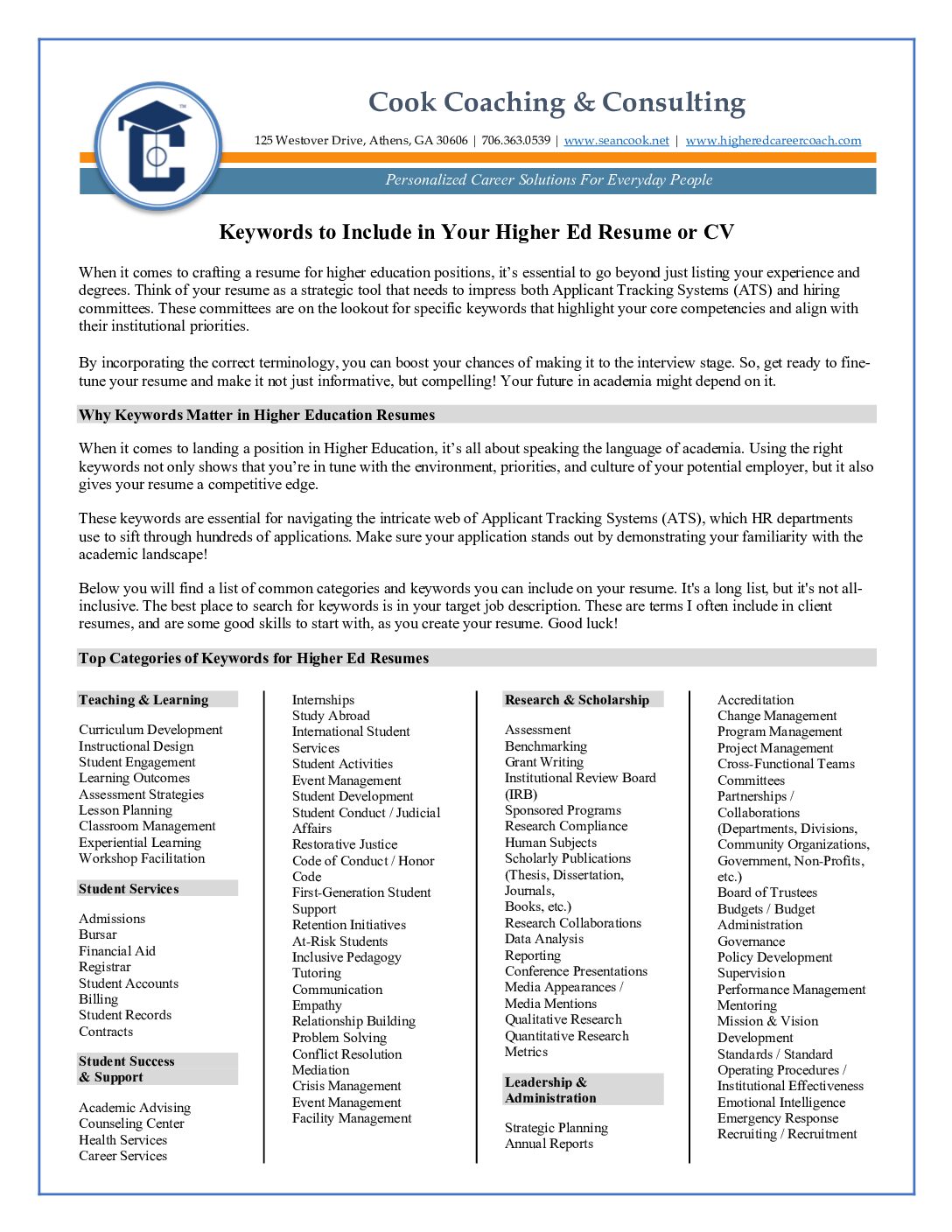
Update your résumé or CV. If you are self-directed, and have generally been getting good results, you may need to only do a minor brush-up. Check out my guide 7 Points to a Winning Résumé for ideas about how to write a targeted résume that gets you more interviews. It’s $10 and you get some great extras, including a $25 discount on my coaching or résumé writing packages if you decide you’d rather have professional help. Go to the sales page for more information.
Get social. Networking has always been a great way to get job leads and to understand job roles, formal and informal rules of particular organizations, and the work environment you might be joining. Social networking can extend your reach. The role of social media in the job search has changed drastically over the past few years. It’s no longer a luxury but a basic skill. If you don’t “get” social, you will differentiate yourself in a bad way.
One more thing you can do, if you need some help: talk to a coach. Contact me to set up a free coaching consultation.
I finally finished my first e-book, which I am calling
“7 Points to a Winning Résumé.”
It’s $5 until December 30, and $10 after that. It comes with some special offers.
I have a great salespage you should check out if you are interested, with an overview of the e-book and what else you get. Please feel free to tell your friends and colleagues!
If you are not interested, come back later for more of the regular articles and advice you find here.
And if you have a break from work this month, enjoy it. I hope this month brings you happiness and good times with friends and family.
Networking is a skill that comes naturally for some, and less so for others. And it takes many forms. But ask most people if it’s essential to getting ahead in your field, and moving up, and you will get a resounding “yes” from most.
In a recent edition of the #sasearch Twitter chat, which I host each week with Laura McGivern of theSASearch.Org, we talked about networking and tried to give people some good tips on how to network, in person and online. You can find the full transcript of the chat at thesasearch.org/chats, so I encourage you to go there and download the pdf.
I think that networking is a skill that must be learned by doing. So while it was definitely nice to talk about how to network, and to learn about what people struggle with, I also want to help people move from processing and reflecting and into action. (And, as Mallory Bower pointed out in the networking chat, we often network without realizing that were are doing it.)
It also occurred to me that staying motivated is one of the hardest parts of any job search. It can be hard to keep your spirits up in the face of uncertainty. At times like these it’s useful to have a strong support network, and these days that extends oftentimes to online networks. Twitter in particular is one place where modern professionals find regular support and encouragement.
But there is something to be said about taking networking relationships off-line, and dialing back the use of technology. Some great example that comes to mind are the “good luck” cards that many of us make a point to put in candidate mailboxes at Placement Conferences, and those times when people who have connected online send each other cards and faxes, or schedule phone calls or Skype dates. Bringing in a human element to your online relationships makes them feel more real, and can reaffirm the possibility of these virtual relationships resulting in long-term friendships, mentoring relationships, and even potential career opportunities. (My favorite example of this was the “parking lot pep talks” that Stacy Oliver and Shannon Healy discussed on a previous episode of my podcast.
In this vein, I would like to create an opportunity for readers and colleagues to engage in positive networking, to bring relationships off-line and into the real world, and to share a little bit of themselves and their talents with a broader audience.
I am a big fan of the simple artwork by Hugh MacLeod of gapingvoid.com, and of the simple cartoons by Mike Davenport of stickfiguresimple.com, who I worked with to create a brief video last year as part of the “What Higher Education Needs to Learn” series. These two artists post regular updates to their blogs in the form of simple drawings that creatively illustrate simple and powerful lessons for life and for work.
As the father of 2 small children I am also a big fan of arts and crafts. This was true before I ever had children and is a common affliction among many in student affairs. A while back, I came across an article about artist trading cards in Disney Family Fun magazine. You can find the article online at familyfun.go.com, but I’ll explain the concept briefly here.
Artist trading cards are tiny works of art on rectangles of paper, either cut by hand or bought in an art supply store. The artist trading card movement, also called ATC movement, began in Zürich Switzerland, and has become a favorite activity of many. The idea is that artists swap work in their communities and online and then kids and family discover art, and learn about trading, while expressing themselves, and developing a love for art.
There are just 2 rules in ATC. First, the cards must be 2.5″ x 3.5″ and second, they may be traded but not sold. I think that the ATC movement, crashed together with the kind of inspirational and motivational messages in MacLeod and Davenport’s art, could lend itself toward the creation of the great experiment in positive networking that could forge new off-line connections between members of the online student affairs community that might otherwise not happen.
You may have noticed that a while back, I posted some random cartoons that I drew on my Facebook business page and on Twitter. This was the mysterious project that I was beginning to work on. And now I need your help.
I’d like to feature artist trading cards designed by readers and other members of the student affairs communities that exist online on this blog. But I want to take it a couple of steps further as well, by not only sharing the art here, but by acting as an intermediary in the creation of potential real life relationships. If you would like to participate, here’s what you need to do:
Draw an artist trading card with your own original message and art on a 2.5 x 3.5 piece of paper or index card stock.
Mail the artist trading card, a copy of your current business card (if you do not have one, include a piece of paper with your name, telephone number, physical mailing address, and e-mail address written clearly on it), and a pre-addressed, stamped envelope to Cook Coaching and Consulting LLC, 191 E. Broad Street, Suite 217, Athens Georgia 30601
When I receive your card, I will scan it, and upload the images to a gallery that will be linked to my Facebook company page.
In your pre-addressed stamped envelope, I will return to you someone else’s art card and business card, in the hope that you will connect off-line. (Please remember to pre-address and pre-stamp the return envelope!)
This project will continue through the end of the year (if not longer), and the art contributed to this project will be considered for inclusion in upcoming products, including postcards, posters, online videos, presentations, and a possible motivational book for job seekers in higher education. Ideally, I’d like to choose a few of the best and make some cards that you can send to friends, colleagues and students to help them stay motivated in their search, or to
All submissions shall become the property of Cook Coaching and Consulting LLC. Artists will not be compensated for their contributions.
Proceeds from the sale of any products developed as a result of this project will go toward providing free or reduced-cost coaching, resume services and other career assistance to job-seekers in higher education, and to support other worthy efforts that benefit higher education job-seekers. Updates about proceeds collected, and services/assistance provided will be posted periodically on this site and the Facebook page.
Many professionals start strong but struggle to define themselves when they arrive at the “middle” of their career tracks. Early career moves may have pointed them toward other paths than they imagined, or obstacles may keep them from where they would like to go. This could mean taking on new responsibilities, supervising and mentoring young professionals, pursuing further education, or taking different approaches to your career altogether.
So what can you do when you arrive at the midpoint of your career, to successfully manage career transitions?
We’ll talk about mid-career transitions with Caroline Ceniza-Levine, career expert, writer and speaker, co-founder of SixFigureStart. Caroline has 16 years of experience in professional services as a management consultant and executive and corporate recruiter. She has recruited for leading companies in media, financial services, management consulting, pharmaceuticals and technology. A career columnist for CNBC.com,Vault.com, Wetfeet.com, and Forbes.com, as well as an adjunct assistant professor of Professional Development at Columbia University School of International and Public Affairs, Caroline is the co-author of “Six Steps To Job Search Success” and of the best-selling “How the Fierce Handle Fear: Secrets to Succeeding in Challenging Times” Her career advice and job market insights have been quoted on CBS, BusinessWeek, CNN Money, NBC News.com, Newsweek.
Please join us at 11 am ET Friday!
SixFigureStart offers career coaching by former recruiters. Their coaches have hired thousands of people and know firsthand what employers really want. Founded by two professionals with over 40 years of combined HR experience. More information can be found at the links below.
Work with Sean. I help higher ed professionals take control of their careers with tailored services including resume and CV development, LinkedIn profile optimization and networking strategy, interview coaching, and one-on-one career guidance.



 I’ll make this post short