by sean@higheredcareercoach.com | Sep 17, 2012 | Job Search, job search tools, Resumes and CVs
When I became a Certified Professional Resume Writer a couple of years ago, I had never heard of an Applicant Tracking System, or ATS. I knew that many companies used software packages to allow candidates to upload their applications, and had used Penn State's HR system as a member of several screening committees. That system was pretty basic, allowing committee members to view applications online as they screened them in whatever way their department prescribed, but if it had higher-level functions, we didn't use them.
It wasn't until I began following a discussion on a resume writers' discussion forum that I learned how widespread Applicant Tracking Systems are, and how they can be used to mine data and determine a candidate's match to a position. I left the discussion, though, with a clear understanding that I needed to learn more about these systems, if I wanted to be a better resume writer.
I'm still unclear on how colleges and universities are using Applicant Tracking Systems, and hope to interview some Human Resources professionals soon to learn more, but I have come to the conclusion that it is always best to write your resume with both the human reader and the computer in mind.
Computers and Humans Use Different Logic
Writing for a computer forces you to apply some different logic than writing for a human. I had learned this already in my efforts to understand Search Engine Optimization (SEO) and get better rankings on Google for my websites. Computers parse information differently than a human reader does. In some ways, software can be less forgiving than a human reader. As a result, simple mistakes in formatting, style, or word choice can cause the ATS to misinterpret information and return a low score for your match to a position. If you don't get past the ATS, a real human might not see your resume!
For the past few months, I have been using a tool called Resumeter that emulates an Applicant Tracking System, and can help you identify the potential matches and gaps between your resume and a position description or job posting. It can also return reports that show you where errors in formatting are confusing the ATS, so you can reduce the possibility of information on your resume being misinterpreted or skipped over altogether.
Using a tool like this one takes some patience, because Applicant Tracking Systems are "smart enough to be dumb."
Five things you need to keep in mind, and how to work around them:
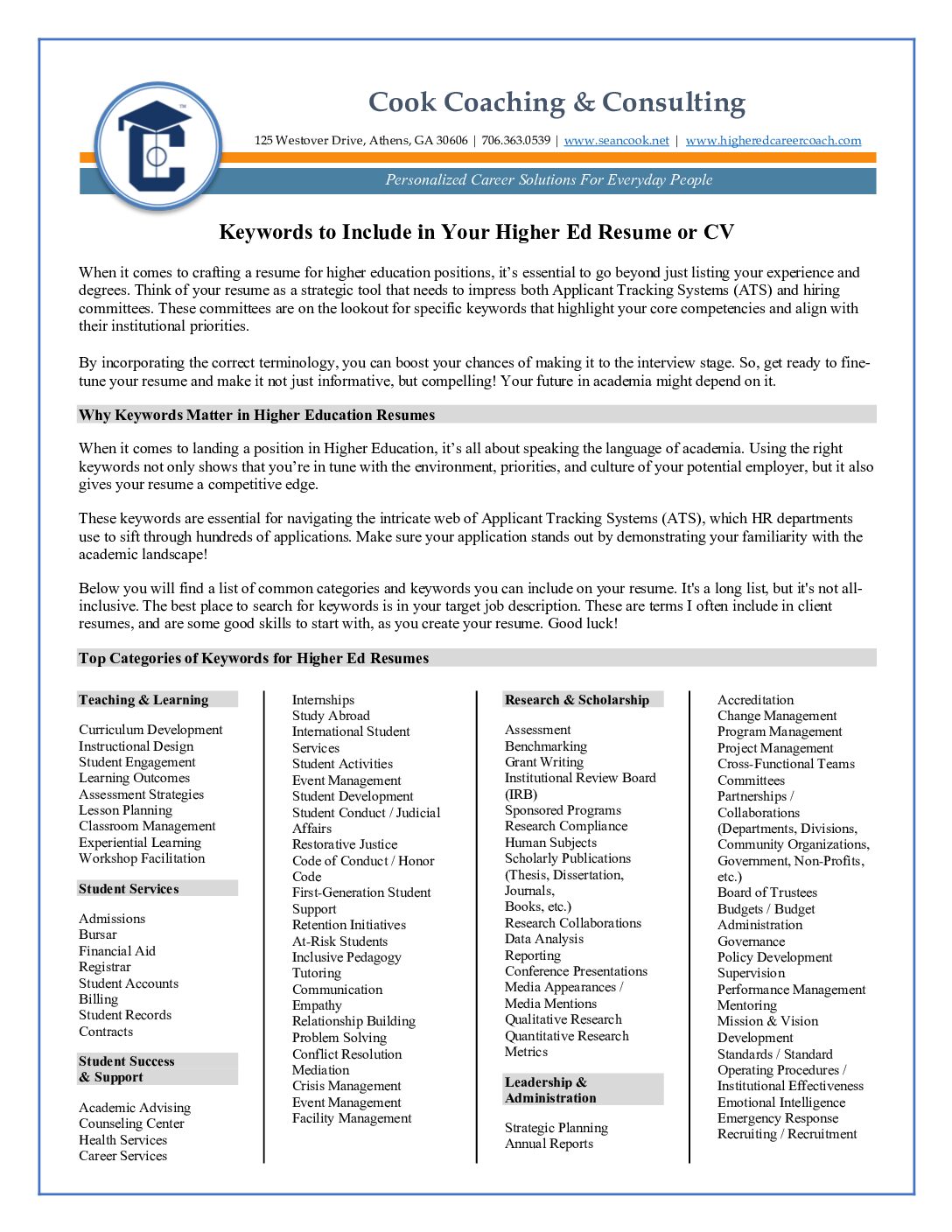
- Keywords matter. Applicant Tracking Systems apply some of the same principles that a search engine does. In particular, they look for keywords. When parsing information out of a document, an ATS will find exact matches, but may indicate information is missing, if it does not find an exact match. Some systems will give partial credit for related terms, some will not. Work-around: To maximize the possibility of being seen as a match, use the exact words you see in a position description or advertisement, whenever you can honestly and accurately do so.
- Applicant Tracking System software is logical but not reasonable. I've had to learn when to edit the job description down to only the most important keywords (almost always). Since the software will be applying rules, not reason, you sometimes have to step in and apply kind of a "reasonable person" test and take your best guess at whether a term is a "required" term, a "preferred" term, or just some word that was stuck in there. This requires using the tool, seeing what the tool is not finding, and then going back to read the position description in context. Sometimes the tool is looking for a more complex word where you may have used a simpler one. Work-around: When this happens, you can change the word on your resume to the exact one being sought, or you can edit the job description in the tool to search for the simpler word instead, and hope that it won't count against you in an actual application process.
- Repeating yourself is a good thing. One thing I used to do when writing resumes was switch up wording here and there, because I played similar roles across different jobs. I didn't want to bore the reader by seeming repetitive. Throw that idea out the window! Applicant Tracking Systems, like search engines, score documents higher based on keyword density. So if you are applying to be an academic advisor, for example, don't put in one bullet that you "advised" students and in another bullet that you "assisted" students. If you "advised" them here and "advised" them there, then maybe you can "advise" them anywhere. Work-around: Use the word they are looking for whenever it applies, and you will get better results than going for variety.
- Inconsistent formatting will confuse the software. Applicant Tracking Systems will parse information out of sections of your document, by looking for words commonly used in Headings, or words that seem to be headings (For example, single words in all capital letters or underlined and set apart from other information.) The ATS may find a blank line and interpret it as a section break. One area where I see this often is in the "Education" section. Let's say that you have an advanced degree and wrote a thesis, so you list it under the graduate degree, maybe inset by a tab. Then you list your bachelor's degree but do not have a parallel section there. Even worse, you have more than one graduate degree and you list your thesis the same way for both. I've seen the ATS get confused and start mismatching degrees to institutions and dates, and I've seen it think that the thesis was a separate degree and note it as missing dates and the issuing institution. Work-around: Tweak the format within each section and eliminate any extra line breaks, until the ATS at least records the correct degrees, dates and institutions, even if it lists some of the other information as "additional education." Or you can move your thesis information into a "publications" or "research" section.
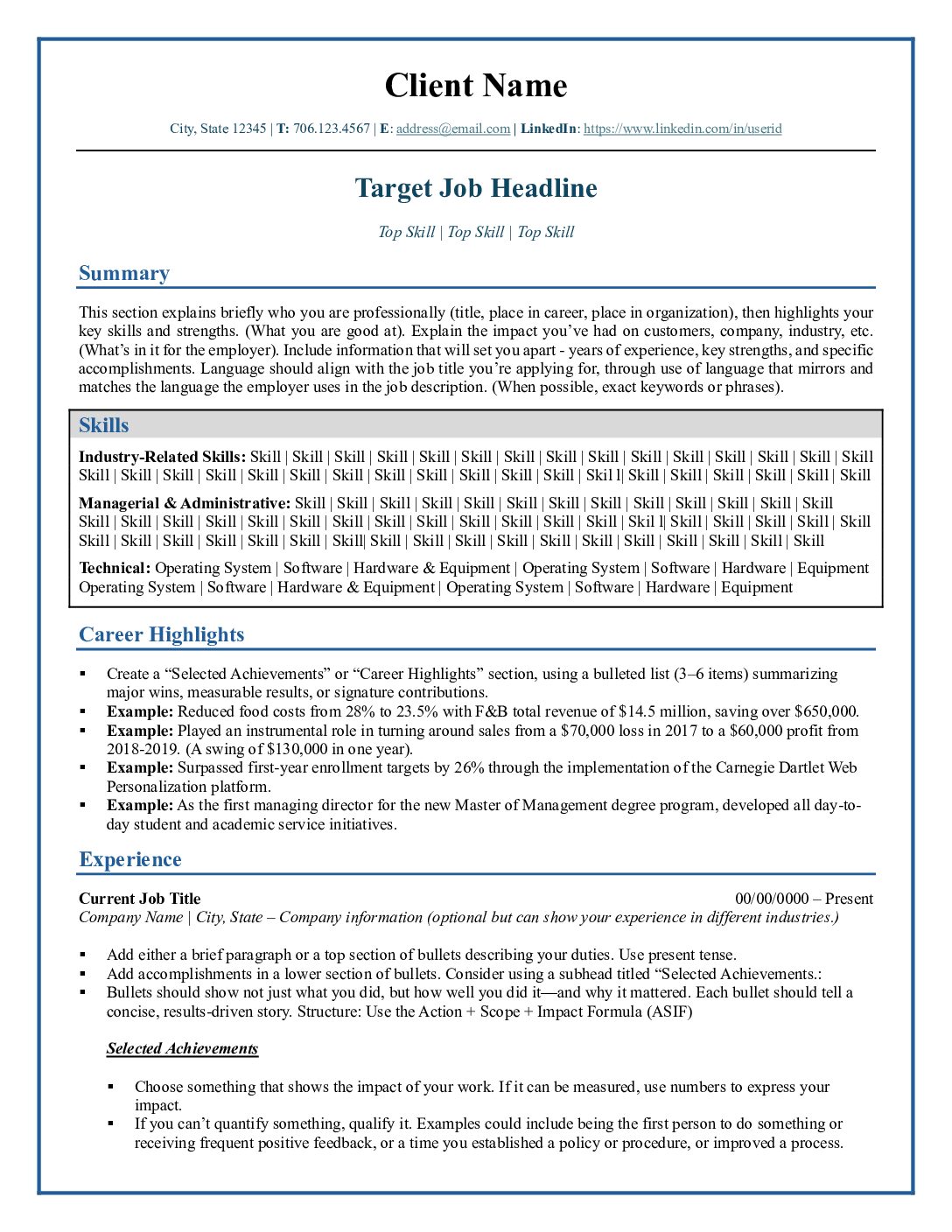
- Where (and how) you list skills matters to the Applicant Tracking System. If you have many skills that you would like to list, you may be tempted to use a table. It's a legitimate way to get a lot of information into a document. But there are legitimate reasons to list your skills in bullets, under specific positions. First, it helps in interpreting your skills in context. Second, many ATS systems give credit for one year of experience for each mention of a skill in a skills list, but will estimate length of experience listed in position-related bullets by looking at the dates you were in a position. They can tally up skills mentioned under multiple positions, and give a much better approximation of your experience. Work-around: Put skills in position-related bullets whenever possible. Some ATS systems are confused by table formatting, and will skip tables altogether, which means that whatever you listed in the skipped table won't count toward your potential match score. Work-around: If you use a skills list, do not use the "table" function in Word. Use the columns setting instead, or make columns using the tabs.
I'll be writing some more posts soon about Applicant Tracking Systems, and how candidates can write their resumes to get through computerized screening measures. In the meantime, please share this article with anyone you think might be interested, and post your questions and comments.

by sean@higheredcareercoach.com | Jul 31, 2012 | Career Skills, Career Tracks, Career Transitions, Higher Education, Job Search
Eric Grospitch, Ed.D is the Assistant Dean of Students for the Division of Student Affairs and Enrollment Management at the University of Missouri-Kansas City. For this post, which is the second edition of our new guest post series on Career Tracks in Higher Education, Dr. Grospitch answered questions about his role, where it fits within the university, and what he does as an Assistant Dean of Students.
Name: Eric Grospitch, Ed.D.
Highest Degree Earned: Ed.D. University of Kansas
Title: Assistant Dean of Students
Division his department falls under: Student Affairs and Enrollment Management
Enrollment of the University of Missouri Kansas City: 15,492
Number of years of full-time experience Grospitch had when he began this position: 11
The minimum education required for this position: Masters
Years of experience that were required for the Assistant Dean position: 8-10
What are your major responsibilities in your current position?
Responsible for oversight of Residential Life/Housing; Student Involvement (orientation, LGBTQIA, Fraternity & Sororities, Student Programing) Student Government, Student Allocations, Veterans programs, Campus Discipline
Does your role require direct service to students? If so, explain.
Yes, serving as an advisor to SGA, Allocations and various student focused committees.
How many persons in your department hold an equivalent rank? One.
How many people do you supervise? Are they Full-Time or Part-Time? Professional Staff, Trades/Custodial Staff, or Student Staff? (Please list numbers for each.)
- Directly – 2 Directors
- Indirectly:
- Full time – Masters level –10
- Full time administrative – 5
- Full time maintenance – 5
- Grad students -5
- Undergraduate students – 50+
What is the title of the person your report to? What is the title of that person’s immediate superior?
Vice Chancellor for Student Affairs and Enrollment Management, and he reports to the Chancellor.
What is your typical day like? Your typical week?
That is hard to say because each day is different based on the time of year with the ebb and flow of the academic year.
What do you spend the majority of your time doing in your current role?
Clearly most of the time is in different meetings and following up on individual concerns, discipline or projects.
What did you think you would be doing more, when you applied for the job?
I’m not sure what I thought I would spend more time doing, but I have spent more time working on enrollment management type conversations, and how all we do engages us in the recruitment and retention of students.
What survival skill is most important in your current role?
Creating relationships with trusted colleagues is clearly the most important – and those colleagues may not be on your campus. As you move “up” you are more and more isolated on your campus. Having colleagues that you can connect with to bounce ideas, seek input and advice is critical. I have found that through my involvement with NASPA.
Do you serve on committees within your department? Division? University-Wide? What roles do you play on these committees?
- ZIPCar and Transportation Launch Team (Chair)
- Veterans Services Development Committee
- Collected Rules and Regulations Review Committee
- Academic Program Review Committee
- New Student Convocation (Chair)
- Divisional Customer Service Training Program (Chair)
- Campus Safety Messaging Committee (Chair)
- Case Management Team (Member)
- Student Affairs and Enrollment Management Divisional Assessment Committee
- LGBTQIA Partnership Committee (Chair)
- Violence Prevention Task Force (member)
What advice do you have for persons seeking this type of position?
The piece that has been hard for me, but most important is to take your time. Many of us want Dean, VP roles, but the tradeoffs and politics need to be weighed as you move up – particularly as you balance life & job. That said, I do think there are a few things to remember that I will tell anyone that will listen.
- If you say you are going to do something, do it. New and even seasoned professionals that forget or fail to follow through on commitments can quickly be chalked up to someone you can’t count on.
- If you know something can’t be done in the time given, make sure you are honest in your statements. But again, if you say you can get it done, do it.
- Do the things no one else wants to do. With a smile.
- Don’t have one year of experience 5+ times, work to diversify your work to get a true 5+ years of experience.
- Look for ways to volunteer and get involved with different offices on campus. Help with Bid Day, Orientation etc. Those are tangible experiences that you can use to guide your career path later.
- Get involved with a regional or national organization. Whether reviewing proposals for a conference, volunteering at the conference, begin to build your network of friends and colleagues.
- Don’t forget how small our profession is. If you grotesquely burn a bridge in one place, it is very hard to truly start over, unless you are willing to reflect, learn and share about that experience.
- Learn technology. Twitter, web, etc. We don’t need more technophobes and serving our students will require it.
- Engage authentically in diversity training at all opportunities. The more we know about ourselves, the better we are able to serve all of our students.
- Read, Read, Read. The student development theories that we learned in grad school are great, but things are changing rapidly and the research is trying to catch up. Keep abreast of new ideas and concepts as it relates to retention and matriculation of students and bring those ideas (with appropriate citations/credit) to the table.
Eric submitted his article by e-mail, in response to my recent call for first-person perspectives on career tracks in higher education. You can, too! Visit our guest post submission form or e-mail sean@higheredcareercoach.com.
Do you have questions for Eric? Post them in the comments, or send him an e-mail. (He said it was okay!)

by sean@higheredcareercoach.com | Jul 24, 2012 | Career Tracks, Higher Education, Job Search, Podcast

Sarah Craddock, Academic Advisor
On today’s podcast, I’ll have an interview with Sarah Craddock, an Academic Advisor for Mechanical Engineering at Colorado State University. We will talk about different aspects of her job and how her education and experience prepared her for it.
Sarah also shares some insights on how her experience in Residence Life was perceived during the interview process, what her work entails, and different roles she plays in working with faculty and other staff at Colorado State.
This podcast is part of a new series about Career Tracks in Higher Education that will be running periodically on Higher Ed Career Coach, to help graduate students and new professionals understand different roles across academia, so they can gauge opportunities during their job search. Listen in Friday July 20, at 11 am ET. Call in to share your thoughts and questions.
Also, updates on news in the higher ed world, including the recent happenings at Penn State in relation to the Jerry Sandusky Scandal, and some updates on upcoming features and programs at HigherEdCareerCoach.Com.
Next week, I’ll be running a guest post from Eric Grospitch, Ed.D., the Assistant Dean of Students for the Division of Student Affairs and Enrollment Management at the University of MIssouri-Kansas City. A couple of other guest posts are pending, but I’d like to have a lot of variety, so that readers can get some ideas about how roles may differ, depending on size of university, university type, and different organizational structures.
If you are interested in sharing perspectives about your job, check out the outline for the guest posts and submit your guest post via the guest post submission form or via e-mail to sean@higheredcareercoach.com. Guest bloggers will be invited to give interviews for the podcast (either live or pre-recorded, depending on availability.)
If you have suggestions for future posts, contact Sean.

by sean@higheredcareercoach.com | Jul 18, 2012 | Higher Education, Infographic Tuesday

[THIS ARTICLE LINKED TO AN INFOGRAPHIC AT A WEBSITE THAT IS NO LONGER IN SERVICE. THE INFORMATION BELOW WAS UP TO DATE WHEN THE ARTICLE WAS ORIGINALLY PUBLISHED.]
The Infographic of the Week this week comes from FindOnlineEducation.Com, and gives an interesting overview and some facts about the growth of online education.
Some key information featured in the infographic:
- Online education represented 5.6% of enrollment in the United States in 1995 and now represents 27.5%
- U.S. News and World Report ranked 196 online bachelor’s degree programs in January 2012 and recognized Westfield State University for having the best faculty credentials and training, Arizona State University for having the best student services and technology, and Bellevue University for having the most student engagement and assessment.
- The overseas market in online education is expected to grow by 50% by 2014.
- Online education is currently a $73.8 billion enterprise but is expected to grow to $220 billion by 2017.
Predictions
The growth of online education programs will have a great impact on career tracks in higher education. While it remains to be seen how this will actually play out, I think that the trend toward online education will mean the following for higher education professionals:
- Comfort with technology will continue to be a key differentiator between candidates. With so many baby boomers and early Gen X-ers re-entering the job market or finding themselves “re-careering,” they will increasingly need to adapt to new technology. If this does not happen, we will see even further growth of millennial representation in key support roles.
- There will be an increase in advising and admissions positions, and over time, a decrease in residence life and student activities staff on campus. This will require candidates to increasingly demonstrate their knowledge of curriculum development, information systems and databases.
- Advising from a distance will require comfort with virtual teams, online project management systems, webinar/webmeeting technology, and cloud-based data storage and file-sharing.
What Do You Think?
What trends do you see higher education professionals dealing with, as online education programs continue to grow? What key skills do you think will be required? And how can we train people for the challenges that come with this new educational environment?

by sean@higheredcareercoach.com | Jul 17, 2012 | Career Skills, Career Tracks, Career Transitions, Job Search
Career Track: Academic Advising
My name is Sarah Craddock, and I am an academic advisor for the Mechanical Engineering department at Colorado State University. We are part of the College of Engineering, which falls under the Academic Vice President/Provost. CSU has about 29,000 students.
As for myself, I currently have a B.A. in Sociology from Minnesota State University Mankato and a M.S. in College Student Personnel from Western Illinois University. I am also working on a Ph.D. in Higher Education and Student Affairs Leadership from the University of Northern Colorado. I had 4.5 years of professional full-time experience when I started working as an academic advisor here. If I remember the job posting correctly, a bachelor’s degree was required for application, a master’s preferred. I believe they were looking with someone with at least one year of experience in higher education (though it didn’t have to be in academic advising).
My major responsibilities include advising about half of the undergraduate students in Mechanical Engineering, including a subsection of students working on dual degrees with Biomedical Engineering and Mechanical Engineering. It involves quite a bit of direct service to students – everything from meeting with prospective students, advising incoming students at Preview (our orientation), meeting each semester with all undergrads continuing on in the major (as well as those that may now meet entrance requirements), and even working with graduation contracts to ensure students have met all criteria for graduation.
My department is the 5th largest major on campus, with about 750 undergraduate students for the 2011-2012 academic year, so we have two full time professional academic advisors (myself and one other woman). I do not supervise anyone. My colleague coordinates our mentoring program, and supervises the students employed through that (about 3-5). My boss is the Associate Department Head for Mechanical Engineering, and is a full faculty member within the department. His supervisor is our Department Chair for Mechanical Engineering.
My typical day…oh, in advising, there’s not a typical day. There is a LOT of ebb and flow in this field. For example, during the summer, I have a bit more down time – but I am still working with prospective students and advising incoming students at Preview. I’m also working with students to continue to manage their schedules for next fall, including working with students who didn’t pass a necessary course, or are taking courses over the summer at another institution. However, in a month like October or April, I’m scheduled pretty much every half-hour, meeting with current students to help them determine which classes to take prior to the next semester’s registration opening. The beginning of the semester often includes students panicking about their course load (too much, not enough, times not working,etc.), and the end often includes students panicking about course grades that they’re on the fence for.
I actually think I had a pretty good idea of what I was getting into before I started. I don’t know that there’s anything that’s come as a surprise to me. My time, like I said, ebbs and flows – I guess I wasn’t quite aware of just how much and how intense peak advising times can be (but I love it!).
Most important survival skill…flexibility, and prioritization. You’ve got to be able to judge quickly whether something is a real emergency and needs your attention now – and if so, what can move around, and if not, when it can be addressed. Also, a detail orientation is CRUCIAL in advising. You’re managing a lot of paperwork with substitutions, waivers, prerequisites, etc. You’ve got to have a way to manage that.
Committees and Tasks
After I started working here, we have begun to have a monthly academic advisors meeting within the college to talk about common issues. I also participate in our Professional Advisors Network and Key Advisors network to learn more information about what’s going on on campus. Because a friend of mine works in Greek Life, I’ve also helped them out with a few things (like end of the year awards).
The biggest piece of advice I have? A few things: detail orientation. Figure out how you best manage details (in general) before you start so that you can figure out a game plan quickly once you begin. Care about students. A monkey can follow a checksheet – an advisor works with the student to figure out what’s best in their situation – full time, part time, double majors, minors, etc. Finally…though many academic advising positions don’t require a degree in higher education (such as my M.S. in College Student Personnel), I would still STRONGLY encourage you to look at some student development theory and to connect to the professional organizations available and their subcommittees (NACADA, athletics advising, honors students, STEM, etc.)
Sarah submitted her article via our guest post submission form, in response to my recent call for first-person perspectives on career tracks in higher education. You can, too.
If you would like to connect with Sarah, check out her blog or e-mail her.