by sean@higheredcareercoach.com | Sep 16, 2025 | Career Skills, Higher Education, Job Search, Job Search, optimization, Resumes and CVs, transferable skills
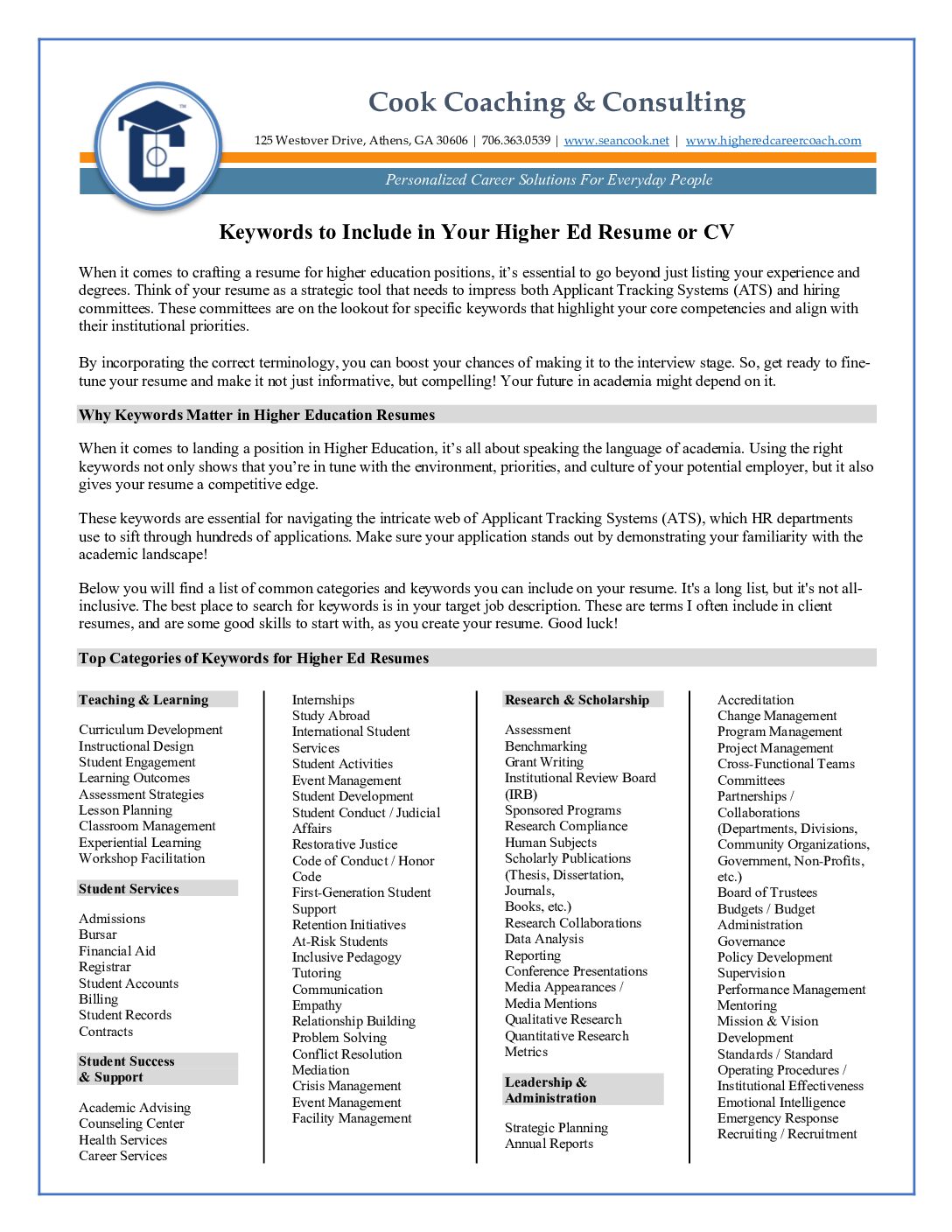
When it comes to crafting a resume for higher education positions, it’s essential to go beyond just listing your experience and degrees. Think of your resume as a strategic tool that needs to impress both Applicant Tracking Systems (ATS) and hiring committees. These committees are on the lookout for specific keywords that highlight your core competencies and align with their institutional priorities.
By incorporating the correct terminology, you can boost your chances of making it to the interview stage. So, get ready to fine-tune your resume and make it not just informative, but compelling! Your future in academia might depend on it.
Why Keywords Matter in Higher Education Resumes
When it comes to landing a position in Higher Education, it’s all about speaking the language of academia. Using the right keywords not only shows that you’re in tune with the environment, priorities, and culture of your potential employer, but it also gives your resume a competitive edge.
These keywords are essential for navigating the intricate web of Applicant Tracking Systems (ATS), which HR departments use to sift through hundreds of applications. Make sure your application stands out by demonstrating your familiarity with the academic landscape!
Below you will find a list of common categories and keywords you can include on your resume. It’s a long list, but it’s not all-inclusive. The best place to search for keywords is in your target job description. These are terms I often include in client resumes, and they are some good skills to start with, as you create your resume. Good luck!
Top Categories of Keywords for Higher Ed Resumes
Teaching & Learning
- Curriculum Development
- Instructional Design
- Student Engagement
- Learning Outcomes
- Assessment Strategies
- Lesson Planning
- Classroom Management
- Experiential Learning
- Workshop Facilitation
Student Success & Support
- Academic Advising
- Counseling Center
- Health Services
- Career Services
- Internships
- Study Abroad
- International Student Services
- Student Activities
- Event Management
- Student Development
- Student Conduct / Judicial Affairs
- Restorative Justice
- Code of Conduct / Honor Code
- First-Generation Student Support
- Retention Initiatives
- At-Risk Students
- Inclusive Pedagogy
- Tutoring
- Communication
- Empathy
- Relationship Building
- Problem Solving
- Conflict Resolution
- Mediation
- Crisis Management
- Event Management
- Facility Management
Student Services
- Admissions
- Bursar
- Financial Aid
- Registrar
- Student Accounts
- Billing
- Student Records
- Contracts
Research & Scholarship
- Assessment
- Benchmarking
- Grant Writing
- Institutional Review Board (IRB)
- Sponsored Programs
- Research Compliance
- Human Subjects
- Scholarly Publications (Thesis, Dissertation, Journals, Books, etc.)
- Research Collaborations
- Data Analysis
- Reporting
- Conference Presentations
- Media Appearances / Media Mentions
- Qualitative Research
- Quantitative Research
- Metrics
Leadership & Administration
- Strategic Planning
- Annual Reports
- Accreditation
- Change Management
- Program Management
- Project Management
- Cross-Functional Teams
- Committees
- Partnerships / Collaborations (Departments, Divisions, Community Organizations, Government, Non-Profits, etc.)
- Board of Trustees
- Budgets / Budget Administration
- Governance
- Policy Development
- Supervision
- Performance Management
- Mentoring
- Mission & Vision Development
- Standards / Standard Operating Procedures / SOPs
- Institutional Effectiveness
- Emotional Intelligence (EQ)
- Emergency Response
- Recruiting / Recruitment
Advancement & External Relations
- Alumni Relations / Alumni Affairs
- Community Outreach
- Corporate Relations
- Development
- Donor Relations
- Fundraising
- Government Relations
- Legal Affairs
- Public Relations
- Regulatory Compliance (ADA, FERPA, Title IX, EEO, etc.)
Diversity, Equity, & Inclusion (DEI)
- Inclusive Excellence
- Multicultural Programming
- Equity Initiatives
- Accessibility
- Community Engagement
- Cultural Sensitivity
- Intercultural Communication
- Culturally Responsive
- Bias Mitigation
- Employee Resource Groups
- Campus Climate
- Learning Environment
- Work Environment
- Stakeholder Engagement / Stakeholder Relations
Auxiliary & Business Services
- Athletics
- Bookstore
- Campus Dining / Food Services
- Catering
- Housing / Residence Life / On-Campus Living
- Marketing
- Public Safety
- Parking
- Recreation / Intramurals
- Document Services / Printing Services
- Purchasing
- Human Resources
- Training / Training & Development
- Facility Management
Technology & Innovation
- Learning Management Systems (LMS) – Blackboard, Canvas, Moodle, Etc.
- Online Course Design
- Educational Technology
- Data-Informed Decision Making
- Virtual Learning Environments
- Database Management
- User Experience (UX)
- Dashboard Development
- Social Media Management
- Google Analytics
Common Software and Web Platforms
- Microsoft Office – Microsoft Word, Excel, PowerPoint, SharePoint, Teams, Microsoft 365
- Google Apps (Google Workspace) – Google Docs, Sheets, Slides, Google Drive, Google Classroom
- Design – Canva, Figma, Affinity Designer, Adobe Creative Suite – InDesign, Adobe Illustrator, Photoshop, Acrobat, Acrobat Reader, etc.
- Meeting Platforms – Zoom, Google Meet, WebEx, Skype, GoToMeeting
- Website Development: HTML, WordPress, Squarespace, Wix
- Data Visualization – Tableau, PowerBI, Qlik, Google Looker
- Data Collection and Management – Qualtrics, Access, SurveyMonkey, TypeForm
- CRM: Slate, Salesforce Education Cloud, Ellucian CRM, Element 451, TargetX
- Student Information Systems – Ellucian (Banner, Student), Workday Student, Jenzabar One, Salesforce Education Cloud, PeopleSoft Campus Solutions
- Housing & Residence Life Platforms: StarRez, Entrata, eRezLife, Roompact, Creatrix Campus, SpaceBasic
Other Common Keywords
- Adaptability
- Analytical Mindset
- Growth Mindset
- Attention to Detail
- Collaboration
- Coordination
- Critical Thinking
- Time Management
- Customer Service
- Teamwork
- Leadership
- Team Leadership
- Operations
- Planning
- Organizing / Organizational Skills
- Continuous Improvement / Process Improvement / Process Optimization
- Alignment
- Negotiation
- Assess(ed)
- Manage(d)
- Create(d)
- Implement(ed)
- Execute(d)
- Develop(ed), Development
- Critical Thinking
- Increased
- Decreased
- Drove / Drive
- Facilitate
- Create(d) / Creative / Creativity
- Networking
- Present(ed) / Presentation(s)
- Flexible
- Work Independently / Minimal Supervision / Self-Directed/ Self-Motivated
How to Use These Keywords Effectively
- Mirror the job posting: Adapt your resume by weaving in the exact terminology used in the description.
- Be authentic: Only use keywords that accurately reflect your skills and experience.
- Show impact: Combine keywords with measurable achievements (e.g., “Led curriculum development initiative that improved retention rates by 12%”).
- Balance ATS and human readers: Don’t overstuff your resume; ensure it reads naturally and flows smoothly.
Final Thoughts:
Unlocking the next step in your higher education career begins with the right keywords—your ticket to capturing attention and making your resume shine. By crafting your document with intention and authenticity, you not only meet the expectations of today’s institutions but also showcase the unique value you bring. Approach your job search with confidence, knowing that each strategically chosen word brings you closer to new opportunities and professional growth. You’ve got this!
Great Resources for Higher Education Career Advice
If you would like this article as a handout, please support Higher Ed Career Coach by purchasing a PDF version below for $1.
Keywords to Include in Your Higher Ed Resume or CV
When it comes to crafting a resume for higher education positions, it’s essential to go beyond just listing your experience and degrees. Think of your resume as a strategic tool that needs to impress both Applicant Tracking Systems (ATS) and hiring committees. This document includes common categories and keywords you can include on your resume. If you would like to support this site, buy this document for $1.
Work with Sean Cook – Intelligent Career Strategies for Higher Education Professionals
. I help higher ed professionals take control of their careers with tailored services including resume and CV development, LinkedIn profile optimization and networking strategy, interview coaching, and one-on-one career guidance. Whether you’re pursuing advancement in academia or exploring opportunities beyond the campus, I provide the tools and strategies you need to thrive in today’s competitive job market. For more information, visit https://www.seancook.net/. You can read recommendations from previous clients on my LinkedIn profile at https://www.linkedin.com/in/seanccook/. To schedule your complimentary 30-minute consultation, please use the Calendly widget below.
Like this:
Like Loading...

by sean@higheredcareercoach.com | Jul 31, 2012 | Career Skills, Career Tracks, Career Transitions, Higher Education, Job Search
Eric Grospitch, Ed.D is the Assistant Dean of Students for the Division of Student Affairs and Enrollment Management at the University of Missouri-Kansas City. For this post, which is the second edition of our new guest post series on Career Tracks in Higher Education, Dr. Grospitch answered questions about his role, where it fits within the university, and what he does as an Assistant Dean of Students.
Name: Eric Grospitch, Ed.D.
Highest Degree Earned: Ed.D. University of Kansas
Title: Assistant Dean of Students
Division his department falls under: Student Affairs and Enrollment Management
Enrollment of the University of Missouri Kansas City: 15,492
Number of years of full-time experience Grospitch had when he began this position: 11
The minimum education required for this position: Masters
Years of experience that were required for the Assistant Dean position: 8-10
What are your major responsibilities in your current position?
Responsible for oversight of Residential Life/Housing; Student Involvement (orientation, LGBTQIA, Fraternity & Sororities, Student Programing) Student Government, Student Allocations, Veterans programs, Campus Discipline
Does your role require direct service to students? If so, explain.
Yes, serving as an advisor to SGA, Allocations and various student focused committees.
How many persons in your department hold an equivalent rank? One.
How many people do you supervise? Are they Full-Time or Part-Time? Professional Staff, Trades/Custodial Staff, or Student Staff? (Please list numbers for each.)
- Directly – 2 Directors
- Indirectly:
- Full time – Masters level –10
- Full time administrative – 5
- Full time maintenance – 5
- Grad students -5
- Undergraduate students – 50+
What is the title of the person your report to? What is the title of that person’s immediate superior?
Vice Chancellor for Student Affairs and Enrollment Management, and he reports to the Chancellor.
What is your typical day like? Your typical week?
That is hard to say because each day is different based on the time of year with the ebb and flow of the academic year.
What do you spend the majority of your time doing in your current role?
Clearly most of the time is in different meetings and following up on individual concerns, discipline or projects.
What did you think you would be doing more, when you applied for the job?
I’m not sure what I thought I would spend more time doing, but I have spent more time working on enrollment management type conversations, and how all we do engages us in the recruitment and retention of students.
What survival skill is most important in your current role?
Creating relationships with trusted colleagues is clearly the most important – and those colleagues may not be on your campus. As you move “up” you are more and more isolated on your campus. Having colleagues that you can connect with to bounce ideas, seek input and advice is critical. I have found that through my involvement with NASPA.
Do you serve on committees within your department? Division? University-Wide? What roles do you play on these committees?
- ZIPCar and Transportation Launch Team (Chair)
- Veterans Services Development Committee
- Collected Rules and Regulations Review Committee
- Academic Program Review Committee
- New Student Convocation (Chair)
- Divisional Customer Service Training Program (Chair)
- Campus Safety Messaging Committee (Chair)
- Case Management Team (Member)
- Student Affairs and Enrollment Management Divisional Assessment Committee
- LGBTQIA Partnership Committee (Chair)
- Violence Prevention Task Force (member)
What advice do you have for persons seeking this type of position?
The piece that has been hard for me, but most important is to take your time. Many of us want Dean, VP roles, but the tradeoffs and politics need to be weighed as you move up – particularly as you balance life & job. That said, I do think there are a few things to remember that I will tell anyone that will listen.
- If you say you are going to do something, do it. New and even seasoned professionals that forget or fail to follow through on commitments can quickly be chalked up to someone you can’t count on.
- If you know something can’t be done in the time given, make sure you are honest in your statements. But again, if you say you can get it done, do it.
- Do the things no one else wants to do. With a smile.
- Don’t have one year of experience 5+ times, work to diversify your work to get a true 5+ years of experience.
- Look for ways to volunteer and get involved with different offices on campus. Help with Bid Day, Orientation etc. Those are tangible experiences that you can use to guide your career path later.
- Get involved with a regional or national organization. Whether reviewing proposals for a conference, volunteering at the conference, begin to build your network of friends and colleagues.
- Don’t forget how small our profession is. If you grotesquely burn a bridge in one place, it is very hard to truly start over, unless you are willing to reflect, learn and share about that experience.
- Learn technology. Twitter, web, etc. We don’t need more technophobes and serving our students will require it.
- Engage authentically in diversity training at all opportunities. The more we know about ourselves, the better we are able to serve all of our students.
- Read, Read, Read. The student development theories that we learned in grad school are great, but things are changing rapidly and the research is trying to catch up. Keep abreast of new ideas and concepts as it relates to retention and matriculation of students and bring those ideas (with appropriate citations/credit) to the table.
Eric submitted his article by e-mail, in response to my recent call for first-person perspectives on career tracks in higher education. You can, too! Visit our guest post submission form or e-mail sean@higheredcareercoach.com.
Do you have questions for Eric? Post them in the comments, or send him an e-mail. (He said it was okay!)
Like this:
Like Loading...

by sean@higheredcareercoach.com | Jul 17, 2012 | Career Skills, Career Tracks, Career Transitions, Job Search
Career Track: Academic Advising
My name is Sarah Craddock, and I am an academic advisor for the Mechanical Engineering department at Colorado State University. We are part of the College of Engineering, which falls under the Academic Vice President/Provost. CSU has about 29,000 students.
As for myself, I currently have a B.A. in Sociology from Minnesota State University Mankato and a M.S. in College Student Personnel from Western Illinois University. I am also working on a Ph.D. in Higher Education and Student Affairs Leadership from the University of Northern Colorado. I had 4.5 years of professional full-time experience when I started working as an academic advisor here. If I remember the job posting correctly, a bachelor’s degree was required for application, a master’s preferred. I believe they were looking with someone with at least one year of experience in higher education (though it didn’t have to be in academic advising).
My major responsibilities include advising about half of the undergraduate students in Mechanical Engineering, including a subsection of students working on dual degrees with Biomedical Engineering and Mechanical Engineering. It involves quite a bit of direct service to students – everything from meeting with prospective students, advising incoming students at Preview (our orientation), meeting each semester with all undergrads continuing on in the major (as well as those that may now meet entrance requirements), and even working with graduation contracts to ensure students have met all criteria for graduation.
My department is the 5th largest major on campus, with about 750 undergraduate students for the 2011-2012 academic year, so we have two full time professional academic advisors (myself and one other woman). I do not supervise anyone. My colleague coordinates our mentoring program, and supervises the students employed through that (about 3-5). My boss is the Associate Department Head for Mechanical Engineering, and is a full faculty member within the department. His supervisor is our Department Chair for Mechanical Engineering.
My typical day…oh, in advising, there’s not a typical day. There is a LOT of ebb and flow in this field. For example, during the summer, I have a bit more down time – but I am still working with prospective students and advising incoming students at Preview. I’m also working with students to continue to manage their schedules for next fall, including working with students who didn’t pass a necessary course, or are taking courses over the summer at another institution. However, in a month like October or April, I’m scheduled pretty much every half-hour, meeting with current students to help them determine which classes to take prior to the next semester’s registration opening. The beginning of the semester often includes students panicking about their course load (too much, not enough, times not working,etc.), and the end often includes students panicking about course grades that they’re on the fence for.
I actually think I had a pretty good idea of what I was getting into before I started. I don’t know that there’s anything that’s come as a surprise to me. My time, like I said, ebbs and flows – I guess I wasn’t quite aware of just how much and how intense peak advising times can be (but I love it!).
Most important survival skill…flexibility, and prioritization. You’ve got to be able to judge quickly whether something is a real emergency and needs your attention now – and if so, what can move around, and if not, when it can be addressed. Also, a detail orientation is CRUCIAL in advising. You’re managing a lot of paperwork with substitutions, waivers, prerequisites, etc. You’ve got to have a way to manage that.
Committees and Tasks
After I started working here, we have begun to have a monthly academic advisors meeting within the college to talk about common issues. I also participate in our Professional Advisors Network and Key Advisors network to learn more information about what’s going on on campus. Because a friend of mine works in Greek Life, I’ve also helped them out with a few things (like end of the year awards).
The biggest piece of advice I have? A few things: detail orientation. Figure out how you best manage details (in general) before you start so that you can figure out a game plan quickly once you begin. Care about students. A monkey can follow a checksheet – an advisor works with the student to figure out what’s best in their situation – full time, part time, double majors, minors, etc. Finally…though many academic advising positions don’t require a degree in higher education (such as my M.S. in College Student Personnel), I would still STRONGLY encourage you to look at some student development theory and to connect to the professional organizations available and their subcommittees (NACADA, athletics advising, honors students, STEM, etc.)
Sarah submitted her article via our guest post submission form, in response to my recent call for first-person perspectives on career tracks in higher education. You can, too.
If you would like to connect with Sarah, check out her blog or e-mail her.
Like this:
Like Loading...

by sean@higheredcareercoach.com | Jul 13, 2012 | Career Skills, Career Transitions, Podcast
 The Higher Ed Career Coach Show with Sean Cook returns today with a “freenote” (free keynote) for student affairs professionals. Suitable for using in training meetings or team development, if you don’t have the time or money to hire me or another speaker to kick off your fall training. Look for a video version and downloadable handouts and script soon here at the site.
Based on parting thoughts I shared with colleagues in Residence Life upon my departure in Fall 2009, the “FreeNote” gives a dozen brief lessons culled from over 15 years working in student affairs.
Professionals (new and not-so-new) will appreciate the perspectives and hopefully the humor herein. If not, they may at least find something worth disagreeing with.
This episode features pre-recorded content. The live show will return later in July or early August.
Notice: This episode is best suited to adult listeners and contains a couple of instances of mildly coarse language. Nothing too crazy, but it’s probably best to listen yourself before playing for the whole staff.
A Note From the Author:
Hello Student Affairs Colleagues. Right now many of you are either planning or starting your professional staff training, depending on your institution’s academic calendar. I remember how tough it was to fill the schedule with worthwhile activities, so over the next month or so, I’m going to share content on my website and podcast that you can hopefully use in staff training. The first piece is this week’s podcast, which I am calling a “FreeNote” (free keynote), where I share some thoughts and perspectives on working in Student Affairs. I also plan to post outlines for some of the better staff discussions I had during training, and maybe even later, I might share some RA training and orientation activities. I hope you can use this stuff. I’ll be making some downloads available soon, and possibly a brief video of this same talk.(Length: 10 minutes)
Like this:
Like Loading...

by sean@higheredcareercoach.com | Oct 27, 2011 | Career Skills, Job Search, life purpose, Social Networking, transferable skills, Who-Dos, Workplace
Motivation is sometimes hard to come by, but it’s essential to keeping forward momentum in your career.
If anyone knows this, it’s online marketing strategist Tommy Walker, who went from being fired over pair of pants 3 years ago to writing a magnum-opus guest post “106 Excuses That Prevent You From Ever Being Great” on Chris Brogan’s web site. Brogan, known for almost never accepting guest posts, took a chance on Walker’s piece, and in the process threw any editorial guidelines he might have had out the window, posting all 7,000+ words of it.
The response the post received so far has been phenomenal, with 329 retweets and 1,260 likes on Facebook as this is being written. We’ll talk to Walker about his journey from fired cell phone salesman to successful online marketing strategist and guest blogger, and get tips for knocking down excuses and staying motivated.
This segment was pre-recorded, and will air Friday, October 28, 2011 at 11:00 a.m. ET. To listen, follow this link or use the player in the right sidebar.
Like this:
Like Loading...

by sean@higheredcareercoach.com | Oct 18, 2011 | Career Skills, Job Search, transferable skills
At some point, many educators find themselves looking at career options outside of academia. There are many reasons one might consider doing so…feeling stuck in a career rut, a change in interests, new opportunities that arise through networking, or perceptions of “greener grass” just beyond the academy walls.
But how should you go about deciding on a career outside of higher education? What do you need to consider in putting together a plan for making a successful transition?
In this week’s edition of the podcast, we’ll get perspectives from Dr. Laurence Shatkin, who made a successful transition to the corporate world after several years as an adjunct.
In his current position as Senior Product Developer for JIST Publishing, Shatkin researches career topics and writes books, including “The Sequel: How to Change Your Career Without Starting Over.” You can find more information about Dr. Shatkin and his books at shatkin.com and you can follow him on Twitter at @LaurenceShatkin
The episode will air at 11 a.m. ET this Friday. The interview with Shatkin is being pre-recorded due to a scheduling conflict, but the rest of the show will be hosted live. Please call in with your questions and comments. The call in line is (347) 989-0055 or you can connect via Skype from the episode page, once the show is on the air, by clicking on the Skype “S” click-to-talk logo.
Check out The Sequel and other titles on Dr. Shatkin’s page on Amazon.Com (affiliate link).
Like this:
Like Loading...