Does your role require direct service to students? If so, explain.
Yes, serving as an advisor to SGA, Allocations and various student focused committees.
How many persons in your department hold an equivalent rank? One.
How many people do you supervise? Are they Full-Time or Part-Time? Professional Staff, Trades/Custodial Staff, or StudentStaff? (Please list numbers for each.)
Directly – 2 Directors
Indirectly:
Full time – Masters level –10
Full time administrative – 5
Full time maintenance – 5
Grad students -5
Undergraduate students – 50+
What is the title of the person your report to? What is the title of that person’s immediate superior? Vice Chancellor for Student Affairs and Enrollment Management, and he reports to the Chancellor.
What is your typical day like? Your typical week?
That is hard to say because each day is different based on the time of year with the ebb and flow of the academic year.
What do you spend the majority of your time doing in your current role?
Clearly most of the time is in different meetings and following up on individual concerns, discipline or projects.
What did you think you would be doing more, when you applied for the job?
I’m not sure what I thought I would spend more time doing, but I have spent more time working on enrollment management type conversations, and how all we do engages us in the recruitment and retention of students.
What survival skill is most important in your current role?
Creating relationships with trusted colleagues is clearly the most important – and those colleagues may not be on your campus. As you move “up” you are more and more isolated on your campus. Having colleagues that you can connect with to bounce ideas, seek input and advice is critical. I have found that through my involvement with NASPA.
Do you serve on committees within your department? Division? University-Wide? What roles do you play on these committees?
ZIPCar and Transportation Launch Team (Chair)
Veterans Services Development Committee
Collected Rules and Regulations Review Committee
Academic Program Review Committee
New Student Convocation (Chair)
Divisional Customer Service Training Program (Chair)
Campus Safety Messaging Committee (Chair)
Case Management Team (Member)
Student Affairs and Enrollment Management Divisional Assessment Committee
LGBTQIA Partnership Committee (Chair)
Violence Prevention Task Force (member)
What advice do you have for persons seeking this type of position?
The piece that has been hard for me, but most important is to take your time. Many of us want Dean, VP roles, but the tradeoffs and politics need to be weighed as you move up – particularly as you balance life & job. That said, I do think there are a few things to remember that I will tell anyone that will listen.
If you say you are going to do something, do it. New and even seasoned professionals that forget or fail to follow through on commitments can quickly be chalked up to someone you can’t count on.
If you know something can’t be done in the time given, make sure you are honest in your statements. But again, if you say you can get it done, do it.
Do the things no one else wants to do. With a smile.
Don’t have one year of experience 5+ times, work to diversify your work to get a true 5+ years of experience.
Look for ways to volunteer and get involved with different offices on campus. Help with Bid Day, Orientation etc. Those are tangible experiences that you can use to guide your career path later.
Get involved with a regional or national organization. Whether reviewing proposals for a conference, volunteering at the conference, begin to build your network of friends and colleagues.
Don’t forget how small our profession is. If you grotesquely burn a bridge in one place, it is very hard to truly start over, unless you are willing to reflect, learn and share about that experience.
Learn technology. Twitter, web, etc. We don’t need more technophobes and serving our students will require it.
Engage authentically in diversity training at all opportunities. The more we know about ourselves, the better we are able to serve all of our students.
Read, Read, Read. The student development theories that we learned in grad school are great, but things are changing rapidly and the research is trying to catch up. Keep abreast of new ideas and concepts as it relates to retention and matriculation of students and bring those ideas (with appropriate citations/credit) to the table.
On today’s podcast, I’ll have an interview with Sarah Craddock, an Academic Advisor for Mechanical Engineering at Colorado State University. We will talk about different aspects of her job and how her education and experience prepared her for it.
Sarah also shares some insights on how her experience in Residence Life was perceived during the interview process, what her work entails, and different roles she plays in working with faculty and other staff at Colorado State.
This podcast is part of a new series about Career Tracks in Higher Education that will be running periodically on Higher Ed Career Coach, to help graduate students and new professionals understand different roles across academia, so they can gauge opportunities during their job search. Listen in Friday July 20, at 11 am ET. Call in to share your thoughts and questions.
Also, updates on news in the higher ed world, including the recent happenings at Penn State in relation to the Jerry Sandusky Scandal, and some updates on upcoming features and programs at HigherEdCareerCoach.Com.
Next week, I’ll be running a guest post from Eric Grospitch, Ed.D., the Assistant Dean of Students for the Division of Student Affairs and Enrollment Management at the University of MIssouri-Kansas City. A couple of other guest posts are pending, but I’d like to have a lot of variety, so that readers can get some ideas about how roles may differ, depending on size of university, university type, and different organizational structures.
If you are interested in sharing perspectives about your job, check out the outline for the guest posts and submit your guest post via the guest post submission form or via e-mail to sean@higheredcareercoach.com. Guest bloggers will be invited to give interviews for the podcast (either live or pre-recorded, depending on availability.)
If you have suggestions for future posts, contact Sean.
There are so many different career tracks in Higher Ed, and so many different titles and combinations of responsibilities, that it can be hard for graduate students and new professionals to figure out where a position falls in an organization, to understand what the day-to-day experience might be in a particular job, and to key in on skills and interests that will help them make good arguments for a particular kind of job.
In response, Higher Ed Career Coach is introducing a new guest post series where experienced professionals will share more about their jobs, the skills and experiences that helped them get those jobs, and what they really spend their time doing.
In order to have some uniformity to the series, guest posts in the Career Tracks in Higher Education series must answer a common set of questions. The article should be at least 500 words, and when published, will have a headline in the following format:
Career Tracks in Higher Education: [Area]
For example: Career Tracks in Higher Education: Judicial Affairs
You are welcome to suggest any subtitle you like. Articles longer than 750 words may be published as two or more separate posts. If your article is published, you may also be invited to be a guest on the Higher Ed Career Coach show to discuss your article and your career.
8. Number of Years of Full-Time Experience You Had When You Started This Position:
9. What was the minimum education required for your current position?
10. How many years of experience were required for your current position?
11. What are your major responsibilities in your current position?
12. Does your role require direct service to students? If so, explain.
13. How many persons in your department hold an equivalent rank?
14. How many people do you supervise? Are they Full-Time or Part-Time? Professional Staff, Trades/Custodial Staff, or Student Staff? (Please list numbers for each.
15. What is the title of the person your report to? What is the title of that person’s immediate superior?
16. What is your typical day like? Your typical week?
17. What do you spend the majority of your time doing in your current role?
18. What did you think you would be doing more, when you applied for the job?
19. What survival skill is most important in your current role?
20. Do you serve on committees within your department? Division? University-Wide? What roles do you play on these committees?
21. What advice do you have for persons seeking this type of position?
Congratulations! All the time and energy you spent, and all the venting sessions your friends and family have endured are behind you. You have finally landed that new job! Your first order of business: Take a week to decompress from the job search and to check items off your personal to-do list so that you can begin your new job with a clear mind!
Then, Get to Work!
When you’re a new employee, there’s a lot to take in:
Campus culture,
Learning names and faces,
Figuring out where various offices are on campus,
Exploring your role in your department and your specific duties (assigned and otherwise), and
Determining what your supervisor expects from you in the first month or two.
It can be overwhelming at first, especially while coming down from the high of landing the job in the first place. Don’t forget that your interview hasn’t ended; have your elevator speech still at the front of your mind in the beginning, as you will most likely use it again when you continue to meet new people around campus.
Check out the links below to ensure you have a smooth transition into your new role and start off on the right foot.
Take 5 is a regular feature where we present links to some good articles and resources on job search topics. If you have ideas for future topics, send them to Melissa Judy, Content Development Intern at melissa@higheredcareercoach.com.
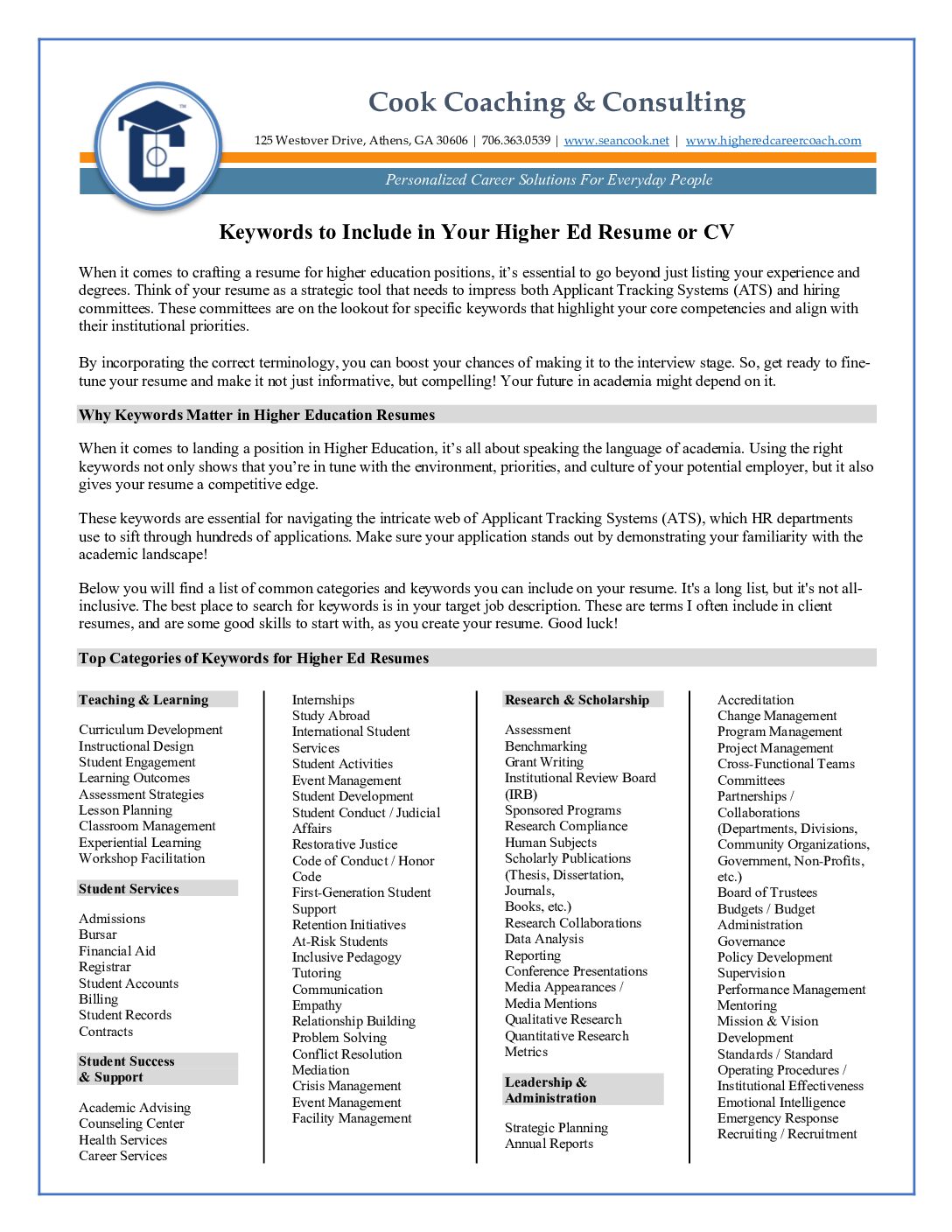
Your resume gets you in the door.Or it doesn’t. It won’t get you a job. Its role is to get you noticed.
In this week’s episode of the Higher Ed Career Coach Show on BlogTalkRadio, I’ll be talking about the art and science of resume writing, and give an overview of the 7 points included in my recent e-book.
We’ll also discuss ATS (Applicant Tracking Systems) and explore tools and tips to help you tackle the challenge of writing a keyword-rich resume.
I will also take calls from those with questions about resumes and provide a brief overview of my resume writing and career coaching packages.
Please join me for the podcast by clicking the episode link or listening with the player in the sidebar at right.
If you’d like to call in, the number is (347) 989-0055, or you can use the Skype “S” click-to-talk button from the episode page to connect via Skype.
Work with Sean. I help higher ed professionals take control of their careers with tailored services including resume and CV development, LinkedIn profile optimization and networking strategy, interview coaching, and one-on-one career guidance.