The New Year is a time when many of us re-evaluate our goals and set new ones. The top resolution people make, according to an article at About.Com, is to spend more time with family and friends. (50% of us place that as our top priority.) Other common ones are to lose weight, get organized and get out of debt. And many of us, whether we say so or not on surveys, l0ok forward to moving on in our careers.
Spring is typically the “high season” for academic job searches, since many institutions begin the hiring season for the next fiscal year in July, and the next academic year in August. Associations sponsor placement conferences, and job boards start to fill with ads.
If you are searching in academia, it’s a great time to get your act together. Here are 5 tips for kick-starting your job search.
Write up all the major elements you will be looking for in a job, including type of institution, roles you would enjoy, salary range, geographic location, size of department, place within the organization, daily tasks, office environment. Don’t leave anything out that you consider important. Write toward the ideal job and let yourself imagine yourself in that ideal situation. Don’t filter yourself. This is about reflecting on your priorities. Later, you will gauge your opportunities against this ideal (and yes, non-existent) position.
Make a list of your top 5 “must haves” (things that a position must include) and top 5 “deal-breakers” (those aspects of a position that you are unwilling to perform). Gauge every position you consider against them. Do not apply for any job that doesn’t have your “must haves” or includes your “deal-breakers.” Trust yourself enough to know what you have to do, and will not do. If you do not find any jobs to apply for, then it’s time to sit with a coach, a mentor, a trusted colleague, or a counselor to figure out it you have realistic expectations for your job search.
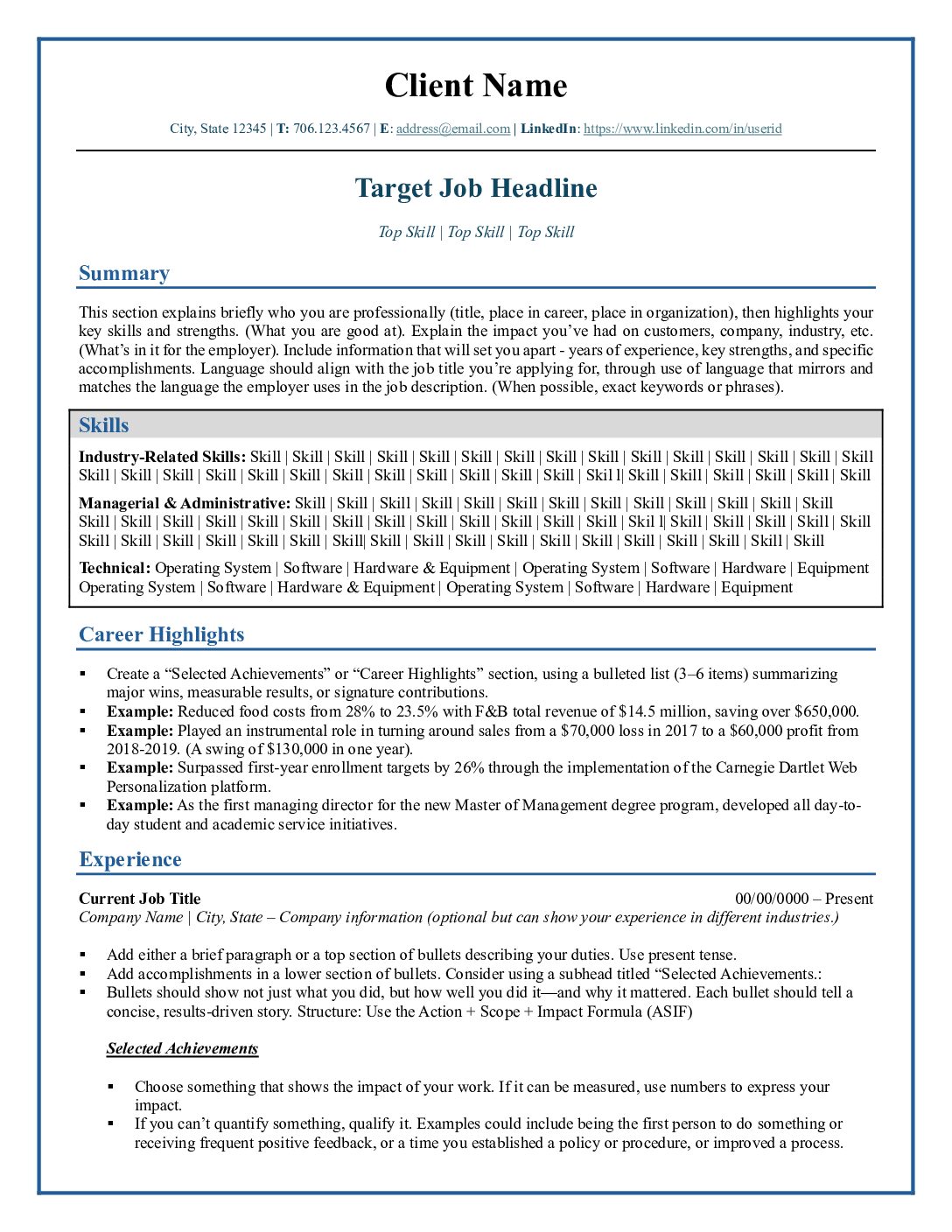
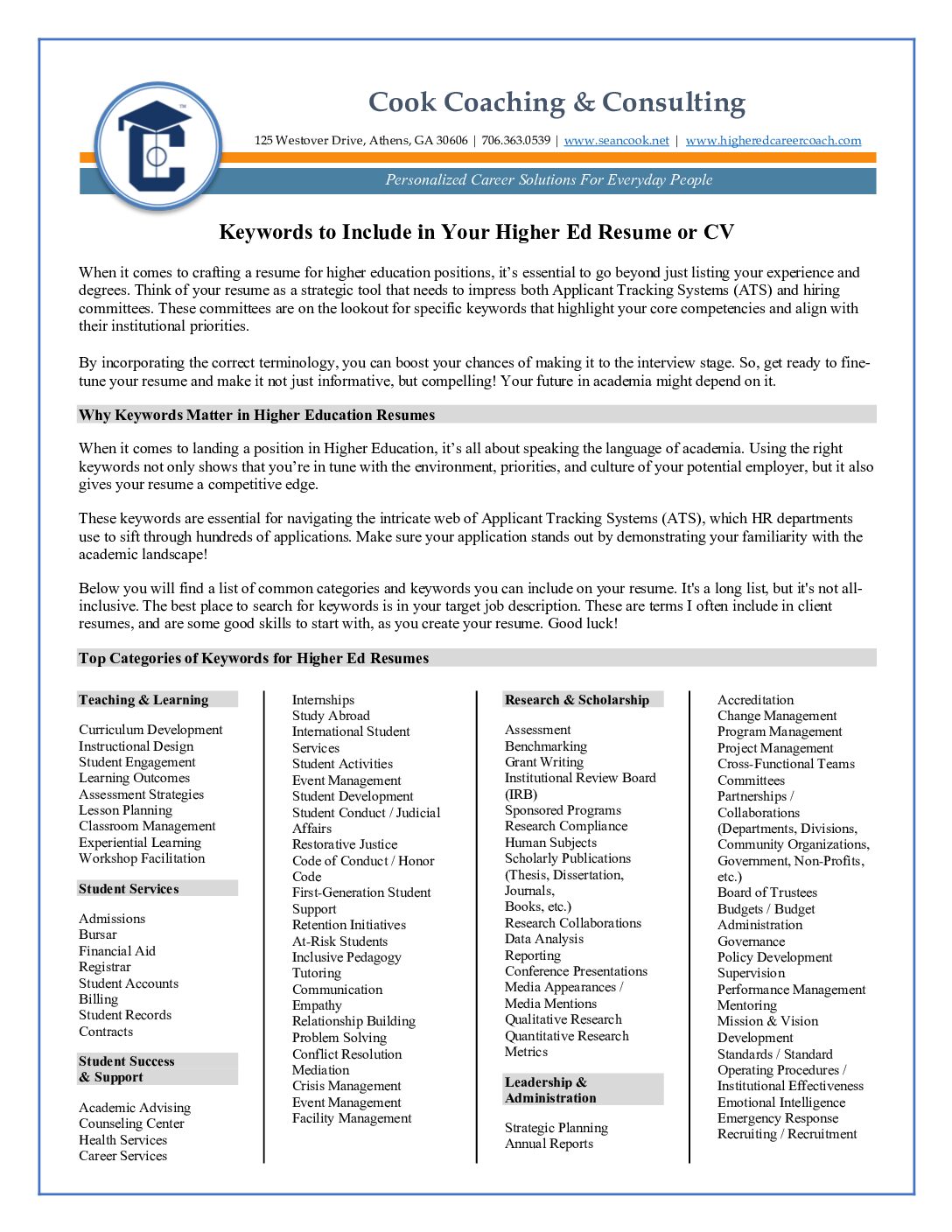
Update your résumé or CV. If you are self-directed, and have generally been getting good results, you may need to only do a minor brush-up. Check out my guide 7 Points to a Winning Résumé for ideas about how to write a targeted résume that gets you more interviews. It’s $10 and you get some great extras, including a $25 discount on my coaching or résumé writing packages if you decide you’d rather have professional help. Go to the sales page for more information.
Get social. Networking has always been a great way to get job leads and to understand job roles, formal and informal rules of particular organizations, and the work environment you might be joining. Social networking can extend your reach. The role of social media in the job search has changed drastically over the past few years. It’s no longer a luxury but a basic skill. If you don’t “get” social, you will differentiate yourself in a bad way.
One more thing you can do, if you need some help: talk to a coach. Contact me to set up a free coaching consultation.
I finally finished my first e-book, which I am calling
“7 Points to a Winning Résumé.”
It’s $5 until December 30, and $10 after that. It comes with some special offers.
I have a great salespage you should check out if you are interested, with an overview of the e-book and what else you get. Please feel free to tell your friends and colleagues!
If you are not interested, come back later for more of the regular articles and advice you find here.
And if you have a break from work this month, enjoy it. I hope this month brings you happiness and good times with friends and family.
Transparency is one of the essential elements of career success. Pick up any modern book on career planning, small business development, marketing, or social media, and you’ll probably find a section devoted to the idea of transparency, and how essential it is to establishing the three foundational elements of successful relationships: people know you, like you and trust you.
It Should Be Easy, Right?
But it’s not easy to be “transparent.” Each of us struggles with something, but no one wants to be defined by their problems. Especially if you are looking for a job, looking for customers, or trying to establish yourself as an “authority” within some niche. If you’re truly transparent, people identify with your humanity, because your successes and your struggles are both familiar, and they root for you.
So What’s the Problem?
Herein lies the rub: the more risks you take in your career or with your business, the greater the potential reward…or potential loss. So you stay within your comfort zone, and try to figure your way through, on your own. And sometimes, it’s neither practical (nor healthy) to do so. But, “issues” put aside are eventually recognized for what they are…problems. And when you have a problem, it’s supposed to be okay to ask for help. As educators and supervisors, we know this. We preach this to our students. We evangelize for this to our young professionals. And yet we resist holding ourselves to the same standard, even though we know–genuinely know–that those who ask for help are usually met with kindness, understanding, and support.
So What’s My Problem?
I’ve arrived at a point with this site and with my business where it would be folly to continue without more help. As I expanded the local aspect of my business, I’ve been getting more clients for résumé writing and LinkedIn profiles, and many of these are from outside of academia, and have varied experiences that are hard to tie together into a coherent package.
I’ve always been good at writing résumés, and I enjoy challenges, but it requires a very different type of energy and focus than writing blog posts and sharing perspectives. And I find it hard sometimes to shift gears and keep moving. For the past couple of months, the result has been writer’s block, and I’ve had to devote more time to the writing I am paid for (the résumés) than to my sites.
What Kind of Help Do I Need?
I have some ideas that need to be implemented, and resources that need to be developed, and not enough time and energy to do them all. And I would like to revive my second site, Higher Ed Life Coach, and continue development on a local career resource site, AthensGACareerCoach.Com. So I am looking for an intern to help in content development, and social media, and also for high-quality, relevant guest posts. I will post something later this week about guest posting opportunities. In the meantime, here’s a description of what I am looking for in an intern.
The Internship
The Career Content Development Intern will compile career resources and develop new content for websites (primarily HigherEdCareerCoach.Com and AthensGACareerCoach.Com, but possibly including other sites currently published or under development by Cook Coaching and Consulting); may appear as a guest or co-host on podcasts; schedule guests for podcast, interview educators, job-seekers, coaches and others for site and podcast features; co-host webinars and twitter chats, assist with social media publishing (Twitter, Facebook) and assist with site management, search engine optimization and site design. Other duties will be negotiated, based on current site development needs and the intern’s interests.
Compensation
Anticipated compensation is $8/hour, for a maximum of 5 hours a week, and the duration of the internship will be 20 weeks or 100 hours. This is a part-time contract position, beginning in late November or early December, and ending in May 2012. The finalist will be required to submit appropriate documentation confirming eligibility to work in the United States of America, keep and submit accurate and timely records of hours worked, and your contract income will be reported to the IRS. Additionally, the intern will receive a profile page on HigherEdCareerCoach.Com, a HigherEdCareerCoach.Com e-mail account, and may be featured on podcasts and videos.
Qualifications
Minimum qualifications: Bachelor’s degree and at least one year of relevant experience in student affairs/higher education (undergraduate and graduate experience counts!). Excellent verbal and written communication skills, ability to research and compile information and resources quickly and accurately, experience using social media, blogging, podcasting, and producing internet video. Access to a working computer, internet connection and some form of telephone (landline, cellular or VOIP.)
Preferred qualifications: Current graduate student or recent graduate of a student affairs, higher education, college student personnel administration or related program. Ideally, the candidate will also be someone not employed full-time, who can use the internship to expand his or her career development portfolio. Experience using Mac computers, WordPress, iMovie, and Garageband to produce engaging content is a plus; Efficient and deadline-oriented, but flexible and good-humored, with an ability to deliver consistently accurate information; creative but organized, who will focus on helping our web sites reach their potential.
Application Process
Applications should consist of the following:
A current résumé
A cover letter, no longer than 2 pages, outlining your relevant experience and your most compelling arguments.
Some explanation or evidence of your positive engagement in social media. This can be addressed in your cover letter, or through creative use of social media platforms (Twitter, YouTube, Facebook, LinkedIn, etc.) to demonstrate your experience, comfort level and engagement with these platforms.
3 professional references who can speak not only to your character and work ethic, but toward your ability and/or potential as a writer and content developer.
Deadline
Applications should be sent via e-mail to sean@higheredcareercoach.com with the subject “Career Content Development Intern” no later than 5 p.m. ET Friday November 18. For documents, .pdf format is preferred for all attachments. Interviews will be scheduled during the last two weeks of November, and will be conducted via a webmeeting/video chat interface. Start date will be sometime in late November or early December and will be negotiated with the successful candidate.
Equal Employment Opportunity Statement
Cook Coaching and Consulting, LLC is an Equal Opportunity Employer. All qualified applicants will receive consideration for employment without regard to race, color, religion, sex, gender, ethnicity, sexual orientation, national origin, or genetic condition. The company strives for compliance with all applicable labor laws outlined by the State of Georgia and the U.S. Department of Labor, including the Americans with Disabilities Act.
Networking is a skill that comes naturally for some, and less so for others. And it takes many forms. But ask most people if it’s essential to getting ahead in your field, and moving up, and you will get a resounding “yes” from most.
In a recent edition of the #sasearch Twitter chat, which I host each week with Laura McGivern of theSASearch.Org, we talked about networking and tried to give people some good tips on how to network, in person and online. You can find the full transcript of the chat at thesasearch.org/chats, so I encourage you to go there and download the pdf.
I think that networking is a skill that must be learned by doing. So while it was definitely nice to talk about how to network, and to learn about what people struggle with, I also want to help people move from processing and reflecting and into action. (And, as Mallory Bower pointed out in the networking chat, we often network without realizing that were are doing it.)
It also occurred to me that staying motivated is one of the hardest parts of any job search. It can be hard to keep your spirits up in the face of uncertainty. At times like these it’s useful to have a strong support network, and these days that extends oftentimes to online networks. Twitter in particular is one place where modern professionals find regular support and encouragement.
But there is something to be said about taking networking relationships off-line, and dialing back the use of technology. Some great example that comes to mind are the “good luck” cards that many of us make a point to put in candidate mailboxes at Placement Conferences, and those times when people who have connected online send each other cards and faxes, or schedule phone calls or Skype dates. Bringing in a human element to your online relationships makes them feel more real, and can reaffirm the possibility of these virtual relationships resulting in long-term friendships, mentoring relationships, and even potential career opportunities. (My favorite example of this was the “parking lot pep talks” that Stacy Oliver and Shannon Healy discussed on a previous episode of my podcast.
In this vein, I would like to create an opportunity for readers and colleagues to engage in positive networking, to bring relationships off-line and into the real world, and to share a little bit of themselves and their talents with a broader audience.
I am a big fan of the simple artwork by Hugh MacLeod of gapingvoid.com, and of the simple cartoons by Mike Davenport of stickfiguresimple.com, who I worked with to create a brief video last year as part of the “What Higher Education Needs to Learn” series. These two artists post regular updates to their blogs in the form of simple drawings that creatively illustrate simple and powerful lessons for life and for work.
As the father of 2 small children I am also a big fan of arts and crafts. This was true before I ever had children and is a common affliction among many in student affairs. A while back, I came across an article about artist trading cards in Disney Family Fun magazine. You can find the article online at familyfun.go.com, but I’ll explain the concept briefly here.
Artist trading cards are tiny works of art on rectangles of paper, either cut by hand or bought in an art supply store. The artist trading card movement, also called ATC movement, began in Zürich Switzerland, and has become a favorite activity of many. The idea is that artists swap work in their communities and online and then kids and family discover art, and learn about trading, while expressing themselves, and developing a love for art.
There are just 2 rules in ATC. First, the cards must be 2.5″ x 3.5″ and second, they may be traded but not sold. I think that the ATC movement, crashed together with the kind of inspirational and motivational messages in MacLeod and Davenport’s art, could lend itself toward the creation of the great experiment in positive networking that could forge new off-line connections between members of the online student affairs community that might otherwise not happen.
You may have noticed that a while back, I posted some random cartoons that I drew on my Facebook business page and on Twitter. This was the mysterious project that I was beginning to work on. And now I need your help.
I’d like to feature artist trading cards designed by readers and other members of the student affairs communities that exist online on this blog. But I want to take it a couple of steps further as well, by not only sharing the art here, but by acting as an intermediary in the creation of potential real life relationships. If you would like to participate, here’s what you need to do:
Draw an artist trading card with your own original message and art on a 2.5 x 3.5 piece of paper or index card stock.
Mail the artist trading card, a copy of your current business card (if you do not have one, include a piece of paper with your name, telephone number, physical mailing address, and e-mail address written clearly on it), and a pre-addressed, stamped envelope to Cook Coaching and Consulting LLC, 191 E. Broad Street, Suite 217, Athens Georgia 30601
When I receive your card, I will scan it, and upload the images to a gallery that will be linked to my Facebook company page.
In your pre-addressed stamped envelope, I will return to you someone else’s art card and business card, in the hope that you will connect off-line. (Please remember to pre-address and pre-stamp the return envelope!)
This project will continue through the end of the year (if not longer), and the art contributed to this project will be considered for inclusion in upcoming products, including postcards, posters, online videos, presentations, and a possible motivational book for job seekers in higher education. Ideally, I’d like to choose a few of the best and make some cards that you can send to friends, colleagues and students to help them stay motivated in their search, or to
All submissions shall become the property of Cook Coaching and Consulting LLC. Artists will not be compensated for their contributions.
Proceeds from the sale of any products developed as a result of this project will go toward providing free or reduced-cost coaching, resume services and other career assistance to job-seekers in higher education, and to support other worthy efforts that benefit higher education job-seekers. Updates about proceeds collected, and services/assistance provided will be posted periodically on this site and the Facebook page.
At some point, many educators find themselves looking at career options outside of academia. There are many reasons one might consider doing so…feeling stuck in a career rut, a change in interests, new opportunities that arise through networking, or perceptions of “greener grass” just beyond the academy walls.
But how should you go about deciding on a career outside of higher education? What do you need to consider in putting together a plan for making a successful transition?
In this week’s edition of the podcast, we’ll get perspectives from Dr. Laurence Shatkin, who made a successful transition to the corporate world after several years as an adjunct.
The episode will air at 11 a.m. ET this Friday. The interview with Shatkin is being pre-recorded due to a scheduling conflict, but the rest of the show will be hosted live. Please call in with your questions and comments. The call in line is (347) 989-0055 or you can connect via Skype from the episode page, once the show is on the air, by clicking on the Skype “S” click-to-talk logo.
Check out The Sequel and other titles on Dr. Shatkin’s page on Amazon.Com (affiliate link).
Work with Sean. I help higher ed professionals take control of their careers with tailored services including resume and CV development, LinkedIn profile optimization and networking strategy, interview coaching, and one-on-one career guidance.



 I’ll make this post short